


- Podcast
In L&D… Learning doesn’t happen in isolation, it happens in relationships | Amie Boylan
14 Apr 2026
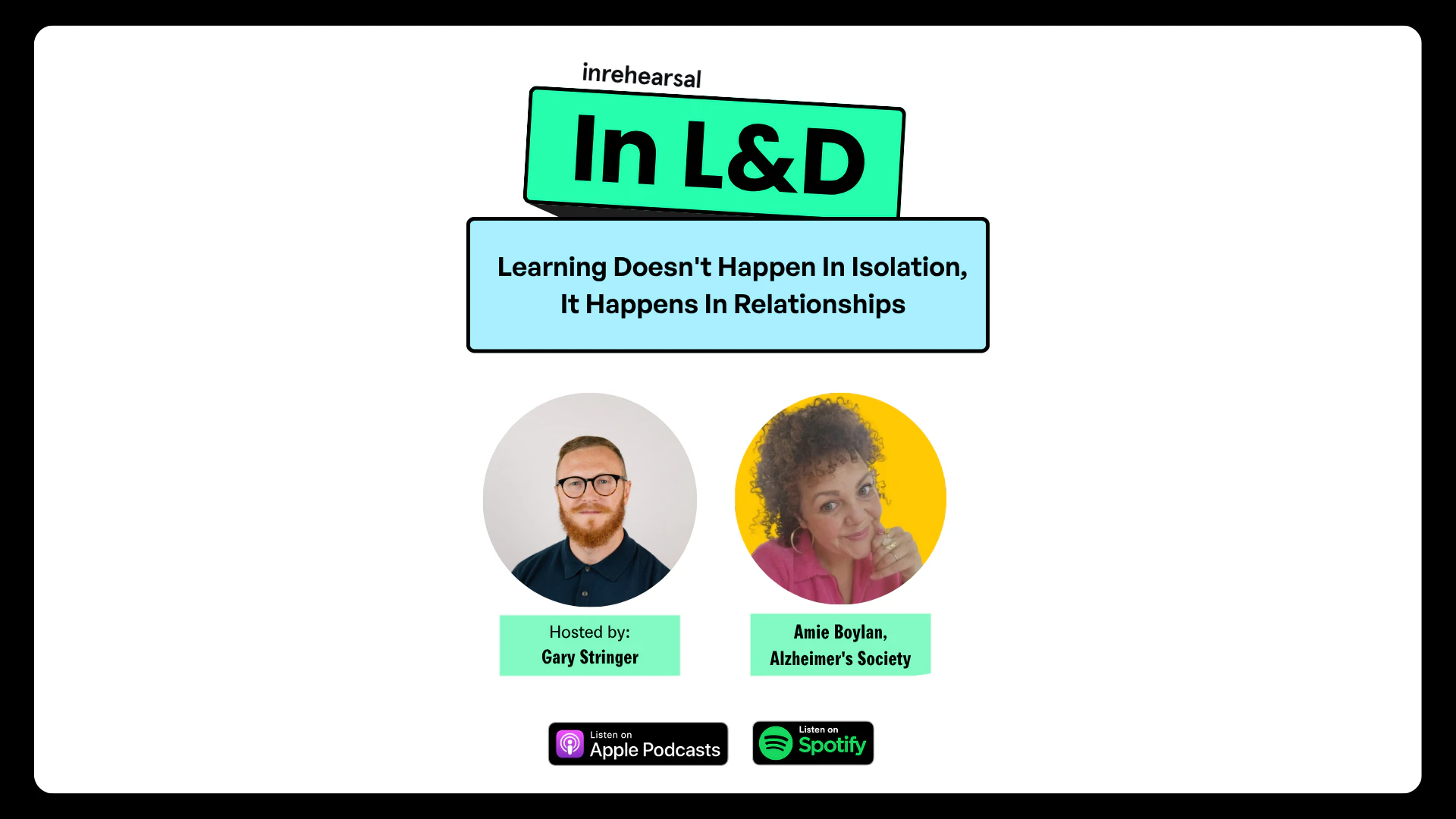
Learning doesn’t happen in isolation — it happens in relationships.
That’s the belief Amie Boylan brought to the very first episode of In L&D…
Amie is currently Alzheimer’s Society’s Income & Engagement Academy Lead and has loads of experience in coaching and development, She’s also the Co-Founder of You’re Invited, delivering joyful and creative experiences that help people play, learn, and connect
In our conversation, we explored how Amie gave people a platform to share expertise, how she built advocates for the Manager Academy, why you have to think about what’s in it for the other person, owning mistakes, being authentic and loads more.
You can connect with Amie on LinkedIn and follow the You’re Invited page here.
Watch and listen the episode
You can also listen to the episode:
On Spotify by clicking here.
On Apple Podcasts by clicking here.
Or by searching for In L&D… wherever you get your podcasts.
5 lessons on building relationships in L&D
1. Build trust by giving people a platform to share knowledge
“Giving people that permission to come forward, that’s something that is still very much at the heart of my focus all the time.”
Amie’s approach brought in a mindset to lead with the question: what do we already know about this topic internally?
Rather than people feeling disempowered, they felt empowered by a platform that gave them a chance to show their subject matter expertise at internal events.
“It’s a bit of an engagement strategy, marketing strategy and L&D strategy of how can we encourage people to come forward and share their expertise?”
“The Manager Academy is there to create learning opportunities, to create peer-to-peer development, but also to showcase what we’re about, what we’ve got, and what we do.”
2. People care about what’s in it for them
“One of the key things that I always think about when I’m building relationships, I’m conscious that I’m thinking… what’s in this for me?
“How can this benefit me? My agenda in L&D? My role and to achieve a target? And they’ll be thinking the same as well. I think that’s okay to admit that!
“And when people were coming forward, they could obviously see what was in it for them as well as me seeing what would be in it for me and the wider org.”
3. Checking your ego can improve relationships
“My role was initially fixed term. And from an integrity perspective, I was just so adamant that I wanted to create something that, if the end did come from the contract, then it wouldn’t fizzle out because that for me would be a failure, even if it was really successful.”
This mindset, which really involves leaving ego at the door, is something Amie credits in building strong relationships.
“With relationships, I think people really need to check their ego and think okay: well who am I doing this for? Is this hurting my ego and does this make me feel uncomfortable if somebody is talking about something and they know more?
“Well, why does it make you feel uncomfortable? Or maybe why are you resisting it? Is that your ego popping up and do you need to pull it in check?”
“So I was like, no this is everyone’s. Let’s get stuck in. Everyone should be working on this because it’s yours. It’s not mine.”
4. Owning it when things don’t work will help build trust
“Ego can stop us from putting our hands up and saying that didn’t work. And I think that’s part of the problem. It’s like people cover up and then they try to find data that disproves the fact that it went wrong and everyone knows it went wrong.
“And then, you’re doing a full briefing about how amazing this initiative was and everyone on the call is rolling their eyes. And again, that’s performative, it’s showboating. Like what’s the point, it doesn’t serve anyone.”
5. Be authentically you, but adapt in ways that engage people
“I am naturally quite enthusiastic and I’m quite bold in how I show up really. And that’s taken a long time for me to be comfortable and not code switch or change in that way.”
“Sometimes it’s not helpful because sometimes we all need to adapt to different audiences.
“And sometimes that jars with me for integrity. Actually, am I showing up in a different way that isn’t authentic to me? But how I think about it is that I’m showing up in a way so that people can engage in a way that is the most helpful for them.
“So it’s almost like making reasonable adjustments.”
Built for L&D,
Loved by Learners
See the most authentic library of original expert-led video content in L&D. Learn how it could work for your organisation.
Related articles