

Topic
Author
Published
What Is a Content Library? L&D Guide
If you’re searching “what is a content library?”, you’re probably trying to answer a simple question:
What does it actually mean in an L&D context — and what is it used for?
In this guide, we’ll break down:
- What a content library is
- Why they’re so popular
- What they typically include
- Features/traits of high-performers
- What to look for when choosing one.
Because the best content libraries don’t just give you more resources. They make it easier to deliver learning that actually gets used.
Quick answer: What is a content library?
A learning content library is a centralised collection of resources like videos, courses, podcasts, templates, and practice activities that support learning across an organisation.
It helps L&D teams deliver scalable learning by making high-quality content easy to find, reuse, and apply in real work.
TL;DR on content libraries
- A content library is a centralised collection of resources to improve access to learning.
- Most libraries include video, courses, audio, templates, and practical resources.
- L&D teams use libraries to scale learning without creating everything in-house.
- The best libraries aren’t built around volume — they’re built around relevance and usability.
- A modern content library should support curation, integration, and real-world application.
Want the deeper breakdown of why most libraries fail and what high-performing teams do differently?
Read our full guide and explore why most content libraries fail and how modern teams use them effectively
Defining the content library in corporate learning
In simple terms, an off-the-shelf content library is a collection of learning resources that organisations typically use as part of their people development approach.
Normally, it’s made up of content created with and by experts the organisation might not have access to.
Content libraries are used by:
- L&D teams, to deliver learning at scale
- People managers, to support development in their teams
- Employees, to access learning independently and build skills over time
Content libraries tend to cover the skills that apply across teams and roles. You might know them as soft or human skills, but they tend to be more prevalent over technical or hard skills.
Skills like: communication, leadership, confidence, performance, productivity, wellbeing, and collaboration.
Here are 9 content library examples you can understand and take guidance from today.
Why content libraries became so popular in L&D
Content libraries are popular for a reason: they solve a few key problems for L&D.
1. L&D teams can do more with less
Most L&D teams don’t have the time, budget, or specialist skills to create high-quality learning content from scratch — especially when they’re trying to support hundreds or thousands of employees.
Content libraries allow them to bring in that expertise without creating everything from scratch.
2. The organisational shift: A move away from in-person training
Organisational learning has seen a shift away from the bums-on-seats, in-person training that was so dominant in the past.
This has only increased the appeal of content libraries, and the extent of this was seen during the COVID pandemic, when there was a huge surge in their popularity:
- Udemy reported a 455% increase in enrollments from consumers and an 80% increase in usage from businesses and governments.
- LinkedIn Learning, meanwhile, saw a 3x increase in time spent learning in early 2020.
Underlying this has also been the rise of remote and global teams, forcing organisations to move offline training online and rethink what learning should look like in a changing workspace.
3. The employee shift: A change in our consumption behaviours
The way we consume media has changed. The way we learn has fundamentally changed too.
- When you need to learn something to solve a problem, you might turn to YouTube.
- If you’re interested in a new topic or skill, you might listen to a podcast.
- Learning is happening in micro moments throughout the day, as we scroll social media.
90-minute modules and long, theory-based courses appeal less.
Content that feels short, accessible, relevant and human (like the stuff we consume every day) appeal more.
What’s inside a content library? (Common formats)
Most content libraries include a mix of formats.
Depending on the provider, you might expect to see things like:
- Expert-led videos (often microlearning-style)
- Courses, playlists and pathways (structured collections)
- Podcasts or audio learning
- Live masterclasses and events
- Templates and frameworks
- Practical activities and reflection prompts
- Guides for managers and facilitators
Some libraries focus almost entirely on video.
Others combine content with enablement resources that help L&D teams turn learning into sessions, programmes, and experiences — which is where the real value tends to come from.
Essential content library tools and features
When L&D teams search for a content library, they’re rarely just looking for “more content”.
They’re usually looking for something that makes learning easier to engage with, easier to deliver, and easier to access.
Think of these six items as a checklist of what to look out for:
1. Multi-format learning resources
Modern libraries shouldn’t rely on just one format. The strongest ones include a mix of:
- Short-form video
- Structured courses or playlists
- Audio or podcast-style content
- Templates and practical tools
- Activities or discussion guides
People learn differently, at different moments in the day, in different contexts.
Format variety increases usability and gives L&D teams more scope to apply it to their context.
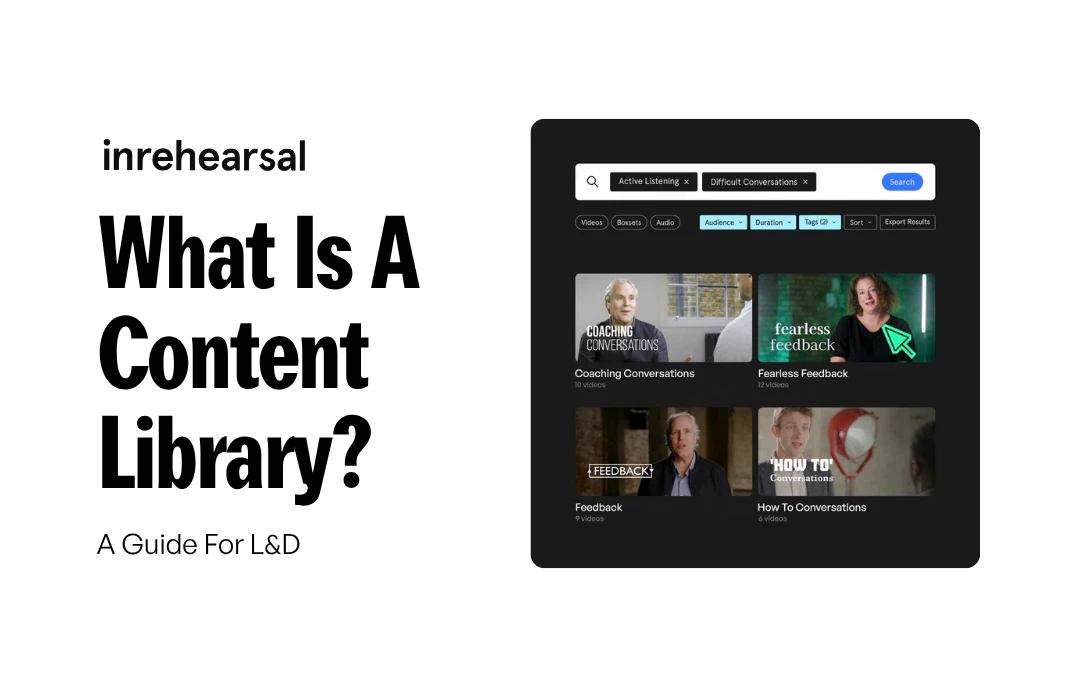
2. Strong search and discoverability
A library is only useful if people can actually find what they need.
Look for:
- Clear tagging by skill or topic
- Filters by format, length, or level
- Intuitive navigation
It’s easy for even the best, high-quality content to get buried in the shuffle. Better filtering and search functions make that less likely.
3. LMS and LXP integration
A good content library for L&D shouldn’t require a complete tech overhaul.
Organisations tend to have a set of learning tools in place, and are looking for a content library that is:
- SCORM or xAPI compliant
- Easy to embed into an existing LMS
- Designed to “plug and play” into your current stack
This reduces friction for both L&D and employees, who don’t need to change existing behaviours drastically.
It also improves the speed at which a content library can be launched and leveraged within a business.
4. Easy curation and activation tools
Access alone doesn’t drive learning.
High-performing libraries support:
- The ability to build or customise learning pathways
- Enablement resources that help managers run sessions
- Curation support to contextualise learning
This makes it easier to turn content into experiences, and connect the library to the goals of the business.
5. Accessibility across devices and locations
Libraries need to work beyond desktops and central offices, because they typically cover workforces with deskless employees and in global teams.
That means:
- Mobile-friendly access
- Short-form options for busy schedules
- Translated and dubbed content for native languages
If a library only works well behind a desk, it limits adoption across the workforce.
6. Ever-growing content that solves emerging problems
Skills evolve. So should the content.
Strong libraries regularly introduce:
- New content aligned to emerging skills
- Updated resources that reflect modern workplace challenges
- Experts who bring fresh thinking
Without regular refreshes, even the largest library can miss mission-critical skills.
A modern learning content library isn’t defined by how much content it holds — but by how easily that content can be found, activated, and applied in real work.
Built for L&D,
Loved by Learners
See the most authentic library of original expert-led video content in L&D. Learn how it could work for your organisation.
The inrehearsal approach: authentic, human, expert-led learning
Many off-the-shelf content libraries are built around one thing: volume.
Thousands (or even hundreds of thousands) of resources.
But the truth is, most organisations don’t need more content.
They need better content — and better support for using it.
At inrehearsal, our approach is built around two things:
- High-quality, human content
- Human enablement that helps L&D win
In other words, the content you need and everything else to make it succeed, which means:
- Filming experts without scripts, so the content feels real
- Prioritising practical advice rooted in real workplace problems
- Supporting customers with curation, skills focuses, and enablement guides
- Making it easy to embed learning into existing ecosystems
Because the content library itself isn’t the end goal or destination.
It’s a tool for helping people learn and helping L&D teams do more with less.
Frequently asked questions about content libraries
What is the difference between a content library and an LMS?
An LMS (Learning Management System) is a platform used to manage, assign, and track learning. A content library is the collection of learning resources themselves — such as videos, courses, and templates. Many organisations integrate a content library into their LMS so employees can access expert-led content within existing learning systems.
What formats does a content library include?
Most modern content libraries include a mix of formats to support different learning moments. These often include expert-led videos, structured courses or playlists, podcasts or audio learning, templates, practical frameworks, and facilitator guides. The strongest libraries combine content with tools that help L&D teams turn learning into real experiences.
Who typically uses a content library in an organisation?
Content libraries are typically used by L&D teams to deliver scalable learning, by managers to support team development, and by employees who want to build skills independently. Because they focus on widely relevant skills like communication, leadership, and productivity, they can support learning across many roles and departments.
Why do many content libraries fail to get used?
Many content libraries struggle with adoption because they focus on volume rather than usability. When thousands of resources are added without curation or guidance, employees struggle to find what’s relevant. High-performing libraries focus on discoverability, contextualisation, and helping L&D teams connect content to real workplace moments.


