


Topic
Author
Published
The L&D Content Library: Why Most Fail & How to Fix It
Content libraries are one of the most commonly used resources in learning and development.
And if you’re here, it’s probably for one of two reasons:
- You’re looking for your first content library — and don’t want to get it wrong.
- You already have one, but it’s not delivering what you expected.
Either way, there are common pitfalls to avoid, best practices to follow, and real examples of how modern teams are using content libraries in ways that actually work.
The current state of content libraries
Most off-the-shelf content libraries fail — not because the content is bad, but because they’re designed around storage and scale, rather than how people actually learn and use content at work.
High-performing content libraries work differently. They prioritise curation, relevance, and real-world application, helping L&D teams connect the right content to the right moments, skills, and challenges.
In this article, we’ll explore:
- What a content library is and how they’re typically used in L&D
- Why most content libraries fail to drive engagement or impact
- What modern L&D teams do differently to make content libraries effective
Click below to jump ahead:
- What is a Content Library?
- The problem with content libraries
- What a high-performing content library looks like
- How modern L&D teams use content libraries
- Solving the problem of low adoption
- Rethinking the role of content libraries in L&D
A quick content library defintion
What is a content library? It’s a centralised collection of learning resources — normally in formats like videos, courses, templates, and practice activities.
Designed to help L&D teams deliver learning across an organisation, through a library they can easily access, search, and reuse to support learning and growth goals.
The mission statement of content libraries probably started something like this:
“Let’s give companies and their employees access to a bank of resources, covering important topics, and created with experts. Allowing them to bring expertise in-house without creating all that content for themselves.”
For the most part, content libraries do this — but there are areas where many don’t get it right (which we’ll get to).
Most content libraries focus on video content
Video-based learning content has the ability to capture and deliver ideas in short-form (microlearning), which is useful for demonstrations and storytelling, and scalability.
A lot of the time, these are structured as courses and supported with other formats like audio, events, resources, templates and practical activities.
Libraries cover a broad range of skills and topics
Off-the-shelf content libraries generally cover two types of skills:
- Human (soft) skills.
- Functional or technical skills.
The emphasis is typically on human skills (like communication, leadership, and collaboration) with the technical content focused on core, role-specific capabilities.
It’s not uncommon for resources to hit the thousands
Large enterprise libraries often hit four figures for resources, with LinkedIn Learning being home to more than 20,000 and Udemy hosting a staggering quarter of a million.
The volume of resources creates a sense of affordability, value, and efficiency. This has driven their popularity, due to the belief that:
- They allow managers and L&D teams to deliver structured, repeatable learning
- They allow employees to access resources independently
Why content libraries fail: the core problems
TL;DR Content libraries tend to fail because the content isn’t very good. It doesn’t engage people, it’s not practical, it’s not in a format that makes it easy to apply.
These are some of the big content library pitfalls and should be avoided to avoid some critical consequences.
Ultimately, this all leads to a lack of adoption, makes L&D teams’ job harder, and means little impact for the business.
Given everything we’ve discussed so far, the numbers below might not be surprising.
- 88% of L&D professionals use content libraries.
- 70% of companies with over 10,000 employees use them.
They must all be good, right? Actually no, satisfaction is low, and it’s pretty understandable.

Source: Offbeat’s What tools are L&Ds using in 2025?
Access to learning at scale provides the illusion that learning is happening at scale – because it can be deployed to everyone quickly.
Now the money you’ve spent feels like great value, that’s why those huge libraries are
- So popular in large organisations
- Used by small, time-poor L&D teams
But it’s not a bargain when the content fails to connect with people and most of the workforce won’t engage with the library — that’s actually not the recipe for learning at scale.
For too many L&D teams and organisations, their e-learning content library is actually letting them down.
The three reasons content libraries don’t work for L&D teams are:
- Overwhelm: Caused by too much content and too little support.
- Content fatigue: Caused by scripted, cheesy videos that aren’t relatable.
- Misleading metrics: When libraries push metrics that don’t matter onto L&D teams.
1. Overwhelmed by volume without support
It’s all well and good being given access to 20,000 or 250,000 resources, but where do you start?
Too often, L&D find themselves in this position because their content library just doesn’t provide the support to make the most of the content.
You need help to contextualise it for your business and the unique problems it faces. Whether that’s from a real person and enablement resources created by a real person.
On top of that, if it’s all locked into fixed, prescribed courses, it’s harder to curate for yourself and use the library self-sufficiently.
And it’s often missed that learners are going through similar struggles.
Yes they have more autonomy and choice, but without the right scaffolding, that means sifting through endless resources.
Normally, they’ll use that freedom to choose not to engage at all.
2. Fatigued by content that’s not human and doesn’t fit
With a lot of content libraries, the pendulum has swung too far.
For years, employees would give feedback that the content felt too stiff and formal, meaning they’d lose interest.
The response?
Many libraries tried to build more fun into content, but that often just came across as formal, forced fun. The type that’s bound to happen when you’re bound by scripts and the need to be perfect when editing that content.
Ultimately, that’s why a lot of learning content fails to connect with employees — who normally use phrases like: it’s not authentic, it’s too cheesy, it doesn’t feel human, and it doesn’t feel connected to real situations at work.
And at a time when 91% of L&D pros say human skills are becoming more important, we just cannot have learning content that doesn’t feel human!
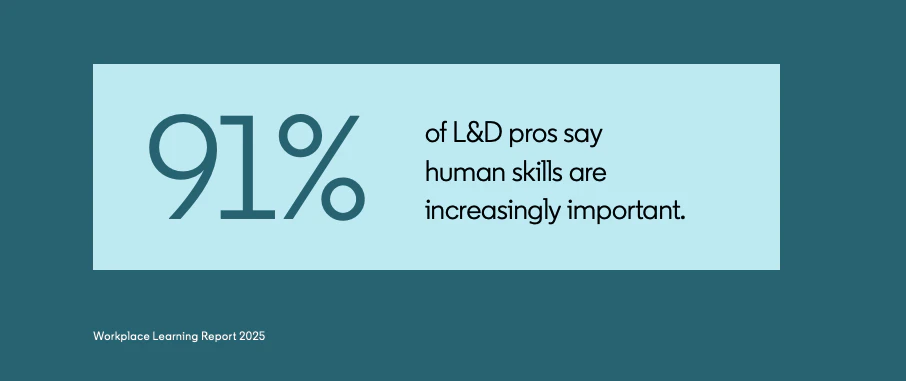
(Source: LinkedIn Workplace Learning Report)
3. Misled by metrics that don’t necessarily matter
L&D teams are under pressure. To deliver learning at scale, to respond at speed, and to provide ROI on whichever learning content library they bring in.
Ultimately, the question is about impact.
And impact isn’t in the metrics that get forced on L&D teams by content providers.
Volume of resources + time spent consuming them DOES NOT = impact.
Consumption is out, context is in. But, sadly, consumption is easier to show.
The content libraries that are going to help under-pressure L&D teams are the ones who help them bring content into their context, so that they can tell a genuine impact story.
Imagine a world where a provider curates the right resources for a new leadership team, and employee feedback, performance, and retention rates go up.
This is what we should be aiming for…
Key takeaways: Why most content libraries fail
- Volume isn’t value: most libraries overwhelm learners instead of supporting them.
- Autonomy without scaffolding isn’t empowering: it’s a fast route to disengagement.
- Content fatigue is real: scripted, overly polished content rarely feels relatable.
- Consumption isn’t impact: completions and watch time don’t prove learning impact.
- The libraries that win: focus on relevance, context, and real-world application.
What a high-performing content library looks like
TL;DR: It’s a combination of human content and human enablement. Yes, you need a library with expert, practical content, but you need the support of real people who know how to use it for impact.
Everything we’re about to tell you is based on working with the 250+ leading companies who use inrehearsal!
From the small companies with solo L&D teams, all the way up to big organisations like McDonald’s, Harrods, L’Oreal.
What we see working for them, and what they tell us drives engagement, performance and results.
Essentially, it can be broken down into two categories:
1. Content.
2. Enablement.
For a learning content library to work, you need both.
High quality content without the support to make it successful won’t work.
Amazing human support goes nowhere without good content that engages people.
Pillar one: High-quality, human content
Authentic, practical advice
Complaints about content aren’t uncommon with content libraries. Whether it’s cheesy acting that turns people off, scripts and scenarios that aren’t realistic, or just the sheer length of what they’re watching.
When we film, we do it without scripts — giving experts the freedom to speak directly to camera, creating a feeling that we’re often told feels like you’re in the room with them.
That doesn’t mean a lack of structure, it means we prioritise problems faced by real people and ask real experts to share their advice for tackling them.
Consistent experts across a variety of formats
It’s easy for an L&D content library to start feeling disconnected from the rest of the development offer or strategy. Essentially, you have a bank of experts in the video content that you won’t see again.
Something that we hear from our customers is that being able to follow our experts across formats engages learners.
Whether that’s attending a live masterclass with an expert they’ve watched or listening to a podcast with them on their commute.
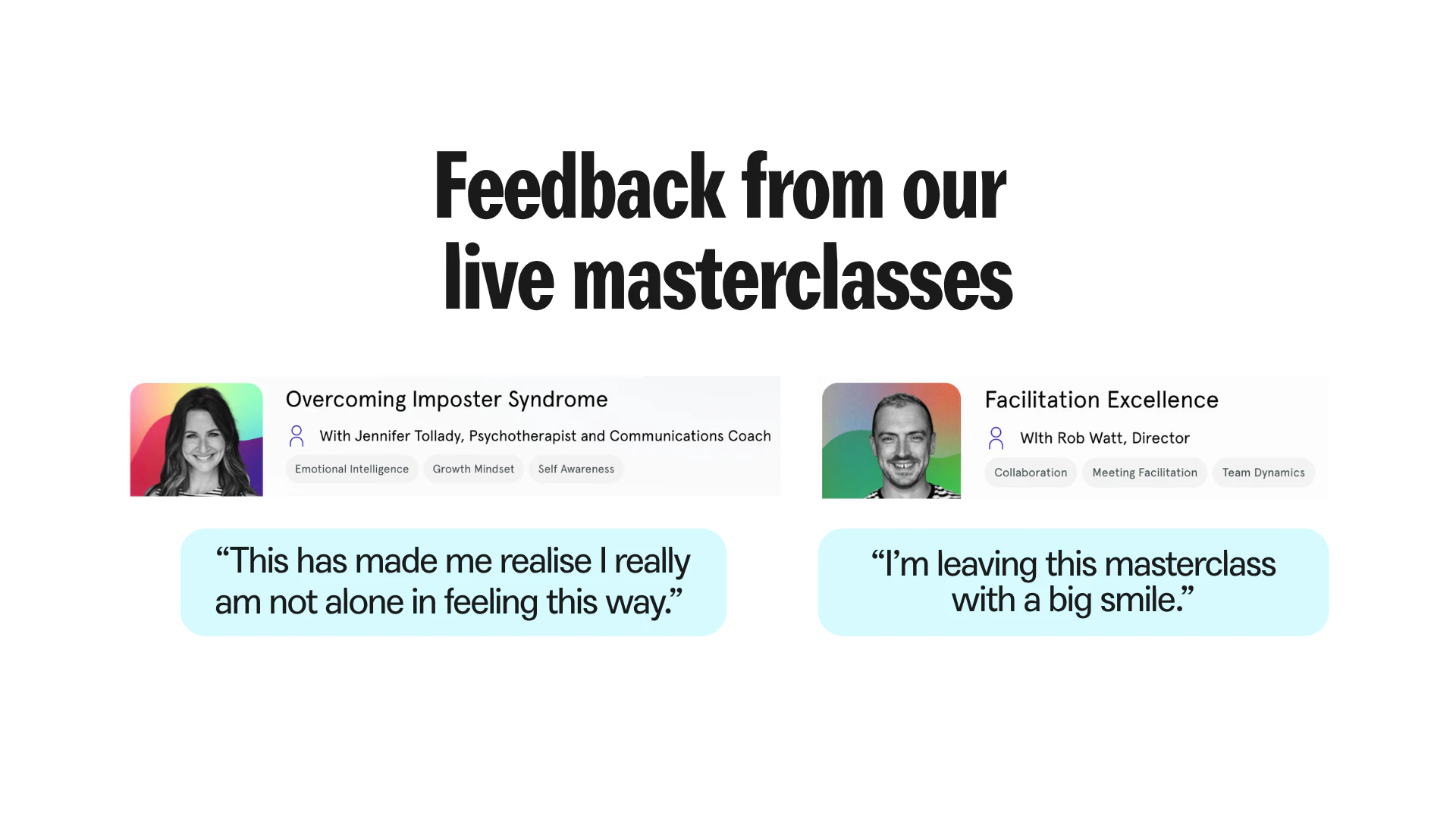
We also connect L&D teams to our experts for their learning events and festivals, meaning they can bring them in house for extra credibility and engagement, which we’ll come back to soon.
Accessible in every sense
Frontline, global and remote employees can easily become an afterthought when it comes to L&D and learning content.
It creates a feeling of disconnect that means growth opportunities seem more limited, culture feels more abstract, and then performance and retention suffer as a result.
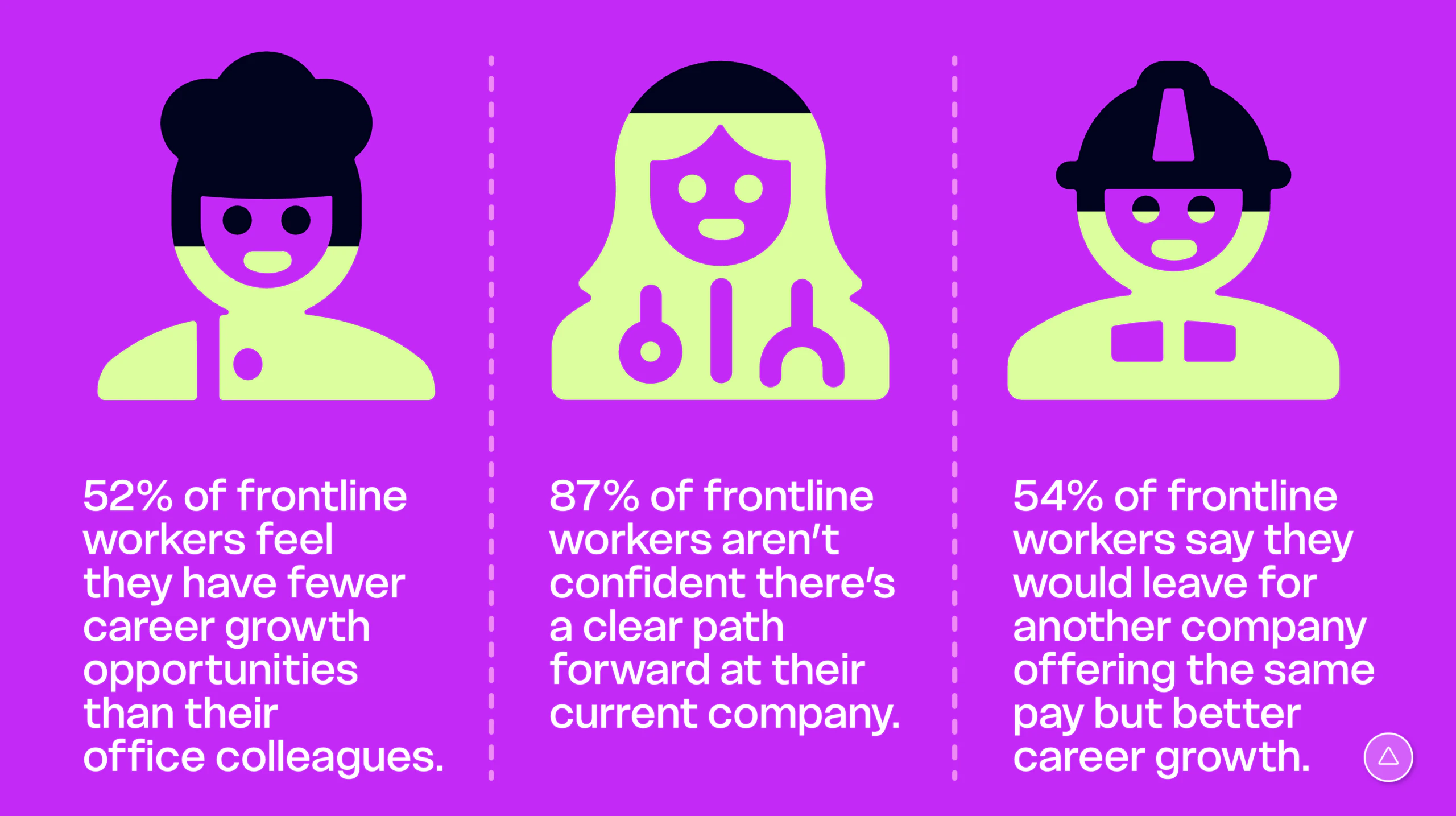
Source: Workvivo
So the best content libraries ensure content appeals to every employee, not just those based behind desks or close to headquarters.
Which really comes down to three things:
1. Ensuring it can be accessed without a laptop.
2. Formats and lengths that fit around busy, different schedules.
3. Offering content in native languages for global employees.
Pillar two: Enablement within your ecosystem
Human support for navigating the library
We mentioned libraries with 25,000 to 250,000 resources earlier. That’s a number that’s difficult for you to navigate alone but is also pretty tough for your support rep to get their head around too.
When this is the challenge, high-performance becomes more difficult.
The common feedback from our customers is that our team offers strategic support in curating the right resources for their goals and projects.
Which is only made possible by the fact our library is focused on quality over quantity, and that we know the content so well because we produce it all ourselves.
On-demand enablement resources that empower L&D teams
On the other side of the coin, you want to be able to navigate and maximise a content library effectively, which is where the right enablement resources come in.
For example, we create skills focuses to help customers understand which resources can be best used to build a core capability.
We also create Discover Discuss Do guides, which as the name suggests, give teams the structure to run sessions around resources, driven by key problems and skills.
Works where you already work and learn
Employees might be hesitant to engage with a new content library. Sometimes because of their past experiences, but often because it signals change.
Does this mean that they’ll need to change their behaviour.
That they’ll need to get familiar with a new tool?
Or start going somewhere different in order to learn?
This can be avoided by choosing an L&D content library that fits into your existing ecosystem. We allow customers to download inrehearsal content and embed it where their people already work and learn.
No new tech to be set up, no disruption for employees — everybody wins!
Key takeaways: What high-performing content libraries do differently
- High-performing content libraries combine both content and enablement: great resources alone don’t drive impact without support.
- Authenticity beats polish: learners engage more when experts feel real, credible, and practical.
- Experts shouldn’t disappear after the video: consistency across formats (live sessions, podcasts, events) builds trust and engagement.
- Accessibility isn’t optional: frontline, remote, and global teams need learning that fits their schedules, devices, and languages.
- Curation beats choice overload: the best libraries stay in the low thousands, making it easier to navigate and activate.
How modern L&D teams use content libraries
One of the biggest questions is how to use a content library effectively, to ensure there’s value in the spend and resources it brings into the organisation.
High-performing teams are moving beyond the common misconceptions like:
- Content consumption = success and ROI
- Give people access and they’ll find what they need
- Libraries are fixed, static resources
Instead, they’re using content libraries with intention. Let’s dive into these three ideas and some inspirational content library examples.
1. They’re contextualising the content
Content libraries are there to help L&D teams do more, by removing the pressure to create and build all the content in house.
And while the content often caters to core skills that are applicable to any business, the nuance and context of how those challenges show up in the company is something L&D teams need to consider.
For example, if the internal feedback has been that they need to have better development conversations, it’s not as simple as the manager watches content and the problem’s solved.
They need guidance and scaffolding.
- Watch this resource before you have the conversation to get the tone right.
- Use this framework to run the session.
- This other resource will help you communicate the next steps clearly.
How Southbank Centre contextualise learning
Luke Jackson, L&D Manager at Southbank Centre explained to us that he goes hunting for use cases for content and business-specific issues that can be solved by using it.
“Maybe a team is having a discussion about task or time management”, explains Luke Jackson, L&D Manager.
“If there’s a Discover, Discuss, Do guide that we could take into a meeting, we’ll use that to have a really high quality conversation with them about that.
“Maybe, I’m pulling together the monthly newsletter for people managers… and there’s a boxset that was released in the last six or eight weeks that really speaks to a theme that we want to communicate on, that will fit in there.”
Content isn’t only being used intentionally with the topic and context in mind, they’re also delivering it in the channels where they’ll connect with people most effectively.
This is essentially turning learning content into a learning experience.
Read the full case study: 4 reasons Southbank Centre loves inrehearsal as an L&D partner
2. They’re mapping content to skill priorities
The shift towards a focus on skills is completely understandable, because skills are the currency that get businesses towards their desired goals and outcomes.
But a lot of companies still aren’t getting it right, normally for two reasons.
- They’re mandating people to consume content: which is met with reluctance.
- They leave people to find skills content alone: which lacks guidance and structure.
Both times, the employee is struggling to work out what’s in it for them.
They can’t see why the mandated content will help.
They can’t find content in the library to support the skills they need.
And that’s if the company has taken the time to map out skills and help people understand which they need to build.
High-performing L&D teams are connecting the content in their library to the skills they’ve established as necessary for performance…
Softcat are mapping content to core skills
“We’re looking at what skills do people need to develop throughout their career, what capabilities do they need to get from the role they’re in now to the role they want to be…” – Daryl Wood, L&D manager at Softcat explains.
And they’re mapping the training and development opportunities available to those skills, including content from the inrehearsal library.
“The inrehearsal boxsets have been brilliant because we can identify the skills that people actually need in their roles, and we can align some of those videos to say…
“If you’re looking to top up on this capability, check out this boxset, check out this podcast, and people can then be doing those little bits throughout the year to continuously push their skills.”
Read the full case study: 5 reasons Softcat use inrehearsal to support skill growth
3. They’re bringing the content library to life
It’s easy for content libraries to feel disconnected from the rest of the L&D strategy.
Employees engage with these experts in videos in the library, but won’t see them again.
If companies put on training sessions or create their own content to supplement the library, they normally use internal resources or new experts.
We’ve seen inrehearsal customers have great success by bringing experts from our library to their in-person events:
- There’s a level of trust and familiarity with the expert.
- There’s consistency in the message and advice delivered.
- The L&D team knows there’s a degree of credibility for the sessions they put on.
A lot of the time, learners are genuinely excited to meet the experts in person.
LIke really excited — to the point where one of our experts was stopped by a Harrods employee on the street.
Harrods brought the experts in for their annual Learn And Connect Fest
Learn and Connect Fest is Harrods flagship moment of their year for the L&D team.
They create their own week of learning, build a moment to celebrate growth, and bring in external speakers from the inrehearsal content library.
“It gives us access to a vetted, credible network of speakers — which gives us confidence and assurance that the people we’re bringing in are of real quality and calibre, so we can really trust them when they speak about their subject matter.”
“We love partnering with inrehearsal and bringing amazing guest speakers in… to challenge our thinking and bring real diversity of thought into our environment.” – Jesse Woodman, Learning Design Manager, Harrods.
Key takeaways: How modern teams actually use content libraries
- Modern teams don’t “roll out” libraries: they design how content shows up in the flow of work.
- Context turns content into impact: the same resource lands differently when it’s tied to a real moment or challenge.
- Skills mapping creates clarity: learners engage more when content is linked to capabilities they need to build.
- Content becomes a learning experience: the best teams wrap resources with discussion, reflection, and application.
- Libraries work best when they’re brought to life: campaigns, comms, and familiar experts create momentum and sustained usage.
Solving low content library adoption: how to ensure it gets used
TL;DR Content library adoption doesn’t happen by accident. The teams that see content get used, they design for it.
Curating intentionally, anchoring learning to real work, and integrating content into everyday workflows rather than pushing access and hoping for engagement.
By this point, one thing should be clear: content libraries don’t fail because people don’t want to learn.
They fail because adoption is treated as an afterthought (and, in many cases, because the content isn’t very good).
Too often, adoption is framed as a learner problem — “people just aren’t engaging” — when it’s actually a design and strategy problem.
High-performing L&D teams don’t leave adoption to chance, they’re designing for it adoption in their L&D engagement strategies. Here’s how…
1. Don’t let the library bypass your L&D team
Content libraries were never meant to be the destination.
They were designed to help L&D teams do more with less — bringing expertise into the organisation without having to build everything from scratch.
Adoption breaks when libraries bypass L&D altogether and are put directly in front of learners.
At that point, the library stops being a tool for L&D and starts asking learners to do a job they’re not set up to do: navigate thousands of resources on their own.
What works better is when L&D stays in the middle — curating content and connecting the right resources to the right people and problems.
At the same time, learners are still given freedom and autonomy to explore the library (even if that means sometimes choosing not to).
2. Treat your content library like a buffet of ingredients
Yes, content libraries package content into playlists and courses — but the most effective L&D teams use resources to build learning experiences, not simply plug in existing collections.
Those collections absolutely have their place (it’s why they’ve been packaged together). But adoption increases when content feels handpicked, timely, and clearly relevant to what people are dealing with.
That might mean taking one video that speaks to a specific problem, bringing in a live event to explore another part of the puzzle, then adding a podcast or a practical activity to help people apply what they’ve learned.
You could think of this as a campaign mindset:
- The focus skill this month is X — what resources best support that?
- Our learning goal this quarter is Y — how do we bring that to life for people?
3. Focus on context, not access
Access to content is rarely the blocker. Most organisations already have more learning resources than people can realistically use.
Adoption breaks down when content isn’t tied to a specific moment.
Learners aren’t asking what’s available — they’re asking what will help me right now. Without that connection, even good content gets ignored.
The teams that see adoption introduce learning at the point of need: before a difficult conversation, ahead of a presentation, or after something hasn’t gone to plan.
When learning shows up in response to real work, that’s when content really resonates — and actually gets used.
4. Bring learning to the places people already work
Learning content is far more likely to be used when it shows up where people already spend their time. When learning requires switching platforms, logging into something new, or stepping away from work, it quickly starts to feel like an interruption.
High-performing teams reduce that friction by bringing content into the tools and spaces people already use — team meetings, 1:1s, internal comms, programmes, and existing workflows.
Learning becomes part of the working day, not something separate from it.
When content fits naturally into how people work, it doesn’t break momentum. It supports it. And that’s when adoption stops being a push and starts happening by design.
Rethinking the role of content Libraries in L&D
Content libraries aren’t going away — and they shouldn’t.
When they work well, they remove the pressure on L&D teams to build everything from scratch and give organisations access to high-quality expertise at scale.
So if you remember one thing, make it this: access alone doesn’t lead to learning.
The content libraries that make a real difference are the ones that offer practical, human learning, supported by teams who know the content inside out.
And the L&D teams that drive real adoption don’t just provide access — they design how content shows up in the flow of work.
That means curating intentionally, connecting content to real moments, and turning resources into learning experiences rather than static collections.
If you’re ready to explore a more human-first approach to content libraries — one that works as a true L&D partner — you can try inrehearsal for free.
FAQs about content libraries
How does a content library differ from a course catalogue?
A course catalogue is usually a list of structured courses inside an LMS.
A content library is broader — it includes a range of formats (videos, podcasts, templates, guides, events) and is designed to be searched, reused, and activated in different ways.
What are the benefits of an off-the-shelf content library?
Off-the-shelf libraries save time and cost by giving L&D teams immediate access to expert-led learning resources — without needing to build everything internally.
They’re especially useful when teams are time-poor, under pressure, or trying to scale learning quickly.
Can I integrate a content library into my existing LMS?
In some cases, yes. Content library software does integrate with learning platforms.
Modern content libraries should integrate into your existing ecosystem — whether that’s an LMS, LXP, intranet, or comms channels — so learners don’t have to change their behaviour to access learning.
What should I look for when choosing a content library?
When choosing a content library, look beyond volume and focus on usability, relevance, and support.
A strong content library should offer:
- Multi-format resources (video, audio, templates, guides) that suit different learning moments
- Clear tagging and search functionality so people can find what they need quickly
- LMS or LXP integration to fit into your existing tech stack
- Curation and activation support that helps turn content into learning experiences
- Regularly refreshed content aligned to evolving workplace skills
Most importantly, ask yourself: Will this library help us deliver better learning — or just give us more content?
The best content libraries don’t overwhelm. They make it easier for L&D teams to drive real impact.
What is the difference between a content library and an LMS?
An LMS (Learning Management System) is a platform used to organise, deliver, and track training programmes.
A content library, on the other hand, provides the learning resources themselves — such as videos, podcasts, templates, and courses.
Many organisations use both together: the LMS manages the learning experience, while the content library supplies the expert-led resources that sit inside it.
What content formats should a learning library include?
Strong learning libraries usually include a mix of formats so learning can happen in different contexts.
Common formats include:
- short-form expert-led videos
- structured courses or playlists
- podcasts or audio learning
- templates, frameworks, and guides
- discussion prompts and practical activities
Offering multiple formats makes it easier for L&D teams to build learning experiences and helps employees engage with content in moments that fit their workday.
How do you increase content library adoption?
Adoption increases when content is connected to real work rather than simply made available.
High-performing teams typically:
- curate resources around specific skills or challenges
- introduce content in programmes, sessions, or team discussions
- embed learning in existing tools and workflows
- provide guidance on how resources should be used
When content is relevant, easy to access, and supported with enablement, it’s far more likely to be used.
What makes a content library effective?
An effective content library isn’t defined by the number of resources it contains.
The most successful libraries combine:
- high-quality, expert-led content
- strong search and discoverability
- multiple learning formats
- easy integration with existing tools
- support that helps L&D teams activate the content
When those elements come together, the library becomes more than a collection of resources — it becomes a tool that helps organisations deliver learning that actually makes a difference.
Built for L&D,
Loved by Learners
See the most authentic library of original expert-led video content in L&D. Learn how it could work for your organisation.


