


- Podcast
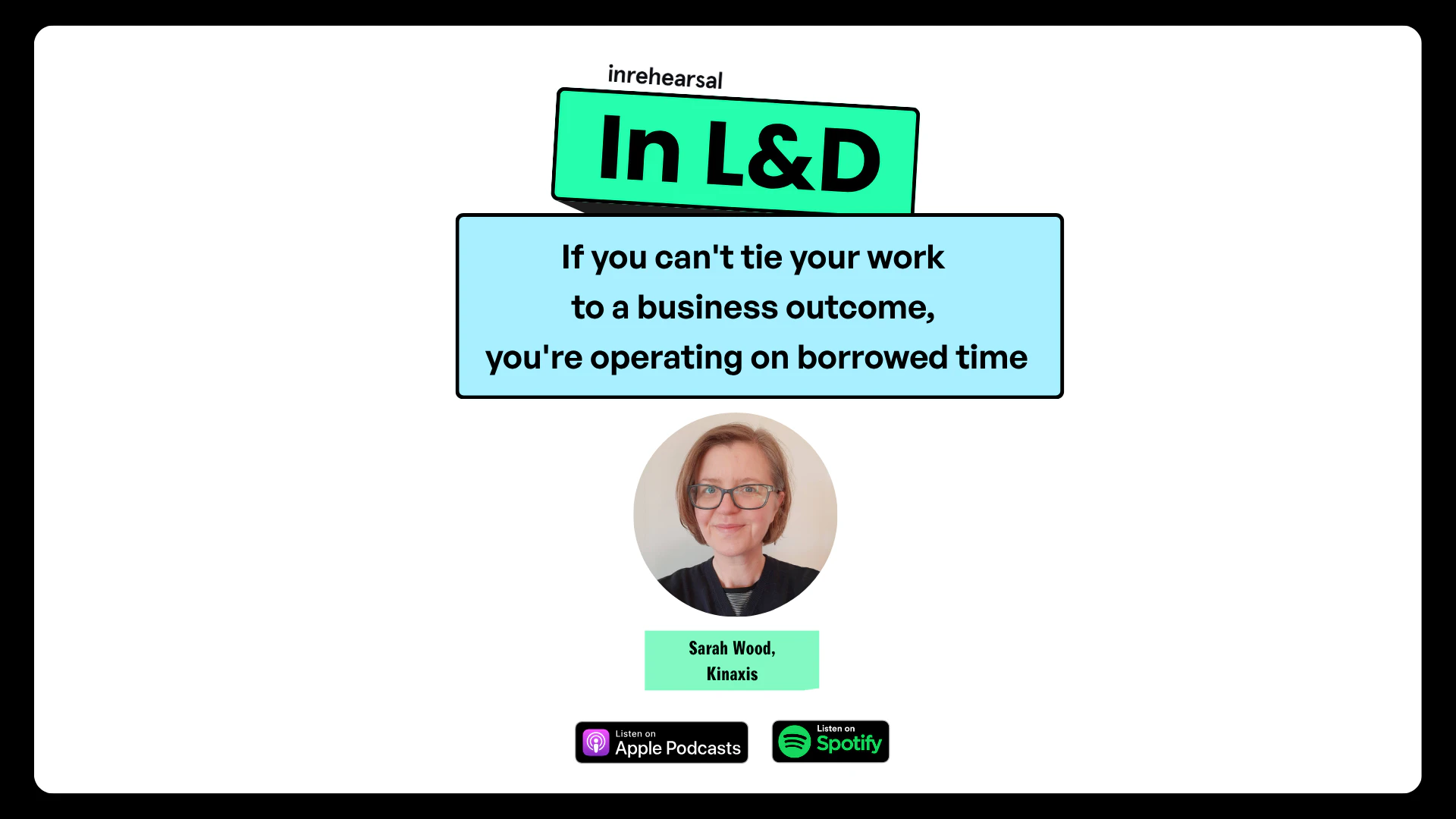
In L&D… if you can’t tie your work to a business outcome, you’re operating on borrowed time | Sarah Wood
22 Apr 2026
We’re often told that L&D needs to rebrand to get a seat at the table, but it’s not as simple as that…
L&D builds credibility and trust by connecting what it does to business outcomes.
And there are challenges that come with this too, as Sarah Wood explains on this episode of In L&D.
You have to be pragmatic about how much influence you have, your access to key data, when you’re brought into projects.
Working within those constraints, rather than following the pie in the sky thinking of rebranding, might help you do your best work!
As Sarah puts it: “Constraints aren’t bad. You can do a lot within them.”
Watch and listen the episode
You can also listen to the episode:
On Spotify by clicking here.
On Apple Podcasts by clicking here.
Or by searching for In L&D… wherever you get your podcasts.
5 lessons on building connections to business outcomes
1. We have to consider access to data and ability to influence
“Most L&D roles are individual contributors or mid-level. They don’t own revenue targets, organisation design, compensation plans, hiring standards, performance management systems. We don’t necessarily have that level of influence.”
Sarah explained that when lots of people entered L&D around COVID and there was an explosion of available roles, there was an enthusiasm for the opportunities and a feeling of excitement.
“We came into that with a different set of expectations, feeling like we had influence and authority. But as time went on, realising that that doesn’t necessarily equate to actual political capital in your organisation.”
The trouble is, this doesn’t feel like the discourse we’re seeing on LinkedIn, where we’re told L&D can rebrand, get a seat at the table, and have unlimited influence.
Something that got a lot of traction when Sarah posted about it on LinkedIn.
“The reality is that we work within constraints. We always work within constraints and we can’t necessarily go out there and change people’s minds in the way that it’s positioned on LinkedIn.”
2. Understand the perception of L&D in the business and work with it
Sarah shared a story from earlier in her career, where L&D was seen as an order taker function and the current training just wasn’t working.
It was a series of technical videos explaining a process of filling in paperwork — but sellers still weren’t filling in paperwork correctly, which was causing problems with customers.
“The videos were meant to walk them through it step by step by step by step. Nobody was watching them.
They figured out if they fast forward through the videos an hour and a half is actually 30 seconds and it ticks off that they’ve completed it, gets their manager off the back.”
The solution? Sarah’s manager spoke with the ops team to find the top 10 errors in this process.
“We decided that let’s focus on that first because the top 10 errors, it actually might’ve even been the top five errors, were causing 95% of the problem.
“If we pull those top five errors and I do some screenshots and some bullet points and they can just scroll through and read as and when they need it and they can just dip in and out.”
So while they were still functioning as an order taker, they came up with a creative solution that met the needs of the business within those constraints.
“I think it’s a really succinct example of how you as an L&D professional can still meet the business needs and hit the mark data-wise within quite extreme constraints.”
3. Be pragmatic about what you can do
“Sometimes, you’re not brought in at the right stage of a project, and you have to be realistic about what you can offer in that scenario.
“With a recent one, I was brought in really late before the launch of a new initiative. And as a result, like I wasn’t able to bring the full scope of what I could offer.
“So instead of trying to squeeze it in or do the whole shebang and say here’s the suite of enablement opportunity… it was very much like, okay well this is the capacity, this is how much time we have…”
It might be hard to look at that and say, it’s not your best work. But sometimes, it’s better to get it done, get it out the door, and learn from it.
4. Win hearts and minds by understanding someone’s challenge and speaking their language
“If I’m building product training and I’m working with the product subject matter experts, I’m like the whole point of this is so that you’re not getting pinged with calls all day.”
“Let’s make sure that we’re hitting those things that you keep getting asked about over and over and over again, so that we can just point them in the direction of the training.”
“And that you can come into high-value conversations like, we’re right on the cusp of signing a deal with a customer, and they need you to come in and answer these highly technical questions rather than coming in at the demo stage of a sale.”
Sarah frames this as winning people’s hearts and minds by:
- And speaking their language so that they get the value of engaging.
- Understanding where someone’s challenges are.
- Thinking about how you can lift some of that off their plate.
5. Reinforce that small improvements can have a big impact
“When you’re delivering this sort of training to like 200+ people, if you move the needle a tiny bit, the impact to that is big.
“So we’re not here to boil the ocean. We’re not here to change everything at once because you can’t. But if you change one thing and you know how to track that one thing, then you learn from it…
“You either bin it because it didn’t work, or you learn from it, you build on it.”
Built for L&D,
Loved by Learners
See the most authentic library of original expert-led video content in L&D. Learn how it could work for your organisation.
Related articles