

- Podcast
In L&D… we need to invest in ourselves with the same energy that we invest in others | Kylie Sturday
06 May 2026 By
Gary Stringer
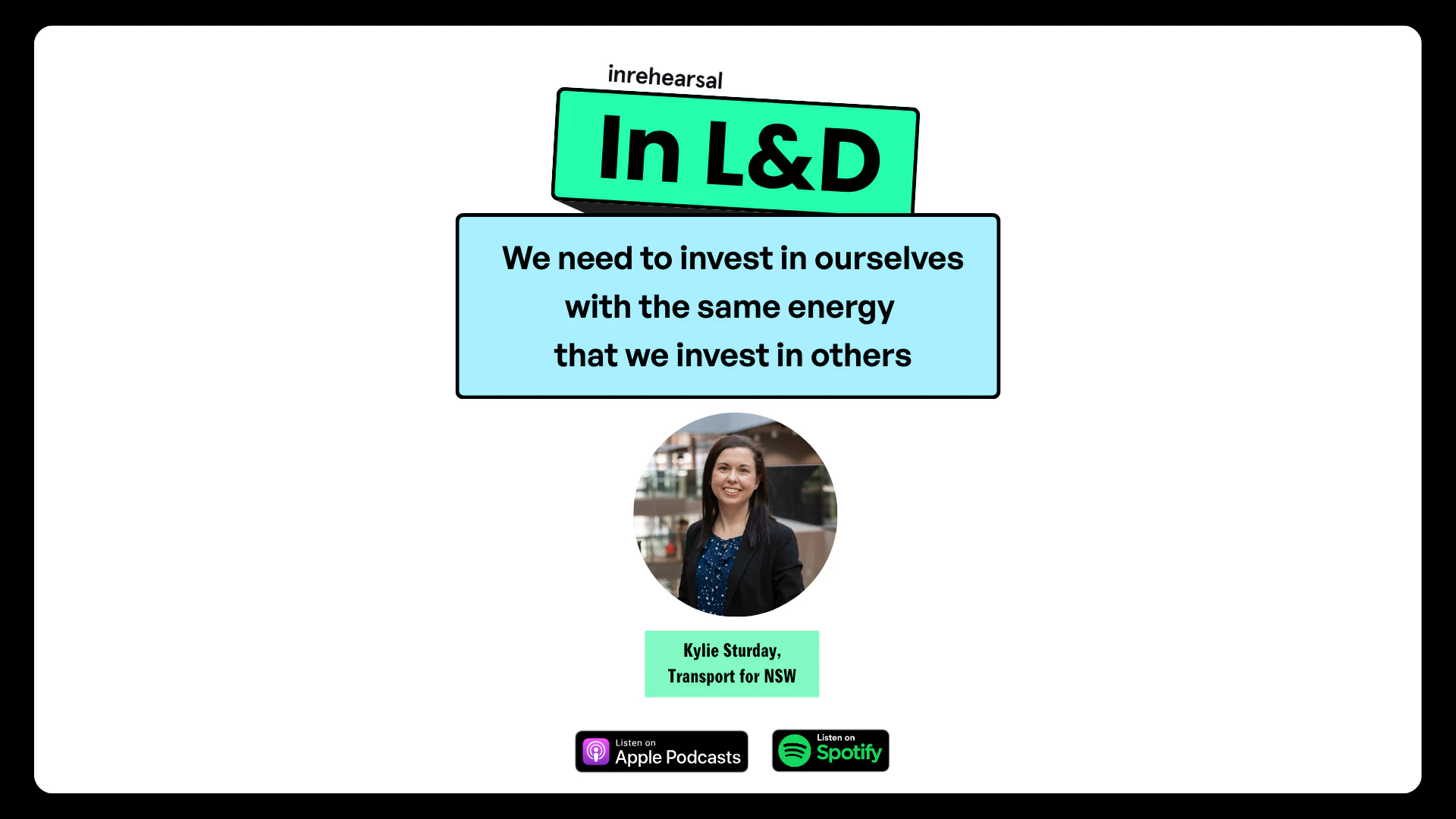
“I sort of had this revelation that pushing aside our own learning isn’t helping us. And it’s also not helping the people that we’re trying to help as well.”
In this episode of in L&D, we unpicked this challenge with Kylie Sturday, Senior Training & Exercise Coordinator at Transport for NSW and Co-Manager of Crackin’ LnD (Down Under) – Learning Community.
There’s a cliche that L&D is often last to learn, but it’s true for a lot of professionals.
Kylie shared how:
- She’s added structure to prioritise her own development.
- How she’s building development opportunities into her existing work.
- How she uses AI to stay accountable.
- The power of community, and a lot more.
Watch and listen the episode
You can also listen to the episode:
On Spotify by clicking here.
On Apple Podcasts by clicking here.
Or by searching for In L&D… wherever you get your podcasts.
5 lessons on investing in our own development in L&D
1. Use existing opportunities to build skills
As part of her commitment to development, Kylie recently began a graduate certificate in organisational and workplace learning.
“What I’ve found has been really helpful is choosing things for assignments that are related to things that I need to do at work.”
“I think we need to probably get a little bit more creative with how we look at ways to develop ourselves and not always think that it’s going to be something that is going to take too much time so we never start.”
For Kylie, this mindset feels similar to what we do for learners — asking them to think about how they can apply it to their job, so “we need to do that for ourselves too.”
“For example, we’re learning about different theories of learning design. And so while I’m designing learning at work, I’m like, well, how can I apply this in practice and give it a go, iterate?
“So that’s been one of the ways that I’ve found really helpful to just dedicate the time without having to think, where am I going to find that on my already full calendar?”
2. Communities give you the opportunity to try new ideas and grow
Kylie describes the Crackin’ LnD (Down Under) community as being there for the messy middle:
“What does the everyday L&D practitioner need? And often it’s just to be able to discuss those messy challenges and learn from each other.
“So it’s about creating more of those opportunities, I think, to get the real practice happening in a community of practice.”
Some of Kylie’s first-hand examples were someone having an idea for a new framework and wanting to get feedback. For others, it’s practising their presentation skills without pressure.
They’ve even started “seeing people wanting to learn AI together and how we apply that in L&D, and we’ve been doing that practically through some monthly challenges.”
3. Use AI to create personalised accountability prompts
It’s easy to make excuses around development, especially if nothing or nobody is holding you accountable.
Kylie shared that she hears people in the community using a trusted friend or co-worker to do this, but she’s approached it differently using AI.
“I’ve got a prompt set up, at the same time, once a week. It’s when I usually would spend that time reflecting anyway.”
“If you’re familiar with habit stacking from James Clear’s book Atomic Habits, it’s to try and see what’s already happening in your day and build around that. So for me, I was already picking a time where I knew I was going to be reflective anyway.”
Kylie also gave it context around where she might normally struggle or need help:
“I’m very good at planning, but I may need some help with the follow through, not making excuses.
“So having those questions aligned to where I know some of my shortfalls have been in the past has been helpful because it’s made me realise where I’m seeing patterns of just planning and not actually following through. So that’s been great.”
4. Getting to know yourself will help
“It may sound a little bit silly, but we all have our own quirks when it comes to learning. For me, inspiration is something that I need.
“So finding some quotes or stories, things like that, and having them visually displayed has been helpful for me.
“For other people it may be that you’re doing your best thinking at a certain time of day. It sounds really simple but we’ll often start with, okay, what’s the free time in my calendar?
“When what we should be really starting with is what’s the best time for me to get the best out of what it is that I’m trying to learn?”
5. Play sessions can help you build practical or technical skills
Let’s imagine you want to learn to use a tool like Miro. You could go to their help centre, spend some time going through their materials on their own…
But what if you could join practical sessions, where you played around with the tool, alongside people in similar roles?
This is what they’ve been doing in the Crackin’ LnD (Down Under) community.
“Darryn, who is our founder, is really keen on getting people to have a go at playing. And one of the things that came out of that was, because people could get together and discuss and learn from each other…
“They could get different ideas about how to use the tool and have a bit of a play in a safe space, no pressure environment.”
“I think in some ways people actually got a lot more out of that learning experience than sitting by yourself and being like, I’m just going to learn a technical skill.
“Whereas, when you’re in a group, you are more likely to question things or be open to different perspectives. So for us, that was a little bit of a softer twist on technical skills.”
Built for L&D,
Loved by Learners
See the most authentic library of original expert-led video content in L&D. Learn how it could work for your organisation.
Episode transcript
This transcript was generated using automated transcription software and lightly edited for readability. There may still be minor errors or inaccuracies.
Gary Stringer
Kylie, thank you very much for coming on the In L&D podcast. Do you mind kicking us off by completing that sentence?
Kylie Sturday
Yes, in L&D we need to invest in ourselves with the same energy that we invest in others.
Gary Stringer
That’s a problem I’ve heard people phrase before, but not as succinctly as that. So I’m excited. We’ve got a nice framing for it. And now we’ve got the rest of the time to just dig into what that means. So I know this is, I don’t want to say recent revelation for your realization, but I know it’s kind of really inspired by recent events, recent circumstances. So tell us how you’ve ended up at this viewpoint.
Kylie Sturday
Yeah, you’re right. I mean, I’ve always sort of believed in like continuous professional development, but I think, you know, as time goes on, when you’ve been in the industry for a little while, it can be easy to lose sight of that. And for me, I sort of had this revelation that, you know, pushing aside our own learning isn’t helping us. And it’s also not helping the people that we’re trying to help as well. It can be quite easy to get caught up in, well, my purpose as an L&D professional is to help other people perform well. And it can be easy to lose sight of our own performance. And yeah, it just took some time, I guess, at the end of 2025 to think through that a little bit more and, you know, what does that mean for me?
you know, how can I actually approach next year with, I guess, a little bit more of a plan and purpose, like be just more intentional rather than leaving things, I guess, a little bit up to chance.
Gary Stringer
And what did that look like? How did you add that kind of framing or structure to the way you were thinking?
Kylie Sturday
Yeah, sorry. I mean, at the end of the year, it’s always a good time to sit back and reflect and then I guess look forward. And I realized that I’d sort of been making excuses for not taking the leap and doing, I guess, more of my own development. been doing it in some ways, but just not with that same structure that I mentioned earlier. So one of the examples that comes to mind is I’ve been thinking about going back to uni for some time and it’s
Gary Stringer
Yeah.
Kylie Sturday
little while since I’d done some, you know, proper study and I thought well I keep making excuses and it’s a little bit ironic in L&D that we are quick to complain about other people maybe not coming to our courses and here I was making excuses not to follow through and go and do one myself. And that’s not to say that courses are always the answer, but I just felt like in terms of getting up to date with the latest theories, it was just getting a little bit overwhelming, you know, the constant LinkedIn scroll. And I just thought better to put some structure around that and maybe find some ways to do things a bit more innovatively at work. So, yeah, I finally clicked enrol and I’m glad I did.
Gary Stringer
Yeah. It’s so true. The making excuses thing is, it’s so easy to do. And I think everyone has that degree of sort of self-awareness that I am probably just kicking the can down the road and yeah, finding a way to kind of bring that to an end, whether it is enroling in a formal course or something else that we’ll maybe get into. It’s such a way to just end that cycle of putting it there. Tell us a little bit more about the degree that you’re. you’re studying as well with that mindset of what are the latest theories, how am I keeping up to date?
Kylie Sturday
Yeah, so I just started a graduate certificate in organisational and workplace learning. So highly relevant because That’s what we do. So studying that at UTS Sydney, doing that online, so still managing to do work and then making some dedicated time outside of it to do the study. But what I’ve found has been really helpful is sort of choosing things for assignments that are related to things that I need to do at work. So it doesn’t feel like I’m having to then create a whole heap of additional time and try and put that in
that aside just to be able to do the study. I think we need to probably get a little bit more creative with how we look at ways to develop ourselves and not always think that it’s going to be something that is going to take too much time so we never start thinking about ways that we can actually apply it back to the job, which is what we tell our learners to do as well and what we’re trying to design for. So we need to do that for ourselves too.
Gary Stringer
Yeah. Yeah. Yeah. I think actually I opened LinkedIn this morning and there was a post from you about innovation that said that innovation isn’t necessarily always the addition of something, but doing something creative with the, what you already have at your disposal. And it’s the same with, if I always think that studying or some sort of development opportunities requires more time from me, then maybe it’s going to affect my adherence to, to doing it. But if I’ve actually baked in opportunities to my day to apply it and it doesn’t really.
Kylie Sturday
Mm.
Gary Stringer
disrupt what I already do, then you’re more likely to stick to it, suppose, is what I’m getting at.
Kylie Sturday
Yeah, definitely. Like, for example, we’re learning about like different theories of learning design. And so while I’m designing learning at work, I’m like, well, how can I apply this in practice and, you know, give it a go, iterate? So that’s been some of the ways that I’ve found, yeah, really helpful to just, you know, dedicate the time without having to think, where am I going to find that on my already full calendar? Yeah.
Gary Stringer
Yeah, yeah. Overwhelming is the word you used earlier and that is what that becomes, isn’t it? And I know there was a, I was going to say, I know there’s another part of this puzzle around, you know, like end of last year reflecting. So yeah, tell us about kind of the rest of the process of forming this, this idea that we need to make just as much time for our own learning.
Kylie Sturday
Yeah, definitely. Yeah, and I think what probably solidified that more for me was joining a Learning Uncut webinar at the beginning of this year. So that was something that Michelle Ockers and Michelle Parry Slater, which we’ve happily adopted down under, ran for us.
Gary Stringer
Yeah.
Kylie Sturday
And they really make the point about some of the skills that are growing in importance. So those include critical thinking, learning agility and systems thinking. And the only way that we can actually grow these skills is to invest in our own development. So, and it really sort of goes to what I’ve thought about for some time is that we sometimes leave things up to chance and we’re not always lucky enough to come across these, you know, perfect opportunities in the workplace where we’re going to grow all these skills that are needed and all these reports that we read. Sometimes we have to create those own opportunities for ourselves. And there were a lot of people on that webinar who really agreed that sometimes we just put our own learning needs.
you know, we maybe don’t have this front of mind for ourselves, maybe for other people but not necessarily ourselves. So it was sort of really good timing in a way for me.
Gary Stringer
Yeah. Yeah. think leaving it to chance is the interesting thing because there’s so many things we want to go well, and then we don’t have any chance to practice them. Like a big example would be one-to-ones or end of year conversations. You know, we want it to go well. it requires some of the skills you mentioned, like critical thinking or what we might call softer skills around communication. And then we don’t create any structure or opportunity for us to practice those skills. And there’s a high chance then that interaction goes wrong. creates this big bad feedback loop for us where we don’t feel as confident to do it again in the future. I think leaving it to chance is what underlies all of those problems.
Kylie Sturday
Yeah, and I guess it probably takes me back to when I first transitioned into L&D and I thought, great, I’m joining this like learning team. They’re gonna teach me how to be this great L&D professional. And then you get there and you realize that like half the people like are just like, yeah, I just kind of fell into this, it’s a job. And the other half, you know. studied something years ago and you know haven’t kept up to date and you think well yeah how am I going to learn so yeah it’s definitely not something that you can just expect that okay just because I’m joining a learning team someone’s going to just take me under their wing and teach me everything there is to know and even since then I mean skills have changed as we know they’ve got like shorter shelf lives as well so the skills for an L&D professional
is changing. You know, we see it every day on LinkedIn as well. I think, and also now like community conversations too. So for me, it’s how do we, I guess, dedicate, you know, the time, the energy, just keeping it front of mind as well and holding ourselves accountable has been a big thing.
Gary Stringer
Yeah. Before we get into all the sort of challenges of actually making that time for yourself, I know you mentioned making yourself accountable, making a commitment there. That was basically what came out of that webinar that you went through as well, wasn’t it?
Kylie Sturday
Yeah, that’s right. So they encouraged us at the end of the webinar to make a commitment for 2026 in regards to our own development. So for me, my commitment was continuing to co-manage the Kraken L&D Down Under learning community and also creating space for fellow L&D professionals to grow, as well as strengthening my own learning experience, design skills, which obviously I’m doing through some formal study. But there are opportunities within communities to grow those skills as well. And it’s something that I know us on our core team are really interested in continuing to explore further, not just for ourselves, but creating that space for other L&D professionals too.
Gary Stringer
Yeah. Do you know what’s interesting is when I joined L&D, it was like 2020 and it felt like it was just at the start of the communities really forming and taking shape. But a lot of it was still very much formalized professional body type community interaction. And now there’s so many great independent people driven communities that are there to give opportunities to do something in practice rather than kind of just more of the theory based stuff. I guess if you noticed that as well, sort of growth of community and the growth of opportunity that’s presented to people.
Kylie Sturday
Yeah, definitely. It’s like if someone’s got an idea, you know, these sort of communities, like, and I’m thinking along the lines of like L&D shakers as well. They encourage people within the community to give those skills a try. So for us, like sometimes, you know, a person might have an idea for a new framework in mind, they want to get some feedback. Others want to practice like their presentation skills. We’re now seeing people wanting to learn AI together and how we apply that in L&D and doing that practically through some monthly challenges. So there’s a whole range of things. mean, you know, the sky’s the limit really when it comes to, you know, that social learning element.
And I think for us, you know, I like to often say we’re here for the messy middle. It’s what does the everyday L and D practitioner need? And often it’s just to be able to discuss those messy challenges and learn from each other. And so it’s about creating more of those opportunities, I think, to get the real practice happening in a community of practice.
Gary Stringer
Yeah, I think that’s the real sweet spot for communities that where you can actually get an opportunity to practice something is the real real goldmine, isn’t it? Because from my experience, when you do a role where you’re often like a solo team, or even if you’re a wider team, there’s still not someone who does your exact specific role. You do really need to go out to other people and try and learn how they’re approaching challenges or just bounce ideas off them to give yourself confidence to go and try them. But if you’ve got the community where you bounce ideas off people. then you get a chance to apply with those people who know all of your context and it isn’t the highest stakes environment of work, then I think it sounds like you’ve got a really nice platform for people to grow and invest in themselves, which is brilliant.
Kylie Sturday
Yeah, definitely. And everything’s free. Because we know how expensive everything is.
Gary Stringer
Yeah, yeah, exactly that. 100%. Yeah, do you know what? The amount of times earlier in my career I thought a course would help me do something and it, you know, or like becoming part of a membership of something or it felt like a community, but really it wasn’t. It was just, you paid loads of money for access to something and to have maybe like a logo. Yeah, I think that those days are truly behind me, truly behind me. Cool.
So we get to this point, end of last year, you’ve made the commitment, you know, keep creating those opportunities for other people. You know you want to add structure to your own learning. Then of course, the sky is the limit, but then what happens, you know, the challenges that we come up against, how we overcome them. So what are sort of the big barriers you’ve found now you’ve made that commitment to your own development that you think other people might be struggling with and we can kind of unpack how you’ve overcome those.
Kylie Sturday
Yeah, one of the big barriers is sort of accountability. So like I was sort of giving the example before, like making excuses, it’s really easy to sort of make those excuses because no one was really holding me accountable. I think making that conscious decision to be like, actually. I need to be held accountable. And I know some people in our community have talked about having like an accountability partner, someone so like a trusted coworker or friend that they know is going to check in and see how you’re going with that particular goal. For me, what’s actually helped this time around is also harnessing some AI for accountability. So I’ve got a prompt set up same time, once a week. It’s when I use
would spend that time reflecting anyway. If you’re familiar with habit stacking from James Clear’s Atomic Habits book, it’s try and see what’s already happening in your day and build around that. So for me, I was already picking a time where I knew I was going to be reflective anyway.
Gary Stringer
Yeah.
Kylie Sturday
And just having that prompt with some real pointed questions about, these were your goals for development. How are you actually tracking and also putting in instructions to be like, well, I’m very good at planning, but I may need some help with the follow through, not making excuses.
Gary Stringer
Hmm.
Kylie Sturday
So having those questions sort of aligned to where I know some of my shortfalls have been in the past has been helpful because it’s made me realise where I’m seeing patterns, you know, of just planning and not actually following through. So that’s been great.
Gary Stringer
and Yeah, I feel so, yeah, I feel very related to that there because I love planning something and I’m, the doing is my least fun part. Like maybe my brain, I’d like to be a strategist somewhere where I just get to do the fun bit and then hand it over to someone else. But yeah.
Kylie Sturday
Yeah, definitely. then with the study, it’s been nice because at least I already knew. someone also doing the same course. yeah, Nicola’s been a good study buddy for me, being able to practice some of our assignment presentations to each other. Again, just sort of talking through, hey, did you understand that theory? Like, how would that make sense in your workplace, my workplace? Again, it does come back to that sort of social learning, being able to do that sense making and just talking out loud sometimes. times it actually really helps with your own development.
Gary Stringer
Yeah. Yeah. In fact, you know, that thing about accountability and going with someone else, I go to a public speaking class. I’ve been doing that for about three years and loads of times where I’ve seen people stick with it and become a member is if they come with someone else, because I think it breaks down the barriers to it being something really daunting to be in something like, well, I’m in this with someone and it’s more manageable for us to do together. And I think that might be, you know, especially with, I think back to formal study.
Kylie Sturday
Mm.
Gary Stringer
speaking with someone about how we break down this theory and how it might actually be applied or how this actually makes sense if it doesn’t make sense the first time I encounter the information. So I think that’s a great, that is a great lesson for anyone, isn’t it?
Kylie Sturday
Yeah, we’ve sort of seen it play out as well in our community. Like I’ve run three book clubs so far and I have to say they’re probably the books that I’ve enjoyed the most because they’ve actually made a whole lot more sense because I’ve been able to talk through some of the concepts with people. And then it’s also brought up other, you know, experiences that people have had sort of related to those key themes. And I know it, guess in a way it sort of bring things to life. You know, we’re all about when we’re planning. learning for our learners. Like how is this going to be relevant to them? You how are they going to be motivated? And, you know, what does it mean in their everyday context? And, and I think of examples like that and I think, actually that’s what’s making it relevant for me and others. So yeah, again, applying our own advice to ourselves.
Gary Stringer
Yeah, it’s remarkably simple, but it is just what you need to do, isn’t it? Were there any other sort of challenges? Mentioned accountability, anything else that you found particularly challenging in terms of just making that time for yourself?
Kylie Sturday
Yeah, that’s right. and Yeah, so I think what also helped was, I guess, getting to know yourself as well. May sound a little bit silly, but we all have our own quirks when it comes to learning. And for me, sometimes like… inspiration is something that that I need so you know finding some quotes or stories things like that and having them visually displayed has been helpful for me. For other people it may be you know you’re doing your best thinking at a certain time of day so it sounds really simple but you know, often we’ll start with, okay, what’s the free time in my calendar when what we should be really starting with is What’s the best time for me to get the best out of what it is that I’m trying to learn. So.
Gary Stringer
Yeah, I think you mentioned James Clear. I think this is another James Clear-ism as well. But the idea that when you go to make habits, a lot of the temptation is to look externally about how other people make habits. And really the best thing to do is reflect on when you’ve previously set yourself a goal to have a habit, what were the things that when it was successful underpin that? Or if you didn’t stick to that habit, what were the things that underpin that? know, did I do it first thing in the morning versus if I left it to the evening, I would never do it. Or if I tried to
Kylie Sturday
Yeah.
Gary Stringer
find free time in my calendar rather than just going with the best time, i.e. when I’m most creative, for example, there’s no point trying to be creative based on when you have free time. There’s being creative based on when you feel most creative is probably… It sounds again so stupid and simple, but if you try and force yourself to do it, it won’t work, will it?
Kylie Sturday
Mmm. What a creative explanation. No, it’s true. It’s so ironic. mean, like, had to, yeah, come up with, like, a… sensationalist headline for all of this would be like the learning people aren’t learning and it’s crazy to think that but it is happening in some cases and you know I don’t want to be that person and yeah that’s part of I guess getting to motivation which is sometimes a barrier for people for me just being clear on you know what is the whole purpose of this part of it is walking the talk like there’s no point
Gary Stringer
Yeah.
Kylie Sturday
you know, encouraging others to develop if you’re not doing it yourself. Sounds quite hypocritical.
Gary Stringer
Yeah, It’s true because you’re trying to show that you believe in the ideas that you’re espousing to other people and what better way to do that than to just do it and have evidence for doing it. But I think that getting to know yourself thing is really such good advice because I don’t think many people sit down, maybe do get reflected by the, at the end of the year, but we don’t necessarily really unpick all of that to work out, well, what’s my underlying motivation for this? And actually what’s
best going to set me up to achieve that. And that’s probably where you came to realizations like I need to find ways to apply it in my current work day, as your point about time. Are there any examples of how you’ve managed to do that already? I know you’re quite early into your course, but are there examples of where you’ve been able to take something you’re learning and say, I’m already working on this thing, let’s apply it there.
Kylie Sturday
Yeah, definitely. guess it’s probably getting into the technicalities of it, but we did learn about like different types of assessment and I’d learnt it like so many years ago, but for me it was like such a good reminder of like, am I just putting an assessment into a program just to say I’ve done an assessment? And We had done a little bit of that in the past, but for me it was like, okay, well, I want to use like the language and the resources that we covered in the course and actually think, well, this is the goal of the program. What assessment fits it best? So it was really funny. Like learnt it one week was literally discussing it at work the next. So.
Yeah, that’s probably like the front of mind example for me. Another thing they sort of encouraged us to do in the course, and it’s something that I’ve probably thought about on and off for some time, but, you know, excuses, motivation, was to, you know, create your own design toolkit. So a little bit like…
Gary Stringer
Yeah. Yeah, yeah.
Kylie Sturday
how we’ve talked about previously, you know, not getting to the end of an assessment and work being like, what are my references? Actually, as you’re discovering things along the way, making the conscious effort to group that together. So it is easy for you to come back to it on the job, like creating your own job aid in a way.
Gary Stringer
Yeah.
Kylie Sturday
So it doesn’t have to be anything fancy, but just little things like that can be motivating, I think as well.
Gary Stringer
Yeah, I think again, the reflective part of that is there’s probably things you want to work on and there’s things you do every day and can you just do the Venn diagram and find ways to tie them together, you know, and then one week you’re hearing about something and then the next week you’re noticing there’s an opportunity to apply. I guess just being in that frame of mind that there’s things I want to apply, then when it does pop up every day, you see it. But if you’re kind of just on the hamster wheel and you keep going and keep going, you maybe miss those.
Kylie Sturday
Yeah, that’s right. I mean, there’s a difference and obviously we see this in, you know, learners as well, people who just want to get through, get a program done and others that are like, well, actually, how is this going to help me work better? How’s this going to help me be a better, you know, professional? So I think it’s, you’re right. It’s probably something that I hadn’t thought about like that clearly, but mindset’s another one. So, yeah.
Gary Stringer
Yeah, you know, I’m only three episodes into doing this kind of new podcast program and you’re the third person who’s mentioned people really wanting to know what is in it for them as the framing for how, should I engage with this and trying to break people out of that habit of just like click and get through it and see it as an interruption. So it’s good to hear that there’s consistency in challenges people are facing or consistency of the mindset and how to tackle them.
Kylie Sturday
Yeah. Yeah.
Gary Stringer
I guess you’re seeing firsthand how a lot of other people, by co-running the Kraken L&D community, you’re seeing how other people invest themselves as well. So you’ve probably got this nice viewpoint of this is how I’m making time for myself, but you also get to observe how others are making time to invest in themselves as well. So are there any things you’ve really observed or lessons you’ve learned from the community about how other people can invest in themselves as well?
Kylie Sturday
I well, it sounds a bit biased, but finding a community in the first place is a really great start. Finding people that you trust that you can talk through and… who maybe have that same excitement as you, who want to get into the details, who want to see like, actually, how does this work in practice? Other things we’ve seen is people just volunteering for different opportunities in the workplace. It may be, you know, a project that they haven’t worked on before, an opportunity to present if they’ve been more in the design space. Again, is the example before people were sharing ideas about approaches like.
For me, myself, we’ve been running these AI symposiums where we get people to present different tools and how they have actually been using it in the workplace for L&D purposes. And came up with a framework myself on how I use AI every day. And it was an opportunity to just share that with people and get some feedback and see if it lands. So I think it’s just… Yeah, like I said, a combination of looking for those opportunities, different ways that you can actually connect with other like-minded people and get into those discussions. And I’ve seen it play out in book clubs as well. Like you don’t all have to come there agreeing on the same thing. It’s actually really exciting when people are like, well,
I don’t know if I quite agree with that point in the book and just applying those critical thinking skills that I mentioned earlier, so important and becoming increasingly important. Like, well, how can you put critical thinking into practice? Find opportunities to do that.
Gary Stringer
Yeah, yeah, I think that’s the other thing as well. I don’t know if you noticed this a lot of the time, I think when people think about development, especially outside of work or their own self motivated development, technical skills is really something that I think people lean to more like, I want to learn how to edit videos, for example, I want to learn how to, I don’t know, build furniture, or whatever weird example is going to come to me next. But I think, I don’t know why they were the first two that came to me.
Kylie Sturday
Mmm. Yes. Yeah, well I’m definitely not volunteering for building furniture. There have been way too many Ikea related fights.
Gary Stringer
No, Yeah, honestly, me and an Alan Key are a terrible combination. can’t build it. But I think people do default to how can I build a new technical skill versus how can I, you what’s the soft skill I’ve always wanted to work on? So do I want to become a better communicator? Do I want to try and be more empathetic or a better listener? And I think sometimes the technical ones dominate and there’s…
Kylie Sturday
I
Gary Stringer
The ones that you just mentioned that are going to become increasingly more important can fall through the cracks a little bit, can’t they?
Kylie Sturday
Yeah, that’s right. And it sort of reminded me of something else that we’ve done in the community. taking the technical skill example, for example, people might be like, I want to learn how to use Miro. So I’ll go watch some videos, you know, they’re in built help and whatever. But we actually ran some play sessions. Darren, who is our founder, is really keen. on getting people to have a go at playing. And one of the things that came out of that was because people could get together and discuss and learn from each other different ideas about how to use the tool and have a bit of a play, again, in a safe space, no pressure environment.
I think in some ways people actually got a lot more out of that learning experience than sitting by yourself and being like, I’m just going to learn a technical skill. Whereas when you’re in a group, you are more likely to maybe question things or be open to different perspectives. So for us, that was sort of a little bit of a softer twist on technical skills.
Gary Stringer
Yeah. Yeah. think you mentioned something there earlier as well about like, I felt like energy, you that when you join a community, I think it’s easier to be caught up in that contagious energy of other people. Like if you do just a solo kind of job and, or, know, you’re the one person L and D team. I often hear people say, well, no one else is excited about learning in my business as I am. So, you know, I can imagine if you’re trying to make chances for your own development and
everyone else around you isn’t as excited, it’s challenging. But if you go to a community space and people are facing the same challenges, but they’re also equally as passionate about solving them or willing, you you can tell how passionate people are by how willing they are to be contrarian or have the opposite viewpoint to your point about the book club and disagreeing. So I guess you must see that, that kind of energy that motivates people to keep going and sort of carry on with those development opportunities.
Kylie Sturday
Mmm. Yeah definitely, yeah it’s great to see.
Gary Stringer
Cool, we’re coming close to time. So is there anything we missed or any final advice you want to give to people who are thinking, I need to also stop making excuses and invest in my own development as well.
Kylie Sturday
Yeah, so one question sort of really helped me and that is, think about it being December 2026. What story do you want to be able to tell about how you learnt and grew this year? So sitting with that question may be helpful and may make you think, well, what is it that I want to be able to say I’ve done and how I’ve grown by the end of the year?
Gary Stringer
and then work back. Mm-hmm. I agree, I do that sometimes and just work backwards from it and say well what needs to happen for that to… and often it will be things like make sure you have enough opportunities to practice and make sure you do X Y’s, you know, it’s a… I think it gives you bit more structure and motivation.
Kylie Sturday
Yeah, definitely. And it doesn’t have to be a really big goal. It’s probably the only other thing I’d say. Like if you’ve got an intention and just to improve a particular skill, start somewhere. Like I said, get to know yourself, your habits and how it can actually fit in best because that’s what’s going to keep it enduring. Not just a, yeah, over in two weeks. Sort of.
Gary Stringer
Hmm. Yeah. Yeah, the realism about the goals you set is such a, I must play such, I’ve not seen any data on this, but must play a huge factor on whether or not you actually follow through with it. If it’s something so unrealistic, it’s not going to be achievable. I think I imagine that that is a higher drop off rate than if I just say, well, by the end of this year, if I speak at one event, for example, if by the end of this year I’ve run an internal session and I’ve never presented internally before, know, small, small steps that, what will I later? keep you on board. I promise this isn’t a pun, but last question that I’m asking to everyone is what’s something you’re still working on or haven’t cracked yet? So it’s not a community-based pun, but is there anything that you’re still working on and we can try and crowdsource some insights.
Kylie Sturday
Definitely. you Well, something we’re still trying to crack in Kraken L&D, no pun intended, is just how do we continue to harness the power of learning communities as a means to help invest and develop ourselves. Like I said, I feel like we’re part of the way there, but I’m always keen to hear new ideas and ways that we can continue to do that for more people.
Gary Stringer
Yeah. Yeah. Brilliant. Well, that is the perfect segue for me to say that if people want to learn more about the Kraken L&D community, because it’s based for people in Australia and New Zealand and Pacific. Is that right? Yeah. the links to that will be in the description below. And so your LinkedIn profile if anyone wants to reach out, but Kylie, thank you very much. And that flew by. really enjoyed that conversation. thank you for joining me.
Kylie Sturday
And the Pacific Islands, yep, that’s correct. Yeah, that went by quick. Thank you so much for having me.
Related articles
L&D Trends 2027: (6 Challenges And What They Mean For Your Team)
Explore 6 key L&D trends for 2026/2027, including talent velocity and manager engagement, backed by fresh industry data and expert analysis.
Read more