



- Podcast
In L&D… Learning doesn’t happen in isolation, it happens in relationships | Amie Boylan
14 Apr 2026
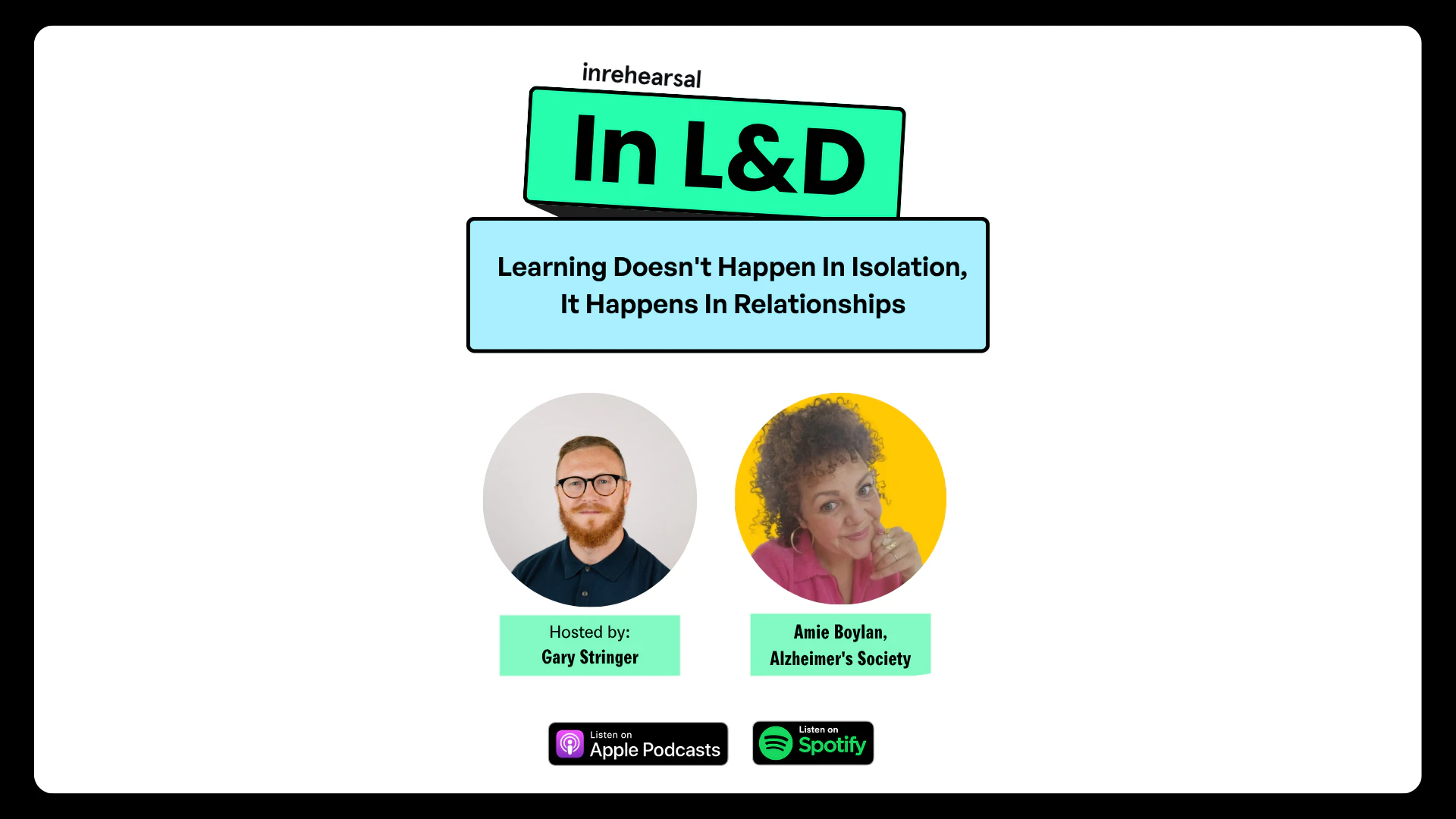
Learning doesn’t happen in isolation — it happens in relationships.
That’s the belief Amie Boylan brought to the very first episode of In L&D…
Amie is currently Alzheimer’s Society’s Income & Engagement Academy Lead and has loads of experience in coaching and development, She’s also the Co-Founder of You’re Invited, delivering joyful and creative experiences that help people play, learn, and connect
In our conversation, we explored how Amie gave people a platform to share expertise, how she built advocates for the Manager Academy, why you have to think about what’s in it for the other person, owning mistakes, being authentic and loads more.
You can connect with Amie on LinkedIn and follow the You’re Invited page here.
Watch and listen the episode
You can also listen to the episode:
On Spotify by clicking here.
On Apple Podcasts by clicking here.
Or by searching for In L&D… wherever you get your podcasts.
5 lessons on building relationships in L&D
1. Build trust by giving people a platform to share knowledge
“Giving people that permission to come forward, that’s something that is still very much at the heart of my focus all the time.”
Amie’s approach brought in a mindset to lead with the question: what do we already know about this topic internally?
Rather than people feeling disempowered, they felt empowered by a platform that gave them a chance to show their subject matter expertise at internal events.
“It’s a bit of an engagement strategy, marketing strategy and L&D strategy of how can we encourage people to come forward and share their expertise?”
“The Manager Academy is there to create learning opportunities, to create peer-to-peer development, but also to showcase what we’re about, what we’ve got, and what we do.”
2. People care about what’s in it for them
“One of the key things that I always think about when I’m building relationships, I’m conscious that I’m thinking… what’s in this for me?
“How can this benefit me? My agenda in L&D? My role and to achieve a target? And they’ll be thinking the same as well. I think that’s okay to admit that!
“And when people were coming forward, they could obviously see what was in it for them as well as me seeing what would be in it for me and the wider org.”
3. Checking your ego can improve relationships
“My role was initially fixed term. And from an integrity perspective, I was just so adamant that I wanted to create something that, if the end did come from the contract, then it wouldn’t fizzle out because that for me would be a failure, even if it was really successful.”
This mindset, which really involves leaving ego at the door, is something Amie credits in building strong relationships.
“With relationships, I think people really need to check their ego and think okay: well who am I doing this for? Is this hurting my ego and does this make me feel uncomfortable if somebody is talking about something and they know more?
“Well, why does it make you feel uncomfortable? Or maybe why are you resisting it? Is that your ego popping up and do you need to pull it in check?”
“So I was like, no this is everyone’s. Let’s get stuck in. Everyone should be working on this because it’s yours. It’s not mine.”
4. Owning it when things don’t work will help build trust
“Ego can stop us from putting our hands up and saying that didn’t work. And I think that’s part of the problem. It’s like people cover up and then they try to find data that disproves the fact that it went wrong and everyone knows it went wrong.
“And then, you’re doing a full briefing about how amazing this initiative was and everyone on the call is rolling their eyes. And again, that’s performative, it’s showboating. Like what’s the point, it doesn’t serve anyone.”
5. Be authentically you, but adapt in ways that engage people
“I am naturally quite enthusiastic and I’m quite bold in how I show up really. And that’s taken a long time for me to be comfortable and not code switch or change in that way.”
“Sometimes it’s not helpful because sometimes we all need to adapt to different audiences.
“And sometimes that jars with me for integrity. Actually, am I showing up in a different way that isn’t authentic to me? But how I think about it is that I’m showing up in a way so that people can engage in a way that is the most helpful for them.
“So it’s almost like making reasonable adjustments.”
Built for L&D,
Loved by Learners
See the most authentic library of original expert-led video content in L&D. Learn how it could work for your organisation.
Episode transcript
This episode transcript has been edited using automated software. There may be minor errors or inaccuracies.
Gary Stringer
Amie, thank you so much for being the first guest, the very first guest on the In L&D podcast. Do you mind kicking us off by completing that sentence? In L&D.
Amie Boylan
Yeah, so thank you for having me. And I think for me, in L &A, learning really doesn’t happen in isolation, it happens in relationships. So that was the first thing that come to me with that sentence really.
Gary Stringer
So we’re going to get into the challenges you might have faced along the way to kind of build the relationships that mean it doesn’t happen in isolation and see if we can share some of that practical advice for people. But I wanted to ask, first of all, what are the key experiences that shape that belief that learning just can’t happen in isolation if it’s going to be effective?
Amie Boylan
Yeah, I think my approach is always to get really connected from like a grassroots perspective. It’s probably where I started because I started out working in community and grassroots activity. So I understand how important it is to speak to the people on the ground who are doing it. So even though my role and my key stakeholders are predominantly management, senior leadership, executive leadership, I do think there is so much like impact and
so much richness that comes from going out and actually speaking to people. And I think once you do that and you start realizing that learning happens regardless and there’s going to be a learning culture, learning is going to happen anyway. And I think for me, it was really about, okay, moving and leaning in towards that rather than thinking of, okay, well, I’m here as an expert. I don’t particularly like that term anyway, but I’m here as someone to, you know, dictate. I’m not here to dictate. I’m here to…
look at what’s happening, build them relationships to see why that learning’s happening that way. It might be because people have moved away from the, you know, traditional learning that’s being offered to them. And I think it’s always important to ask the question, why? Like, why aren’t people accessing maybe the learning that’s already happening? Why are people doing things a different way and understand what actually works in context? And that’s not going to happen unless people trust you and speak to you honestly. So that’s all that wealth. of insight is important and it comes from good relationship building.
Gary Stringer
Yeah, it’s interesting. I didn’t know that point about your background being in community. But I guess when you said community and then you mentioned having a clear why, I guess that is probably one of the core things that’s helped you in L&D from community because communities are formed around a clear why. And you have to have that sense of togetherness or working towards a shared goal in order to see success. So did that kind of carry over into L&D, the fact that you, you recognize you need to have community first and a clear why first before
Amie Boylan
Yeah.
Gary Stringer
can really do anything else afterwards.
Amie Boylan
Yeah, that’s a bit deep. Yeah, it probably has come from that essentially. And just my personal roots of growing up within a community and I think first hand feeling the impact of that community and that’s what really makes a difference. And, you know, we do rely upon systems and processes and organisations. But from my personal experience and then from my first introduction into the training world, it was all about helping other and that was very much the emphasis and looking around probably we probably call it sustainability now but looking around and seeing what exists and what we could access that was long term and I think as you know people sometimes quite rightly can be distrusting of structures and systems and and that happens because change happens a lot and if change isn’t managed well and
then people are going to be reluctant to depend on that system or that process or that structure if that change is quite regular or if the change happens and it feels out of their control then obviously they’re going to go inwards and then source their own support which normally comes from those around you those that you trust those that are dependable so yeah
Gary Stringer
Yeah. Interesting. Yeah. think when you mentioned that reminded me of the first point you made about learning is going to happen regardless. So I think a lot of the time, maybe from what my experience as an employee in companies, when I see them try and impose learning upon people without accepting that maybe they’re already learning in a different way, or there’s limitations of what they can do day to day, it does feel like that change has happened into you and it isn’t being managed well. So I’m just curious about how you tackled that, that kind of approach of understanding that where people are already learning and how you can make sure you try and manage the change world to start building trust as opposed to going in like a ball in a china shop for want of a better word and feel like disrupting people’s flow.
Amie Boylan
Thank Yeah, so I think so I’ll use the Academy as an example. So my role within Alzheimer’s Society was to essentially launch and build a learning Academy and it had lots of really strong objectives and it was clear that the commitment was there from senior leadership and management as well and how it sort of fitted into the bigger picture in relation to growth, productivity, efficientness and all of them key indicators. But what I was really keen to do is say okay well let me build the infrastructure and it sounds a bit corny but like build it and they will come but I was like we need to build it because they’re already here you know we just need to we just need to build something that is really easy and accessible for people to access so one of the key
focuses with the Academy was and this way this is why it worked lovely alongside inrehearsal because I was like we can bring in inrehearsal for all this brilliant subject matter expertise and knowledge but also we’ve got loads of brilliant subject matter expertise and knowledge as well like not just an inrehearsal but I like I don’t want people to feel disempowered and again sort of give that power away and think that if they need support on productivity or conversations that you know this subject matter expertise or live masterclass is where to go absolutely it can help but then also what do you know?
What do you already know about this? So we created a live calendar, which is a mix of in-rehearsal and subject matter experts across our directorate. So the academy is for the Income and Engagement Directorate specifically. I can’t that out there. Still can’t get it out. that will come out today. And we built it around the…
Gary Stringer
Yeah.
Amie Boylan
giving people that permission to come forward and that’s something that is still very much at the heart of like my focus all the time. So it’s a bit of an engagement strategy, marketing strategy and L&D strategy of how can we encourage people to come forward and share their expertise because they do know it. They’re already loads of really good best practice. Our director is really innovative and forward thinking and take really, you know, positive risks and, you know, trailblaze for a lot of…
within the organisation as well. And I really wanted to bring that to the forefront to say, OK, the Academy is there to create learning opportunities, to create peer to peer development, but also to showcase what we’re about, what we’ve got, we do. So we had a lot of subject matter experts come up forward, delivering live sessions, which was great. And then I also focused on Academy advocates, which were essentially learning champions. champions but we call them Academy advocates and again just that was that was something that was very key for me when I launched the Academy to have these advocates at the start there with me and that has just been that has surpassed even my expectations like they’re all brilliant like they’re all brilliant and everyone offers different things but just take inrehearsal for an as an example one advocate said yeah we do watch parties withinrehearsal
Gary Stringer
Thanks
Amie Boylan
We all come along and we watch it together and then we think about what that means to us. And again, it’s that permission to say, well, this is how this is a resource that we can own, that we can use and make, you know, use it in a way that works for us. And that’s the key that we often forget about. It’s great to the resource, but it doesn’t work in principle or if people can’t see how to use it, then they’re not going to use it. And yeah, people come forward, people have created whole hubs. So we’ve got an Agile specialist, she’s created a whole Agile hub. the academy, people are creating their own mini academies within the academy and it’s just it’s like a whole ecosystem so it’s brilliant yeah.
Gary Stringer
Yeah, that’s great. I think what you’ve opened my eyes to there is that when sometimes it’s easy to think of trust quite narrowly, but actually building trust can be about showing people that you trust them. So if you’re creating a platform for people who are already experts in something, I think that’s part of it as well, isn’t it? It’s not like you need to just work with that person, maybe side by side on something on a project, but to give them a platform to go and speak. So how did you go about finding those great advocates or the people, not the advocates, sorry, but the experts who could come and speak on, you know, particular topics. How did you go about finding those and winning them over? Did it take much convincing?
Amie Boylan
not really some people were just chomping at the bit to get sharing because you know we’re
Gary Stringer
Yeah.
Amie Boylan
constantly processing information, we’re a very heavy information and direct, well every workplace is, but within the director there’s lots of different projects, know, real success, there’s lots of things happening. So we’re constantly being flooded with information, so you’re vying for that attention all the time. So I think people who bought into it initially could really see how it could benefit them, which is again, one of the key things that I always think about when I’m relationships.
I am conscious that I am thinking as a human what is in this for me, how can this benefit me, my agenda in L&D as a role, a chief target and they will be thinking the same as well. I think that’s okay to admit that and when people were coming forward they could obviously see what was in it for them as well as me seeing what would be in it for me and the wider org. So people came forward for different reasons, people came forward because they they seen a need so they were saying so someone for example in finance said I feel like people
are you know not sure on this process and I feel like it’s quite overwhelming because there’s a lot of information and people are coming to me quite often so that was solving a problem for them to be able to get that information out somebody else was like I would have I love to be able to share this but I didn’t really know how and again it was just the permission and then some people were like this has happened in anyway we do this anyway but now can we put it on the academy and then from that it was accessible so accessibility was a key
Gary Stringer
Yeah.
Amie Boylan
key part of the academy as well. And it just helped like increase visibility, accessibility, give people a chance to do something a little probably with a bit of a like safety net with me there because maybe they’ll had an idea of training but that again because sometimes with training and development it can feel quite elitist. People think, well I couldn’t possibly create training and maybe maybe even as a bit of pretend safety blanket because they didn’t need me. Give them that you know courage to try.
Gary Stringer
Yeah. Yeah. It’s so true. think you made a couple of great points there that just reinforce that message at the start of a clear why, because, you know, it’s no surprise that if someone comes to you and there’s actually a real problem that they’re trying to solve day to day or people already trying to solve day to day that then if you gave them a platform to share more of that, because it’s a real problem, they will want to. And then the what’s in it for me, like, obviously, as a marketer, that’s the first thing that came to mind when you said that it’s just the basic fundamentals. If people can understand that
Amie Boylan
Yeah. Yeah. Yeah.
Gary Stringer
it’s solving a real problem and there’s some sort of benefit for me, and then you give the platform to do that and amplify that knowledge, then of course you’re gonna tick all those boxes. I think the worst one is when you try and build trust around something that doesn’t feel relatable, or there isn’t a real problem to be solved, or there’s not a clear what’s in it for me. Those are the things I think that start well but fizzle out from my experience.
Amie Boylan
Yeah, I just didn’t want to appear like performative like that. I would hate that. I think that’s probably like my biggest spot in it for me is not to appear performative or tokenistic and do something for doing something’s sake or you know trying to showcase something that is like trending at the moment or jumping on a trend because there’s just going to be a disconnect or it’s just you know shiny syndrome. that’s new. And then let you say it’s that probably that sustainability of well, how is this with the longevity in this? And my role was initially fixed term. I was really from an integrity perspective, I was just so adamant that I wanted to create something that if the end did come from the contract, then it wouldn’t fizzle out because that for me would be a failure, even if it was really successful.
Gary Stringer
Yeah.
Amie Boylan
as a you know as a launch and as a venture I was just so adamant that I implemented ways of working that would be self-sufficient without me which sounds like you know but again that is something that with them relationships I think people really need to check the ego and think okay well who am I doing this for and is this hitting my ego and does this make me feel uncomfortable if somebody is you know talking about something and they know more or they’ve already you know they’ve got a great training offering well
Gary Stringer
Yeah.
Amie Boylan
Why does it make you feel uncomfortable? Or maybe why are you resisting it? Is that your ego like popping up and do you need to to pull it in check? So I was just like, yeah, no, this is everyone’s. Let’s get stuck in. Everyone should be working on this because it’s yours. It’s not mine.
Gary Stringer
Yeah, I think, yeah, it sounds like you’ve created a good sense of shared ownership around it early on, which meant that there was buy-in and it probably, that mindset piece, I remember when we had the kickoff call, you used the term, I’m not here to get trophies. And I think that kind of thing about putting yourself to one side, especially when you kind of pitch it to people or you’re brainstorming with people, I think that’s probably the mindset that helps with that sort of thing as well.
Amie Boylan
Yeah. yeah and it’s hard because then from a credential perspective we like awards don’t we you know and so it’s like that balance isn’t it of saying okay well I’m not here for trophies and I don’t want that but wouldn’t it be great if we did get like learning initiative of the year and then am I going against my morals if I do put myself forward for you know learning initiatives of the year because I think that trust it does come from them relationships and it does or that role modeling
Gary Stringer
Yeah Yeah, yeah.
Amie Boylan
But also you do need to show people as well and people do like to see, know, some people are just go with gut instinct and think, yeah, this is the right thing. I can feel it. Some people, you know, we’ve all gotten conscious bias. Some people might want to join in because they like me. Some people might not want to join in because they don’t like me. It’s, you know, it’s the reality of just being human and connecting. And I think credentials. help with the fact, so maybe them like non-believers or people who are quite reluctant to get involved in training or then people who are quite reluctant to like amplify it positively or you know recognition. I think then that’s when credentials and that recognition is really helpful for buying because you can talk about it from a really factual perspective and say well look this is something that could be helpful because and here’s the evidence so.
No trophies but awards are nice.
Gary Stringer
Yeah, yeah. Was there anything else you learned about people who are maybe more reluctant or it seemed harder to build trust with at the start? You mentioned a little bit there, but was there anything else that comes to mind about how other people, they are finding there’s people who are harder to win over? You mentioned the kind of really factual point there around if you do this, this might happen and this is why it’s good. But was there anything else that you learned about?
Amie Boylan
Yeah, I think sometimes you can, just gotta meet people where they’re at and you know, not see it as like a win-lose situation and just see it as, okay, this is where we’re both at. And sometimes, you know, maybe being prepared to… to try things that maybe you know isn’t the best thing but being willing to try to say okay well I’m even just willing to be a bit more curious about it, a bit more open about it, maybe do it at a smaller scale or as a pilot or just be willing to you know not shutting it down essentially willing to okay let’s have another conversation about this and I think sometimes you just
we don’t know, we can make up stories in our head don’t we all the time about things and I’m conscious of that and that that happens you can’t control it and just think okay well let’s not make a story up about why this person isn’t involved let’s try and not do that let’s try and not make a whole backstory of why this person gave a one-star review or you know gave that
Gary Stringer
Yeah.
Amie Boylan
piece of feedback that wasn’t helpful, it was just critical, it felt really pointed and personal because that doesn’t help and we know as well from a science, from neuroscience perspective when we put stories to emotions they stick and last longer as well so you know trying not to do that and go okay well this is a piece of information and thinking about what you can do with that but ultimately meeting people where they are and then thinking well can we try again you know and just being open to try again.
Gary Stringer
Yeah. Yeah. I love that mindset about meeting people where they are, especially with that extra context of what you mentioned around doing stuff on a small scale, maybe, because I think where sometimes you lose trust forever. And I’m saying this from my own experiences where I lost people’s trust forever is when there’s loads and loads of upfront investment into something that may be a bit skeptical of, and then it doesn’t work in their quotes around whatever success is there, you know, there’s been a big load of effort from them. They were already a bit skeptical.
Amie Boylan
Yeah. Yeah.
Gary Stringer
Now it hasn’t worked. Now that’s a bridge burnt from my experience a lot of ways. So think the mindset, they’re starting small, trying to meet someone where they are. So there’s less friction for them. I think you probably stand more chance of building it slowly as opposed to that approach I just mentioned that I experienced where it was loads of effort upfront and it didn’t work out. kind of, yeah, lessons learned for sure on that.
Amie Boylan
Yeah. But isn’t that great though that the lesson learned and I think you can only do what you can do with the information that you have at the time. And I’ve done it, Gary. Like I am quite like a naturally enthusiastic. I’m like holding back now in this conversation because I am naturally quite like enthusiastic and I’m quite bold in how I, and just how I show up really. And that’s taken a long time for me to be comfortable to be there and not like code switch or change in that way. But also I know that that…
Gary Stringer
Amie Boylan
can sort of trigger alarm bells for people of okay you know she’s in this way she hasn’t considered the risks you know she hasn’t thought things through enough and it’s all right for her saying that because she’ll just bounce back because you know that’s her type of personality so I think it is just sometimes we do learn our best lessons from them from them times and I just think if the intent is there Gary like if the intent with what you were trying to do was good and it was trying to be helpful and with new information and where you are now, you you would do that differently. That’s okay. And I think it probably comes back to that ego and then being that ego stops us from like putting our hands up and saying that didn’t work.
That doesn’t work that, you know, and I think that’s part of the problem. It’s like people cover up and then they try and find data that disproves the fact that it went wrong and everyone knows it went wrong. then, you you’re doing a full briefing about how amazing this initiative was and everyone on the call is rolling their eyes. And again, that’s that like performative like showboating. Like what’s the point doesn’t save anyone.
Gary Stringer
Yeah. Yeah. had a real moment a few years ago. read a book and it talked about this thing, the self-serving bias where you essentially, if it works out, it’s all because you did really well. And if it didn’t work out, then you find all the excuses. And I was doing that with data to your point. was cherry picking when something didn’t work out exactly how I thought I would cherry pick the data. And if it really worked out, just use all the data. But I think a lot of the time, if any, when I was cherry picking the data, if people dug a little bit deeper,
Amie Boylan
Okay. Yeah. Yeah. Yeah? Yeah.
Gary Stringer
then that coming back to trust, that kind of did damage trust a little bit because there was a wider story there that I wasn’t telling. I think tangent there, but I think that does help. I did want to ask you actually, that point you made about now kind of feeling really comfortable to be who you are and be bold and enthusiastic. Has that helped in terms of building trust with people? I asked that because when we had the community event at the end of last year and you had the fireside chat with Ben, I could see how brought in people were to you being really open and being yourself about the experiences you’d had in like in your current role. So do you think that that, you know, it might be a bit of a leading question, but has that helped you that really sense of being comfortable with who you are and not code switching and those things you mentioned?
Amie Boylan
Yeah, I think it has. I think it has helped, but sometimes it’s not helpful because sometimes we do all need to adapt. I’ll call it adapting, but we do need to adapt to different audiences. And sometimes that jars with me for integrity, like, oh, actually, am I showing up in a different way that isn’t authentic to me? But I think how I think about it is… I’m showing up in a way so that people can engage in a way that is the most helpful for them. So it’s almost like, you know, making reasonable adjustments. Like if somebody said to me, Amie, you know, I’m coming into a session and I would need to take breaks every half an hour. I would never think, oh, OK, you’re asking me to do something differently. I go, oh, that’s what you need. Absolutely. Be really receptive and grateful that they told me that.
And that’s how I see it really with me now. I’m authentically me. Like the string of me is always who I am. And I try and maintain that. But also I’m conscious that sometimes like reasonable adjustments need to happen in maybe the way I’m approaching situations so that people can lean in, people can get what they need and have a positive experience. I think I’ve picked a lot of that up through my coaching really because I was really worried when I recently qualified as coach and I was so worried that with the advice and the guidance element because I’ve worked in training and L&D and I’ve worked in advice and guidance for so many years and I was like how am I just gonna do lessons guidance when I know when I know like if somebody says oh I need this how am gonna know how am I gonna be how am I gonna stop my initial response of going well do you know what I’ve done and it worked or
Gary Stringer
Yeah.
Amie Boylan
my days, have you read this? Have you listened to Gary’s podcast? you watched inrehearsal? Have you read this book? Like, how am I going to like literally sit on my hand? And I’ve loved this, this learning journey for me because it has, it’s proven the point that you give people the space and you are quiet and you just help people to see what is in, the answer is within them, within coaching, know, helping them understand that they have, they know a lot of what needs to happen. They just need the space.
Gary Stringer
Yeah.
Amie Boylan
And that’s really, really helped me to then go, okay, it’s not about code switching. It’s about just showing different sides of me and leaning into different ways. So yeah.
Gary Stringer
Yeah, that’s brilliant. I completely get that. I did tell you how to nap before this and it was helping my brain be very sharp and I’ve kept something in the back of my brain. I made a mental note of it, which I’ve still got. But it was when you mentioned advocates earlier, because I feel like we mentioned the first couple of things in quite a lot of detail, solving a clear problem, then giving people a platform. But I don’t think we’ve really dug into advocates a lot. And I was wondering how you found those advocates and then what role did they have in amplifying trust of what you were doing?
Amie Boylan
Cool. Yeah, yeah I got questions. So I positioned the Advocate as a role within the Academy. So as I say launched with the Academy so it was like this is a key So there was actually a profile, there was an Academy Advocates role profile and it was very loosey goosey intentionally because I didn’t want to pitch and hold people and at that stage the Academy was new, I was new. academy advocate role was no. So who was I again, who was I to say this is exactly what it was? I understand learning champions and engagement, I understand all of that, but I was trying to remove that theoretical bias of this is what it should be and this is what they should do and say okay well what happens organically. So there was a role there and the the intention of the advocates was very clear that they were there for two key reasons, to help amplify the academy so that it’s helpful.
also to build themselves and that was really key for me. I wanted people to feel like this was a development opportunity for them so I actually created a program for the Advocate that is a Chartered Management Institute recognised program so that then they would have the digital credentials, they would have access to membership so they again, what’s in it for me, they were getting hold of something tangible as well, getting insight to
like new things that were launching and build and trust. I think I was just really open from from the get-go so the role was quite open with what it could be and how it could flex depending on what they needed so that was very clear and I you know plenty of opportunities people to come and have a chat with me. I was very much completely open with how I was, how I felt about the academy, maybe my reservations, it was launching, how you know I was open with some of my challenges and
hesitations so people would then be honest about why they would potentially want to be an academy advocate or not and the application was quite open as well people could send me a team’s chat and say yeah really interested in this kind of do it this is why I’d be good people could do a video and record themselves speaking and people could do a presentation I was like do what feels right for you so the application process was open as well and from that perspective and then it was we just
We created initially a teams group where we very much just, I just encourage people to just share in there and then have one-to-ones and stuff. it still feels new because people are at different stages and then obviously you get people who leave the organisation and then people who really want to engage but you know something happens and they’ve got a really busy time and then you have other people who as I say just are complete advocates and they have their…
like own arm of the academy and they have their own hub and they they actually have admin rights so they physically build themselves so that was another key thing for me I was like this is what because it was a platform that I’ve built off another platform and I was like this is full transparency how I’ve done it this is how it works do you want to know how to do it I will show you so that that advocate in particular Sophie is brilliant and she’s you know she she builds in the background as well her own pages which is fantastic so
Gary Stringer
you
Amie Boylan
Yeah, probably. Yeah, being upfront with the role portfolio, offering one to one upfront with the application process and then being open to the scope of the role. Yeah.
Gary Stringer
Yeah. Yeah. I think why I like that. It really ticks a lot of the what’s in it for me boxes. We discussed earlier, like, speaking about community, the start, if you’re asking people to come on board early, feels like you’re part of something a bit more rather than a lot of the time people think that they’ll build something and then see how it lands and then think about building advocates and you can miss a lot of momentum there. So I think that, and then being accepting of, like you said earlier, where meeting people, where they are, if sometimes you see advocate programs or I’ve seen it with
Amie Boylan
Yeah. Yeah. Yeah.
Gary Stringer
gamified internal things to post on LinkedIn, for example, they start adding fixed criteria that actually makes it feel more like a chore than something you’re passionate about. So I suppose the kind of loose scope around how you could participate in choosing how you applied, I’d probably, I’d imagine, broke down lots of barriers for people in terms of it feeling like an obligation and actually feeling like something manageable alongside what they already do.
Amie Boylan
you Yeah and I was, you know, again I was like I want this to help you so what are your KPIs? I like what are your targets? And they were like oh I’ve got target around this and I was like oh well let’s just say someone was speaking to me about again not plugging inrehearsal obviously we’re all inrehearsals but I like what one person was saying you know I really I’m on the early careers focus group and I was like oh well there’s an early careers box set coming out why don’t you just have a little look at that and if you want to encourage people to watch that maybe give me some feedback
let me know like I always sort of give like a whole plethora of options I’m like you can watch it and just tell me I’m like you can lead a session and I’m like you can give me a case study or you can give me but that is helping that individual somebody else is doing an EDIB project where they’ve got a target for that and I was like well how can we do that as an academy advocate so I’m there so if anything I’ve almost I’m offering the opportunity to become like an extension of a team support and
again that benefits everybody because coming back to the point about training happens anyway, things happen in its silo, if I’m very supporting and involved in it then at least we’ve got oversight of it we can then help standardise it, we can put it on the academy, we can make it accessible and it might be then that from that that then is a training need that is then a wider training needs as well so it just it’s just like everybody wins from that perspective so I was very keen to say what you’re already doing that need what what
what you’re doing already that this role can help you with. And as well for them to, I understand, you you do get manager buy-in, but ultimately we’ve got our productivity, we’ve got our outcomes. But if, so if somebody’s saying, oh, I’m doing this as an academy advocate, that’s lovely, but you need to, you need to do what needs to be done. So it helped with that, um, buy-in for them as well, the team and managers say, I’m doing this and it’s going to help us in this way as well.
Gary Stringer
Mm. Yeah. Yeah. Yeah, yeah, I can imagine that it’s a lot harder for pushback to happen when you’ve started with, what are you trying to achieve as your end goal? And how can we support that as opposed to what we spoke about, you know, start of the conversation where change isn’t managed well, or you can feel like you’re disrupting people. that’s, yeah, I think that is obviously such a great starting point for anyone, guess, struggling to build trust is like go and find out what someone is working on or what their KPIs are, what they’re judged on and
Amie Boylan
Yeah.
Gary Stringer
If you’re there to support that through what you’re doing, it’s very hard for kind of pushback or for it to get deprioritized because it’s connected to your goals.
Amie Boylan
Yeah. And just always get out, get out close. Don’t want to do it anymore, that’s fine. That’s okay. You talk to me about a project for like three hours. We’ve been speaking about it for three weeks. Now it’s not happening. That’s okay. It’s okay. Like, you know, we would have still gained something from having them conversations. We’ve built the relationship through having them conversation. And sometimes it’s not even the output. It’s the conversations in between.
Gary Stringer
Yeah. Yeah. Yeah. Yeah. That’s true. Yeah, like a get out clause is a nice way to think of it. You know, this isn’t forever. Like you said earlier, circumstances are going to come up. I guess that that again reduces weight for people, which probably improves the sense of trust, which is awesome. Cool. We are almost at time, but I wanted to ask if there was any last final words of advice or anything we didn’t discuss that you wanted to drop on people before we wrap up.
Amie Boylan
Yeah. I think build your own community is probably the one for me. you know, try before you buy, try before you communities. And it isn’t always about reputation, it is a feeling. If you can find people who you feel comfortable to be honest and open and drop the jargon and drop all of the sort of pleasantries in the nicest possible way.
Gary Stringer
Yeah.
Amie Boylan
then they’re your people and that is impactful for you. think there’s a lot of emphasis in Oday, L&D, cultural stuff to sort of follow certain people and be part of certain memberships. And I think they can be helpful, certain, know, membership to support from a knowledge perspective, but you do, I just think there’s so much merit in finding your community of people to just have good conversations, talk through. And that’s when you really find your voice because that’s when you’re able to build your voice, practising in a safe space with a safe community and then you feel more empowered and confident to go out and share your voice outwardly. So that’s probably for me, yeah.
Gary Stringer
Mm. Yeah. Brilliant. And the last question, I’m hopefully going to ask every guest to see if we can start crowdsourcing information, but is there anything that you’re still working on or you haven’t quite cracked yet that is a work in progress for you at the moment?
Amie Boylan
Apart from life, Gary. Can I just put it as like that? just top life, there’s life. And then other than life is that balance of, from an engagement perspective, yeah, we’ve got advocacy, yeah, we’ve got subject matter, but I haven’t I haven’t cracked it. Like that just in a meeting today talking about what we can do, like where does, you know, holistically people coming forward come in.
Gary Stringer
Yeah, me too. Everything. Thanks
Amie Boylan
to where do we need a little bit more mandatory encouraging certain people to come forward versus well, what are gonna do if nobody comes forward? And that feedback is so that engagement and that feedback is just so integral from like, ROI and perspective and the good quality data comes from them testimonies, comes from them case studies and. It’s hard because you can’t force people to do that because then the quality isn’t right. So it’s that balance of encouragement and engagement from a feedback perspective. Yeah, the balance is hard.
Gary Stringer
Yeah, I agree. Brilliant, thank you so much for chatting today. If people want to reach out on LinkedIn and connect there, I’ll put all your details in the description so people can get in touch there.
Amie Boylan
Thank you.
Related articles