

Topic
Author
Published
Content library examples: use cases from real L&D teams
The success of a content library isn’t just about the volume or quality of the content.
It’s about how that content is applied within the context of an organisation.
When people are overwhelmed with content — without structure or guidance — it leads to choice fatigue and disengaged learners.
But when the right content is used in the right moments, aligned to real priorities, that’s when it starts to have real impact.
We see this every day working with 250+ L&D teams.
Here are some of the most common ways organisations use the inrehearsal content library to make learning work.
Find your content library use case:
Whatever your organisation’s size, industry or challenge is, there are lessons to be learned from how high–performing L&D teams use content libraries:
- Softcat: Connecting learning to skill needs
- Southbank Centre: Aligning content to current challenges and priorities
- Alzheimer’s Society: Connecting library content to other learning experiences
- Harrods: Using experts from the library at in-person events
- AO.com: Responding to learner feedback with the right content
- BT: Creating bespoke learning content with inrehearsal
- Mitie: Scaling learning across a dispersed and deskless workforce
1. Softcat: Connecting learning to skill needs
Softcat take a capability-first approach to learning. Instead of starting with content, they focus on the skills people need to grow in their roles and progress their careers.
“We’re looking at what skills people need to develop… what capabilities they need to get from the role they’re in now to the role they want to be.” — Daryl Wood, L&D Manager.
They then map content from the library directly to those skills — giving employees clear, practical ways to build capability over time.
“We can align some of the inrehearsal videos and boxsets to say: if you’re looking to top up on this capability, check out this boxset, check out this podcast, and then people can be doing those little bits throughout the year to continuously push their skills,” Daryl explains.
When learning is tied to progression, it becomes far easier to engage with because people understand what’s in it for them.
Read the full story: 5 reasons Softcat use inrehearsal to support skill growth
2. Southbank Centre: Aligning content to current challenges and priorities
At Southbank Centre, content is used to support real conversations happening across teams — not just consumed in isolation.
“Maybe a team is having a discussion about time or task management – and there’s one of inrehearsal’s Discover, Discuss, Do guides that we could use to take into a meeting and have a really high quality conversation with them about that issue.” — Luke Jackson, L&D Manager.Luke calls this hunting for use cases, where he tries to connect content to what’s currently happening in the business:
“Maybe I’m pulling together the monthly newsletter for people managers that we create as a team. And there’s a boxset that was released in the last six or eight weeks that really speaks to a theme that we want to communicate on, so that boxset will fit in there.”
This approach ensures that learning feels aligned to what people are working on, which reduces the chances that learning is seen as irrelevant or an interruption.
Read the full story: 4 reasons Southbank Centre loves inrehearsal as an L&D partner
3. Alzheimer’s Society: Connecting library content to other learning experiences
When content from the library is disconnected from other learning experiences, it can feel disjointed and less strategic.
At Alzheimer’s Society, they encourage internal experts to use content from the library to support the sessions and events they’re running.
“ I encourage facilitators to think about pre-work via inrehearsal, so is there something you can watch to set the scene? I also encourage them to highlight inrehearsal for the post-session, so there’s asynchronous learning as part of that.” — Amie Boylan, Income & Engagement Academy Lead.
Amie has encouraged a mindset to consider where inrehearsal resources support what they’re currently discussing.
By connecting content to live learning experiences, learning doesn’t stop when the session ends and there are pre-session resources that make the live experience more effective.
Read the full story: How Alzheimer’s Society launched an Academy for 350+ employees
4. Harrods: Using experts from the library at in-person events
At Harrods, content doesn’t just live online — it becomes part of their biggest learning moments.
Learn and Connect Fest is their flagship L&D event, designed to bring people together to focus on growth.
As part of that, they bring in external experts from the inrehearsal content library to lead sessions, as Jesse Woodman, Learning Design Manager, explains:
“It gives us access to a vetted, credible network of speakers — which gives us confidence and assurance that the people we’re bringing in are of real quality and calibre, so we can really trust them when they speak about their subject matter.”
“We love partnering with inrehearsal and bringing amazing guest speakers in… to challenge our thinking and bring real diversity of thought into our environment.”
Because employees already recognise these experts from the content, the experience feels more connected, credible and impactful.
Watch the behind-the-scenes video: Come with us to Harrods Learn & Connect Fest
5. AO.com: Responding to learner feedback with the right content
At AO, the starting point wasn’t content — it was employee feedback.
When asked how they preferred to learn, around 50% said video and 29% said audio — formats they already use outside of work.
“What our workforce wanted was videos where they could get the answer to a specific problem or question about their personal development in three to five minutes. That’s what people were telling us felt comfortable for them — and that’s absolutely what inrehearsal does.” — Stephen Holderness, Digital Learning Team Leader.
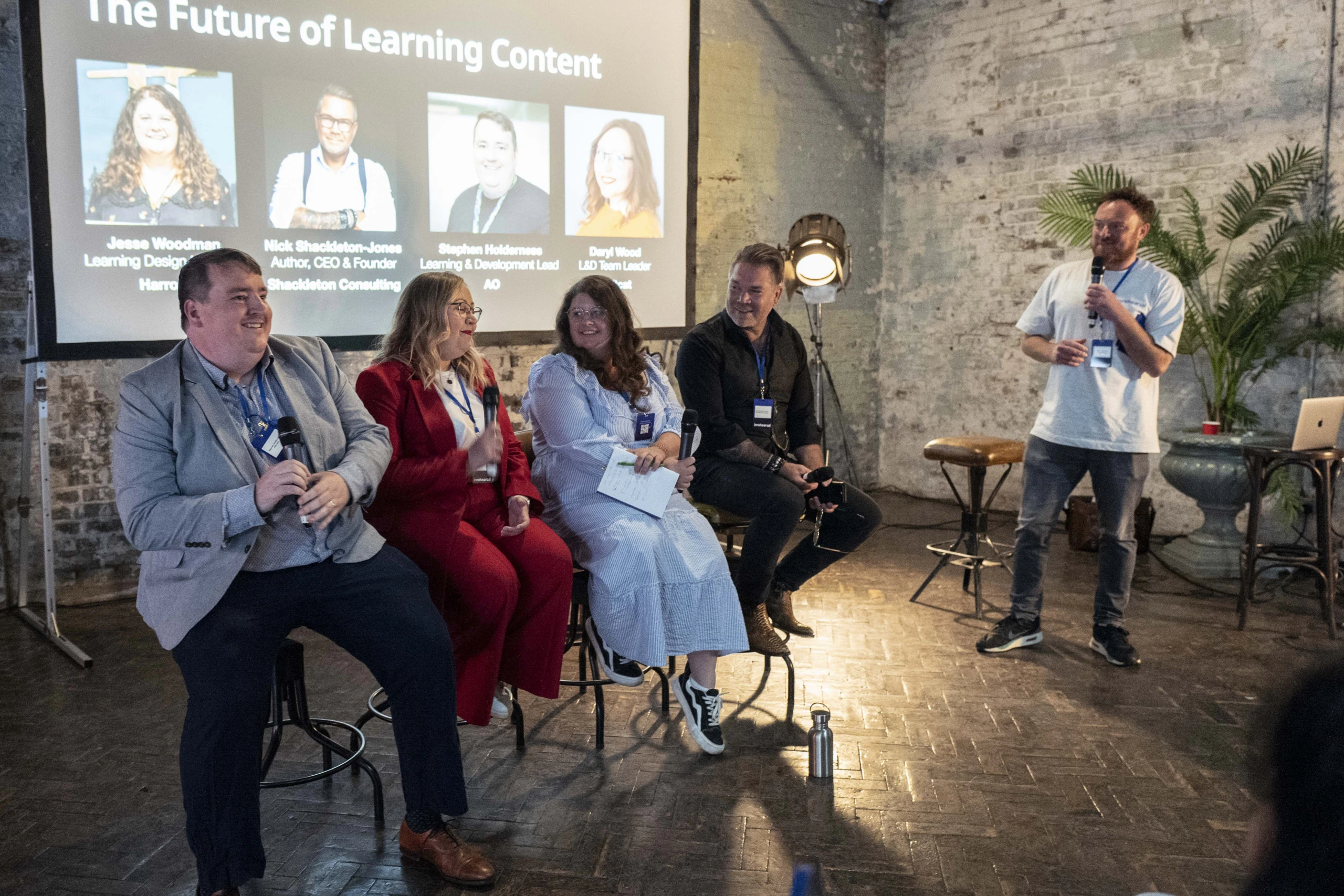
By considering what employees wanted to connect with, they were able to deliver more relevant learning.
Something they also catered for by considering the values that mattered and what’s worked before:
“With everything we’ve done historically, there has to be authenticity to it,” said Stephen. “What employees don’t like is the same person talking about 100 different subjects. That was something we wanted to avoid, and another reason why we chose inrehearsal.”
Read the full story: How AO Created a Culture of Proactive, Continual Learning Across a 3,000-Person Business
6. BT: Creating bespoke learning content with inrehearsal
At BT, building effective learning meant understanding what people actually needed across the business — now and in the future.
They channelled that into collaboration with inrehearsal, using our bespoke content production service to build highly-relevant, custom video content.
“We worked really collaboratively with Ben and the inrehearsal team to not only bring the concepts to life from an understanding perspective, but also bring examples to the foreground to help people change the way they do things at BT.” — Adam Goodsearles, Learning Partner.
This was an iterative process, with the team keen to ensure the content worked for the employees they created it for:
“We decided to build these pieces of content, check in with different people — employees and subject matter experts within BT — and then keep checking in to make sure that we adjust accordingly,” — Vicki Heaven-Chinnick, Senior Learning Partner.
Read the full story: How BT Inspired ‘Aha Moments’ in Digital Learning with inrehearsal
7. Mitie: Scaling learning across a dispersed and deskless workforce
With 65,000 employees — many of them deskless — Mitie needed learning that was accessible in the flow of work.
“The L&D team wanted to move beyond traditional formats to engage their largely field-based workforce with more modern, accessible learning.”
“So, we set out to find learning content that was bite-sized, concise, and focused, enhancing the learning experience our current content provided at the time.” — Victoria Biffin, Head of People at Mitie.
By introducing short, focused content and working closely with inrehearsal, they made learning easier to access and engage with at scale — wherever employees are.
Read the full story: How Mitie, the UK’s leading facilities management company, delivers impactful learning to 65,000 employees
8. Dalkia: Building a culture of self-directed learning
Dalkia wanted employees to use their LMS for more than compliance training. Their goal was to create a culture where people actively sought out learning for themselves.
To support this, they connected content to business initiatives, created role-specific content catalogues and used collaborative formats like watch parties to encourage engagement.
By making learning easier to discover and more relevant to individual needs, they’ve created an environment where employees actively engage with content because they want to, not because they have to.
“Before inrehearsal, we didn’t have the content to promote that self-directed learning, and now we do.” — Hazel Pursey, Head of Talent and Development, Dalkia
9. BPP: Embedding learning throughout the employee lifecycle
BPP’s Talent and Learning team are responsible for learning across the entire employee lifecycle, so they focus on creating as many entry points to inrehearsal content as possible.
This includes embedding content in welcome emails, inductions, career development pages, management programmes, workshops and HR communications.
By ensuring employees regularly encounter relevant content throughout their journey, they’ve grown usage from just 20 employees to almost 1,300 active users.
“Once they’re in there, we tend to get the good signals, and everybody loves it.” — Lee Beck, Head of Talent and Learning, BPP
When a Content Library Works…
These examples show that the value of a content library doesn’t come from the content alone — it comes from how it’s used.
When content is aligned to real skills and priorities, it becomes relevant.
When it’s embedded into everyday work and learning experiences, it gets used.
And when L&D teams are supported to apply it effectively, it starts to drive real impact.
That’s when a content library stops being a collection of resources — and becomes a practical tool for building the human skills organisations actually need.
Read our guide: The L&D Content Library: Why Most Fail & How to Fix It
See inrehearsal in Action
If you’re exploring how a content library could work in your organisation, the best way to understand it is to see it in practice.
We work with 250+ L&D teams to help them apply content in ways that drive real engagement and impact — not just access.
Book a demo using the link below and see the content for yourself.
Built for L&D,
Loved by Learners
See the most authentic library of original expert-led video content in L&D. Learn how it could work for your organisation.
FAQs on using content libraries
How do organisations use a content library in practice?
High-performing teams don’t just give employees access to content — they apply it with intention. That might mean aligning content to skills, embedding it into learning experiences, or using it to support real workplace challenges.
Can a content library work for large or deskless workforces?
Yes — but only if the content is accessible and easy to engage with in the flow of work.
Short-form, practical formats and integration into existing tools are key to making this work at scale.
What makes a content library effective?
It’s not about volume. The most effective libraries combine engaging, relevant content with strong curation, clear alignment to business priorities, and support for L&D teams to use it effectively.
How does a content library fit into an existing LMS or LXP?
A good piece of content library software should integrate into your existing ecosystem, not replace it. That means content can be accessed through the tools employees already use, reducing friction and increasing adoption.
Is a content library enough on its own to drive learning?
No. Content alone doesn’t create learning. Impact comes from how that content is used — through facilitation, discussion, real-world application and alignment to organisational goals.


