



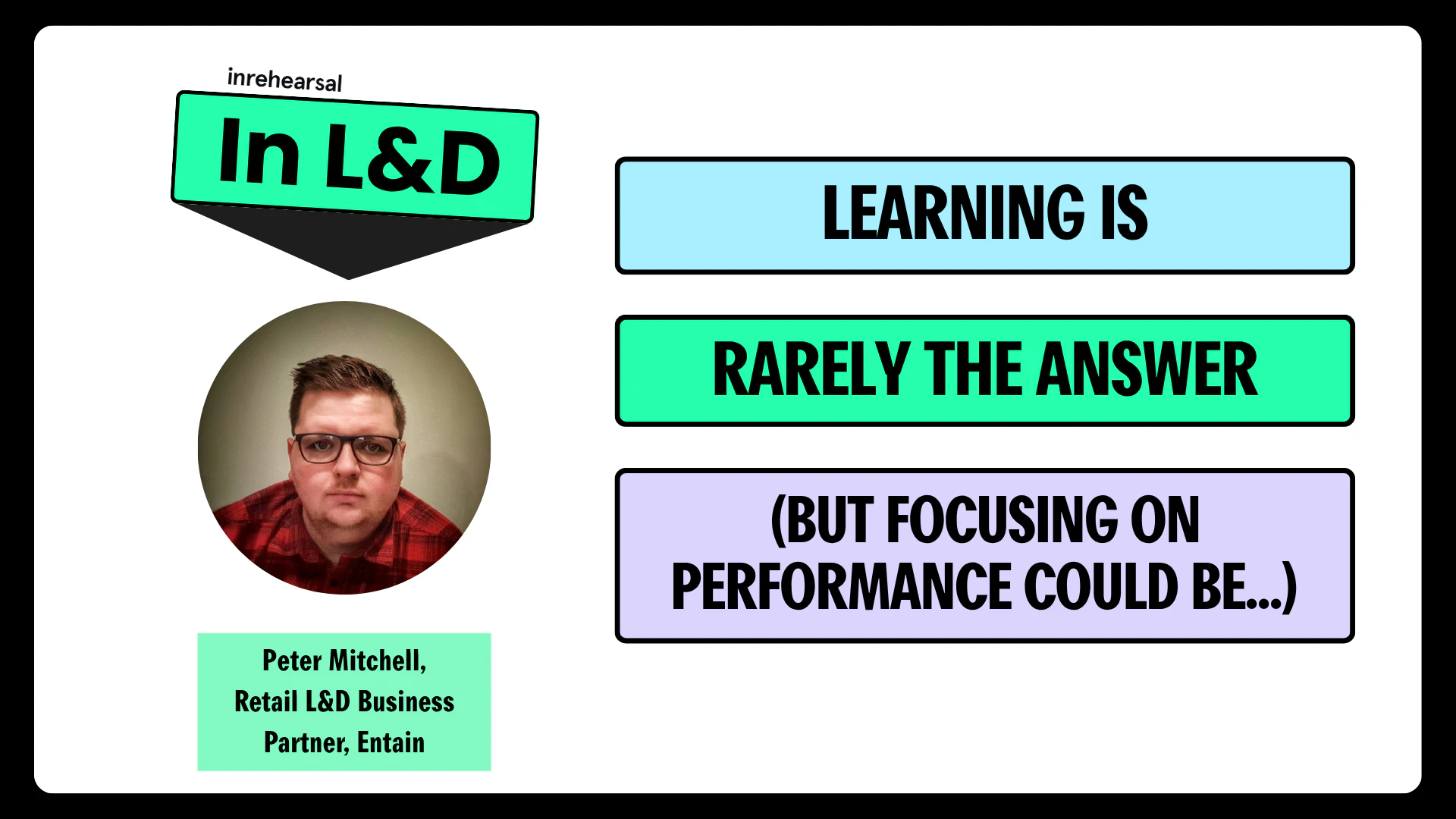
“When we think of stakeholders, they often come to us with a problem and the root cause of that problem is very rarely a knowledge gap, right? A lot of the time it’s a business problem that they want to solve.”
They want to improve revenue, improve performance, or help customer service – and that flips the conversation to solving performance problems, not just chucking learning solutions at it.
Peter Mitchell (Retail Learning & Development Business Partner at Entain) talked us through his experiences focusing on how to solve performance challenges, including:
- Examples of when learning hasn’t been the answer.
- Understanding people’s real problems and priorities.
- Why letting go of completion metrics can help.
- Getting buy-in from the business while being able to push back.
- Questions to ask when dealing with problem statements
Watch and listen to the episode
You can also listen to the episode:
On Spotify by clicking here.
On Apple Podcasts by clicking here.
Or by searching for In L&D… wherever you get your podcasts.
5 lessons on solving performance problems in L&D
1. Don’t assume a performance issue is caused by a knowledge gap
“One of the biggest mistakes that quite a lot of organisations make is assuming that when they have a performance issue, it’s because of a lack of knowledge or because the person doesn’t know what they’re doing.
“Actually, if you think of things like leadership, loads of managers know that they should give feedback. Loads of managers know that they need to do coaching more. They know that they need to have difficult conversations.
“But there’s a very big difference between skill versus will. And there’s also a very different gap between knowing and actually doing what you need to do. That’s the shift that we need to make, and that’s why for me learning is really the answer.”
2. Let go of completion metrics, focus on performance outcomes
Employees care about what’s in it for them, not learning specifically.
So if we tailor what we offer to them (rather than sending learning to everyone), we might actually see a drop in learning completion numbers… but does that matter?
“If your completion numbers drop, who cares? Actually, is it making a difference to the business performance? Are we seeing a reduction in employee relations courses? Are we seeing managers better handling and better improvement in case volumes?
“That’s what I want to see. I don’t care whether 300 people have done it. If 100 have done it and we’ve helped the business on the other end, then that’s great.”
3. Solving business problems through business partnering
Pete gave a great list of honest questions to help you understand your current relationship with stakeholders:
- Do you really understand your colleagues?
- Do you really understand the teams that you’re there to support?
- And actually what are the problems that they’re experiencing?
- Are you not just speaking to the heads that are setting the strategy?
- Are you actually getting in there and speaking to the people that are doing it right?
Pete explained how employees had said content had become more accessible in a recent survey, which was only flagged as a problem through partnering with people.
“That’s only because we had focus groups with people in our neuro-inclusivity group to say, actually, what is really bugging you? What’s annoying you?
“[And they said] well, actually you’re giving us videos, but I can’t then seek through the bar… I can’t rewind it and I don’t have access. We think we’re doing enough because we’re putting a video on but it’s still not quite there.
“So by getting in there and getting to understand the crux of it and getting really to the bottom of the problem, it’s pure business partnering.
“That for me is how you make that shift from good to much better because if you don’t understand your business challenges you are just going to keep churning out the same thing.”
4. What to ask to when speaking with stakeholders about problems
The obvious question is: what are you trying to achieve?
But Pete also recommends asking people about their team:
- What are the strengths in your team?
- Where do you think some of the challenges are with the team and the team dynamics?
“If we’re talking about things like team effectiveness or coaching, who are the people that are strong in your team? Why do you think they are outperforming? Where does the performance difference shift?
“At Vodafone, we’d deal with shop colleagues or with sales, and actually, I’d want to look at the top five performers versus the bottom and say, let’s do a cross comparison. Why are they here versus here?
“It might be something that we can’t address, like location and footfall for that shop or whatever, but actually, let’s drill into those individuals and work out some of those different challenges.”
5. Does the situation require resources over courses?
“That goes back to understanding what it is your business wants to achieve, right?”
- Is it that they want to increase revenue spend per head per customer?
- Is it that they want to see an increase in footfall?
- Is it actually coaching and performance that’s the challenge?
Pete explained that this is rarely why learning is the answer, because in this context, what they need is a resource they can access in the moment.
“If I have a customer in front of me and I’m trying to sell them something, I’m not going to go and do a 30 minute e-learning. I’m going to want the system to tell me there and then, right in front of me, exactly what I need to know for this customer…”
That’s the shift in the mindset that you have to take. It also means getting comfortable accepting when learning isn’t the answer, and thinking about what might be better at solving the problem.
Built for L&D,
Loved by Learners
See the most authentic library of original expert-led video content in L&D. Learn how it could work for your organisation.
Related articles

L&D Trends 2027: (6 Challenges And What They Mean For Your Team)
Explore 6 key L&D trends for 2026/2027, including talent velocity and manager engagement, backed by fresh industry data and expert analysis.
Read more