


About the writer: Hi, I’m Gary Stringer 👋 I’ve worked in L&D for 6 years and written L&D trend and skill reports read by tens of thousands of people every year!

This report takes you through the key workplace skills and trends for 2027, based on data from real organisations. Enjoy!
A list of trending workplace skills is useful. But knowing why people are building those skills can tell L&D teams much more.
That’s what we set out to understand with our 2027 Workplace Skills Report.
We analysed learner engagement across 200+ organisations that are using the inrehearsal content library.
We looked at video content views and completion, Live Masterclass registrations and attendance, and course consumption.
This allowed us to identify the skills consistently driving learner engagement, alongside the capabilities organisations have prioritised over the past 12 months.
But more importantly, it helped us understand what’s driving that demand.
Because how learning is discovered, what employees are trying to achieve, and how relevant a capability feels can all influence which workplace skills people choose to build.
Here are five of the biggest trends we found.
- What’s driving skill demand?
- Trending skills in 2027
- Shifting skill capabilities
- Building for career growth skills
- Formats vs employee motivation
Download and keep this with a PDF version of the 2027 Workplace Skills Report.
L&D Report
Download The 2027 Workplace Skills Report
What’s driving skill demand in 2027?
We analysed how 200+ organisations used the inrehearsal content library over the past year.
It didn’t just tell us which skills they’re prioritising, but the motivations, behaviours, campaigns and formats behind it all.
1. What’s driving skill demand?
Before looking at the most in-demand skills for 2027, there’s an important piece of context.
How employees discover learning influences what they engage with and the skills they build.
Across the data, we saw a clear difference between content people consume through self-directed learning and the learning organisations actively put in front of them.
We’ve called this organisation-led demand and learner-led demand.
Organisation-led demand
Organisations are particularly effective at creating learning demand around three things:
- Collective priorities, such as AI, DE&I and wellbeing
- Awareness moments, such as Learning at Work Week
- Business moments, such as end-of-year performance conversations
The pattern becomes particularly clear when we look at learner engagement throughout the year.
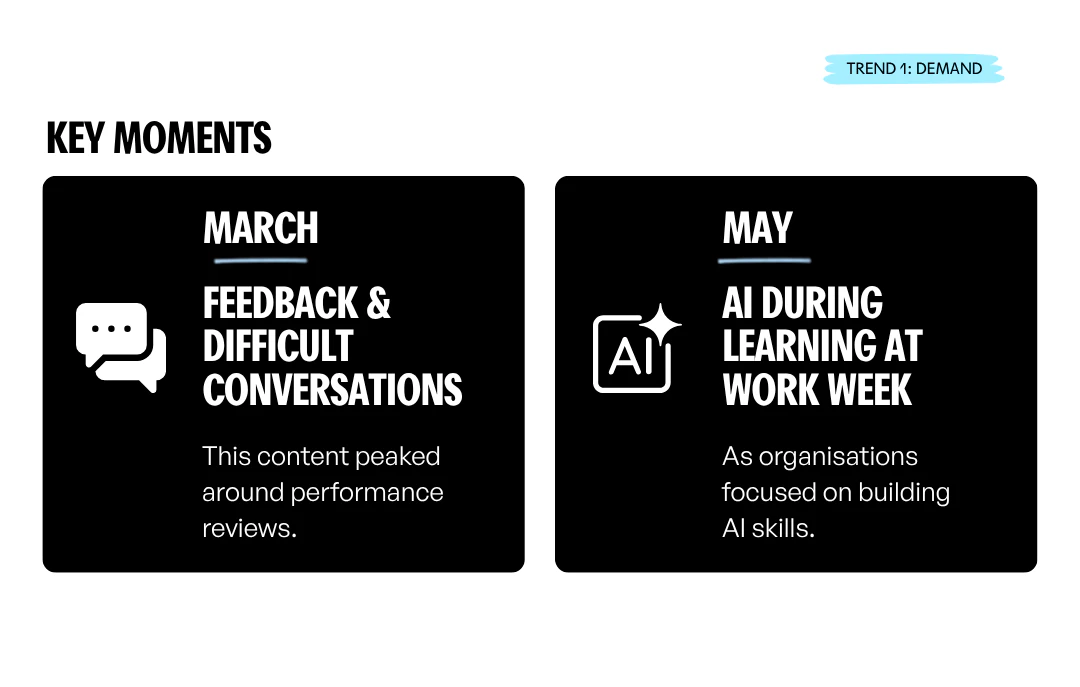
Feedback and Difficult Conversations achieved a 91% completion rate and peaked in March, around the typical period for end-of-year performance conversations.
AI achieved 90% completion and peaked during Learning at Work Week in May, when many organisations were likely prioritising this trending skill.
Learner-led demand
But that’s only one side of the picture.
When learners take a more self-directed approach and choose to invest their own time, we see a shift towards individual development.
Strategic thinking, confidence, productivity and career development feature strongly across Live Masterclass attendance, course consumption and videos with high completion rates.
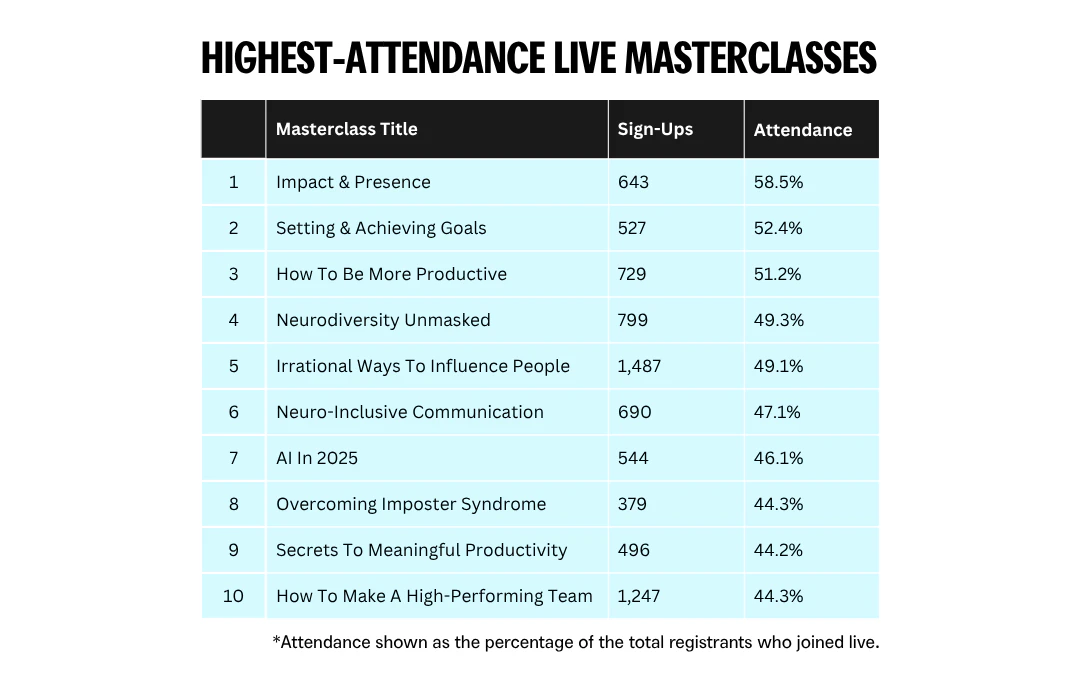
For example, Impact & Presence had the highest Live Masterclass attendance rate at 58.5%, followed by Setting & Achieving Goals at 52.4% and How to Be More Productive at 51.2%.
Unlike organisation-led learning, these topics receive consistent engagement throughout the year.
So this evidence suggests that when a capability feels personally valuable to them, they’ll make time.
Something we’ll explore in more detail later.
2. Trending skills in 2027: top themes
When we bring organisation-led and learner-led demand together and look across every learning format, seven broad workplace skill themes emerge for 2027:
| Skill theme | Core skills |
| Diversity, Equity & Inclusion (DE&I) | Inclusion, inclusive communication, allyship, neurodiversity |
| Artificial Intelligence (AI) | Understanding AI, how to use it, human skills vs AI |
| Communication & Influence | Presenting with impact, influence, stakeholder management, collaboration |
| Feedback & Difficult Conversations | Feedback, coaching, difficult conversations, performance conversations |
| Resilience, Wellbeing & Personal Effectiveness | Confidence, resilience, stress, productivity, time management |
| Strategic Thinking & Decision Making | Strategic thinking, decision making, critical thinking |
| Career Development & Self-Leadership | Professional identity, goal setting, career planning, self-reflection |
What’s interesting is the mix.
AI, DE&I and feedback & difficult conversations show the continued importance of collective capabilities that help organisations respond to change and create better working environments.
At the same time, communication & influence, resilience & personal effectiveness, strategic thinking & decision making and career development show strong appetite for individual growth.
So rather than one type of skill dominating the year ahead, the data suggests organisations need to think about both:
- The capabilities the business needs collectively
- The skills employees are personally motivated to develop.
3. Shifting skill capabilities
Beyond those trending topics and the organisational spikes in demand…
We’re seeing three capability areas emerging across learner behaviour, customer feedback and wider workplace trends.
- Communication is evolving into influence
- Thinking is becoming a competitive capability
- Career ownership is becoming a core capability
A: Influence is overtaking communication as a desired skill
Communication skills in the workplace remain consistently popular across every learning modality, but the emphasis is beginning to shift.
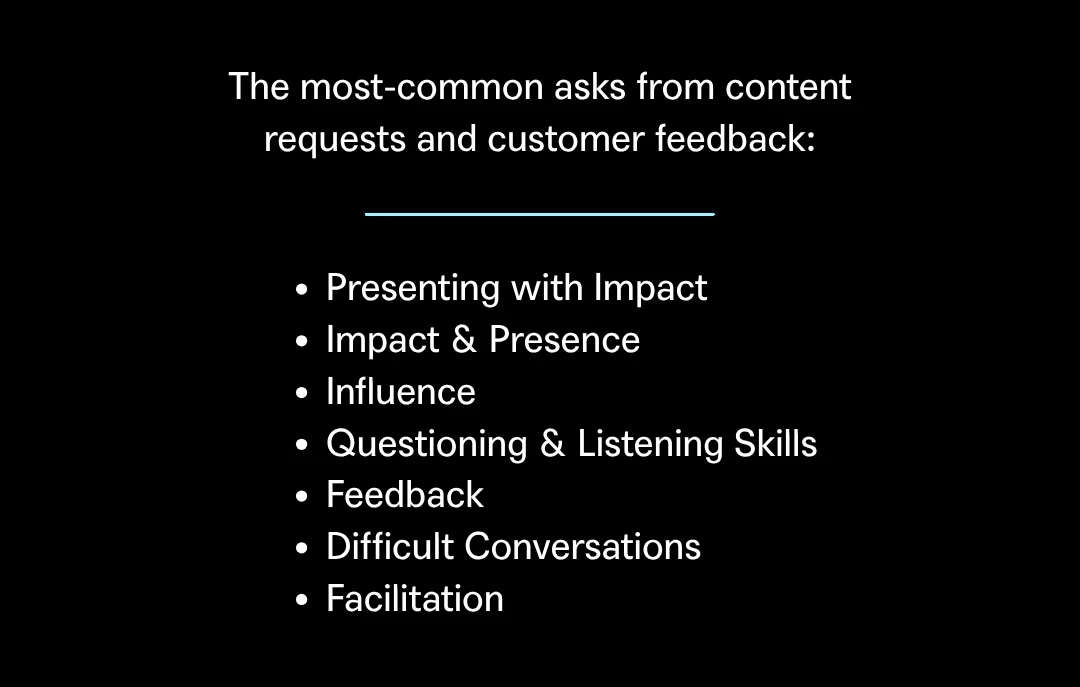
Traditional management topics such as feedback, coaching, facilitation and difficult conversations continue to perform strongly.
But outside management-specific learning, demand is increasingly centred around influence.
Employees increasingly need to collaborate across functions, secure buy-in, navigate organisational politics and influence without authority.
This is reflected in both learner behaviour and the conversations we’re having with L&D teams.
Influence, stakeholder management and managing upwards have been among the most common content requests from inrehearsal customers.
B: Thinking is becoming a competitive capability
We’re also seeing growing demand for higher-order thinking skills, with increased engagement across topics including:
- Strategic thinking
- Decision making
- Learning and failing better
As AI becomes embedded in everyday work, employees are increasingly expected to interpret information, challenge assumptions and make informed decisions.
At the same time, organisational change means decisions often have to be made quickly and with incomplete information.
That’s increasing the value placed on judgement, adaptability and critical thinking.
Strategic thinking was also one of the most requested future capability areas among inrehearsal customers, alongside working through ambiguity, prioritisation, future-focused leadership and decision making under pressure.
The implication isn’t that everyone suddenly needs to become a strategist.
It’s that the ability to think strategically is becoming useful more useful across organisations.
C: Employees are taking more ownership over their careers
The third shift is towards greater ownership of personal development.
Learners continue to engage strongly with topics including:
- Productivity
- Goal setting
- Professional identity
- Imposter syndrome
Together, these suggest employees are becoming increasingly intentional about managing their own development rather than relying solely on organisational career pathways.
And that connects to another significant change in the skills landscape.
4. Building for career growth skills, not just job roles
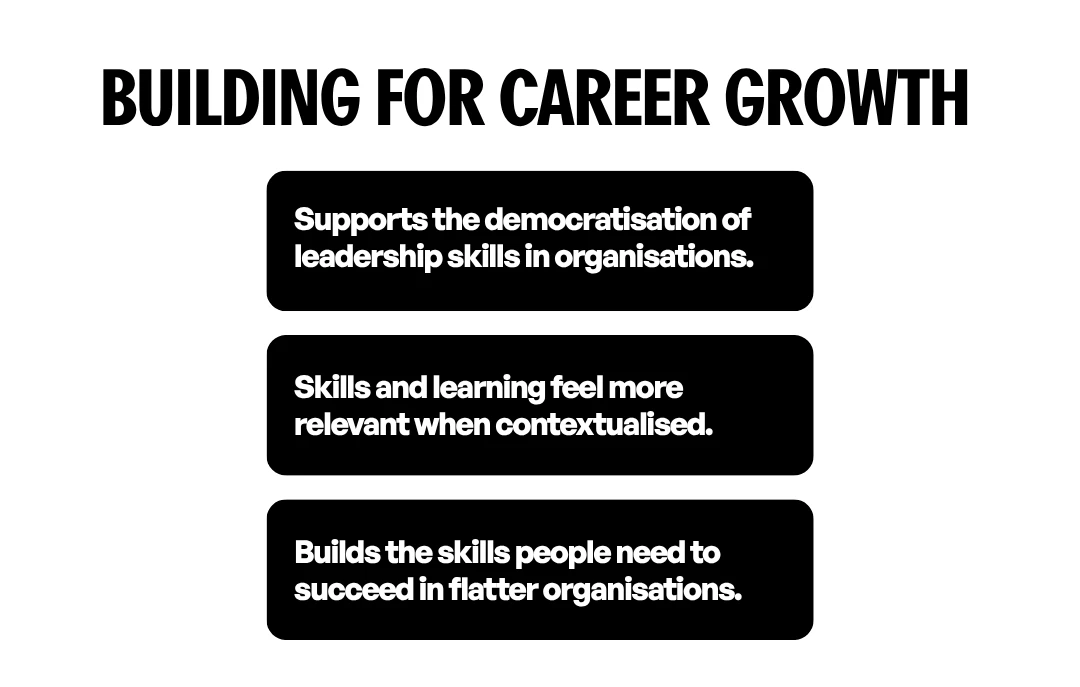
Skills traditionally associated with leadership are becoming career-growth skills.
Influence, strategic thinking, communication and decision making aren’t only useful or relevant when somebody takes a formal step into management.
As organisations become flatter and employees take greater ownership of their careers, these capabilities can be valuable at every career stage.
That changes how L&D teams might think about in-demand skills for career growth.
Rather than asking:
- Which skills does this job role require?
There’s an opportunity to also ask:
- What capabilities will help this person progress from where they are now?
- How can we help someone build the skills to communicate and influence effectively?
Building L&D in the context of careers
We’re already seeing this reflected in requests from L&D teams for learning that contextualises capabilities around different career stages and milestones.
For example:
- What does strategic thinking look like for someone early in their career compared with an experienced professional?
- How should influence develop as someone moves from individual contributor to team leader?
- Which capabilities become important as employees progress through management and senior leadership?
The underlying skill may remain the same.
The context in which somebody needs to apply it changes.
That gives L&D an opportunity to democratise capabilities traditionally reserved for leadership development while making the learning more relevant to the employee receiving it.
5. Formats vs motivation: The relevance of content matters more than length
For years, a familiar explanation for low learner engagement has been:
People don’t have time to learn.
Our data suggests it’s more complicated than that.
The inrehearsal library contains two types of course-like learning:
- E-Courses: typically 45–60 minutes to complete
- Microlearns: typically 10–15 minutes to complete
Despite that significant difference in length, the popularity and consumption is split evenly between them.
This suggests learners aren’t simply choosing the shortest option.
Instead, the relevance of the topic appears to matter more than content length or format.
When something feels useful, employees are willing to engage, but at the level of depth that best suits their need and context.
So perhaps “people don’t have time to learn” isn’t always the most useful diagnosis. And neither is the assumption that shorter content is better.
Instead, we should focus on the optionality to choose between shorter and longer-form content.
L&D should take a relevance-first approach
This doesn’t mean format doesn’t matter.
It means relevance should come first.
Learners are willing to invest in both short and long-form learning when they see clear personal value.
Whether that’s developing strategic thinking, building confidence or progressing their career.
And the most-viewed course topics reinforce that pattern:
- Time management
- Perfectionism
- Anxiety
- Confidence
- Goal setting
- Managing change
- Building professional relationships
- Stepping into management
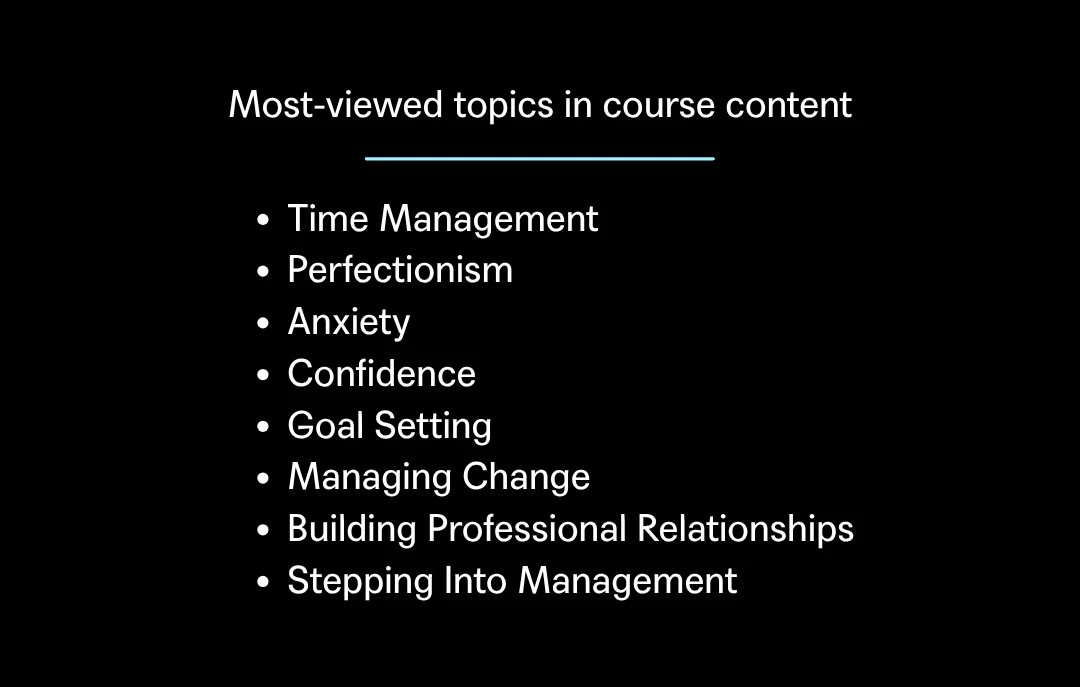
They’re all capabilities an individual can proactively develop to solve a problem or make progress.
For L&D, the opportunity is therefore to start with why a skill matters to the learner, then give them multiple ways to explore it.
Short-form content when that’s what they need. More depth when they want to go further.
Key takeaways for L&D in 2027
Don’t just follow skill demand, understand what’s driving it.
Across the data, one thing is clear:
The skills people engage with only tell us part of the story.
How learning is discovered, what employees are trying to achieve, and a capability’s relevance all influence demand.
If you take three things from this, make it these:
1. Discovery shapes demand
What organisations put in front of people matters.
Campaigns, awareness moments and business priorities can create significant learning demand, while self-directed behaviour reveals the capabilities employees are personally motivated to build.
2. Career growth is changing
Build capabilities around careers, not just roles.
Influence, strategic thinking, communication and decision making are becoming relevant across career stages, rather than simply when someone moves into leadership.
3. Relevance matters to employees
People make time for learning they value.
Rather than assuming shorter always means better, start with what motivates the learner and give them different ways to engage with a capability.
The opportunity in 2027 isn’t to chase the next trending skill. It’s to understand why people want to build it.
Frequently asked questions on 2027 workplace skills
What skills will be the most important in the workplace in 2027?
Our learner engagement data points to seven important workplace skill themes for 2027:
- DE&I
- AI
- Communication & influence
- Feedback & difficult conversations
- Resilience & personal effectiveness
- Strategic thinking & decision making
- Career development & self-leadership
Within those themes, skills such as influence, critical thinking, confidence, productivity and career planning are particularly relevant as employees navigate changing workplaces and take greater ownership of their development.
What’s driving demand for new workplace skills?
There isn’t one source of skill demand. Our data shows both organisation-led demand and learner-led demand.
Organisations can create spikes in engagement through campaigns, collective priorities and important business moments, while self-directed learning reveals capabilities employees are personally motivated to build.
Understanding both gives L&D teams a more complete picture than simply looking at a list of trending skills.
How is career development changing in the workplace?
Career development is becoming less closely tied to formal job titles and management progression.
Capabilities traditionally associated with leadership (including influence, strategic thinking, communication and decision making) are increasingly valuable across different career stages.
For L&D teams, that creates an opportunity to contextualise skill development around where someone is in their career, rather than reserving particular capabilities for people who already hold leadership roles.
Built for L&D,
Loved by Learners
See the most authentic library of original expert-led video content in L&D. Learn how it could work for your organisation.
Related articles
L&D Trends 2027: (6 Challenges And What They Mean For Your Team)
Explore 6 key L&D trends for 2026/2027, including talent velocity and manager engagement, backed by fresh industry data and expert analysis.
Read more