


L&D should do this, that and the other – we hear it a lot.
But is clinging on to what we should do getting in the way of us doing some really great work?
“The shoulds don’t always harmonise with the lived reality of what it’s like to go to work every day.
“And in my experience from what I’ve seen, that results not only in sometimes a hampered ability to do our job, but it sets ourselves up for feeling frustrated, feeling unappreciated, feeling undervalued. That isn’t helpful for us, and it’s not helpful for the organisation.”
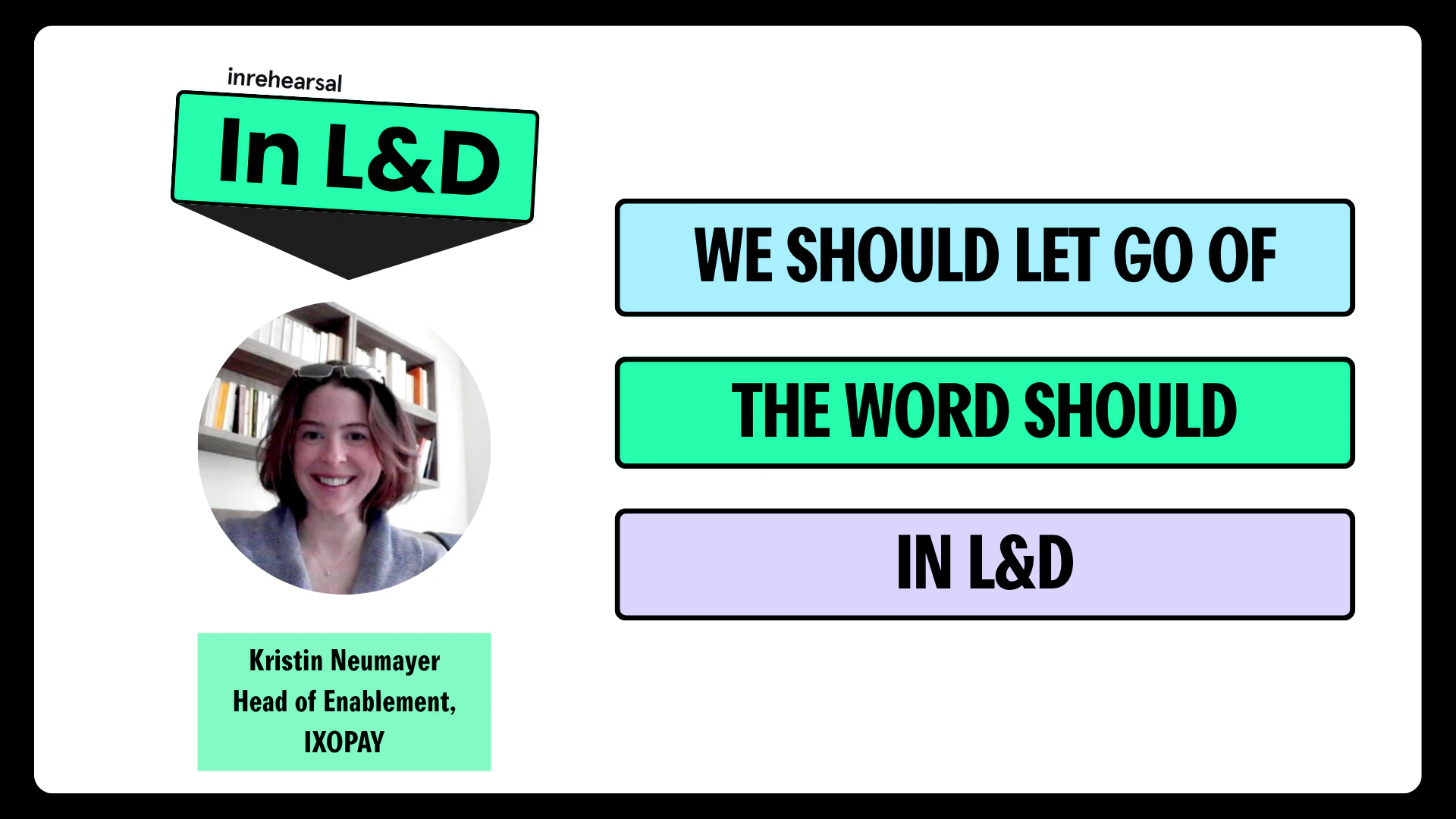
Kristin Neumayer (Head of Enablement at IXOPAY) talked us through the mindset needed to let go of should, what happens when you do, and how to approach problems once you have.
“I have become busier and more productive than I ever have in previous jobs once I let go of what I should do and telling other people how they should interact with me.”
You can connect with Kristin here.
Watch and listen to the episode
You can also listen to the episode:
On Spotify by clicking here.
On Apple Podcasts by clicking here.
Or by searching for In L&D… wherever you get your podcasts.
4 lessons on letting go of ‘the shoulds’ in L&D
1. A should mindset leads to focus on what others should be doing
When we use the word ‘should’ in L&D, Kristin described this as shorthand for “the world isn’t behaving as I want it to.”
“Our lives are full of these shoulds that we’re really expressing disappointment in how we’re experiencing reality rather than thinking about, have I set myself up for feeling this way?”
This means letting go of the white-knuckled grip we have on the word should and phrases like:
- I need a seat at the table because nobody is listening to me and they should.
- I need to be brought in at the beginning of an initiative because what I’m designing isn’t fitting in this mold and it should.
“It just becomes what other people should be doing as opposed to what can we do if we let go of that should a little bit.”
2. Letting go of should means you can be of service to others
“When you let go of should, the whole world opens up.”
Why? Because you’re no longer taking the expert position and assuming you know how something should be done…
“If we let go of everything we can’t, won’t, or aren’t supposed to be doing, then all of a sudden we can be of service, we become the learners and everybody needs a hand.
“I have become busier and more productive than I ever have in previous jobs once I let go of what I should do and telling other people how they should interact with me.”
“And instead just showing up and saying, here I am, how can I be of service? How can I help? How can I pitch in? How can I enable you to do your job in the most efficient and effective way possible? And that’s it. Everything opens up.”
3. Nobody is going to care about L&D as much as you do
Not because they’re indifferent, but because they have other priorities and things they’re passionate about.
“Anything that you’re passionate about that you really care about, no one cares more than you. And that’s okay.”
So if you’re able to put what matters to someone else first, you can become much more effective.
“But how much more effective am I as learning and development or enablement if I can go to somebody else and say, what’s important to you? Talk to me about what’s got you stressed out this week. What numbers aren’t you hitting? What does that mean for your team?…
“If I am really curious about what matters to other people, I become so much more effective at my job.
4. Be grateful for problems (and don’t ask what the real problem is too much).
We hear a lot about L&D teams needing to push back and ask: what’s the real problem?
But can this actually be a real problem? Because the people who come to us with problems often know them better…
“The person who knows [the problem] best is probably the person who’s living in it.
“They might not know why it’s happening and they might not know how to fix it, but they know there’s a problem because otherwise they wouldn’t be coming to you. So we are also grateful for problems.”
“They are much closer in the everyday and their area of expertise and the focus of their energies to the subject matter experts than we are…
“So the more we say, is it really my problem, or what’s your problem? Then we’re isolating ourselves from the very people that we say we want to help and build relationships with.”
Built for L&D,
Loved by Learners
See the most authentic library of original expert-led video content in L&D. Learn how it could work for your organisation.
Related articles
L&D Trends 2027: (6 Challenges And What They Mean For Your Team)
Explore 6 key L&D trends for 2026/2027, including talent velocity and manager engagement, backed by fresh industry data and expert analysis.
Read more