


- Learning And Development
New L&D Role Playbook: Do this in your first 6 months
19 Aug 2026 By
Gary Stringer
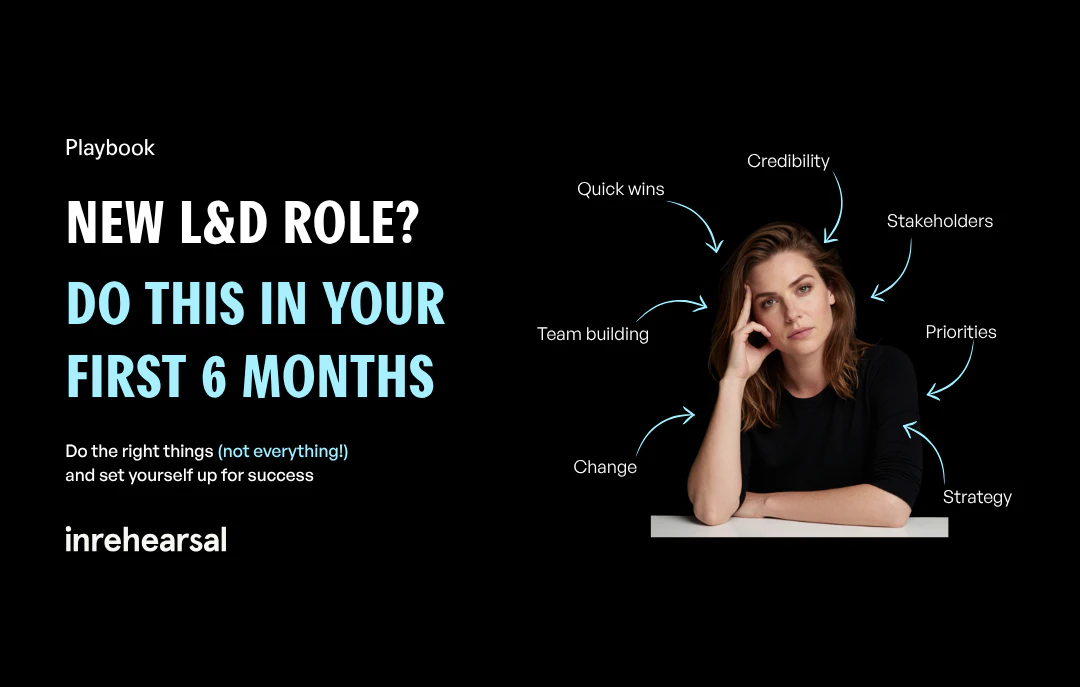
Every new L&D role comes with pressure.
You want to hit the ground running… but you don’t want to end up doing the wrong things.
You want to make a good impression… but saying yes to everything might actually give the wrong impression.
You want to show impact… but what’s really possible in those early months?
There will be noise. The calendar will fill up. The to-do list will grow.
So what you need are practical, realistic actions you can take to get the foundations right (with the limited time and capacity at your disposal).
And that doesn’t mean another generic 30-60-90 day plan.
Instead, think of your first few months as a sequence of steps to progress through and build a foundation for long-term success:
- Understand the business
- Uncover and prioritise the right problems
- Build credibility early
- Understand your team
- Manage change
- Create and communicate your strategy
- Measure what matters
Let’s get into it.
Download the playbook as a PDF
Get your playbook,
start making progress.
Inside the playbook, you’ll work through:
- Understanding the business
- Uncovering prioritising problems
- Building credibility early
- Understanding your team
- Managing change
- Communicating your strategy
- Measuring what matters
With frameworks and advice from industry experts, real learning professionals, and lessons from 250+ L&D teams.
1. Understand the business before changing it
The easiest way to end up doing the wrong things is to act before understanding the business.
Ultimately, you can do this effectively in three parts.
Find and understand the strategy
The typical advice of listen and observe is OK here, but not hugely helpful given you’re both new to the business and needing to ramp up fast.
So what you should be asking is:
Where can I learn the most, in the least amount of time?
Strategy decks, leadership updates and internal reports are a goldmine for the vision.
Company meetings and all-hands — recorded and live — are where it’s articulated.
With whatever you can get your hands on, try to distil it into three statements:
- The business is trying to…
- It plans to do that by…
- Success will be measured by…
If there’s nothing you can already use, those questions will also be helpful in stakeholder conversations.
Understand the current reality
Understanding where the business is going is only half the picture. You also need to understand where it is right now.
There are three areas worth getting your head around:
| What to understand | Questions to ask | Where to look |
| Commercial performance | How does the business make money? Which products and services matter most? How has it performed recently? | Annual reports, financial updates, sales dashboards |
| Operational reality | How does the business actually work? How are teams structured? What does the customer journey look like? | Org charts, process docs, team meetings, customer data |
| Employee sentiment | How are people feeling? What are they excited or concerned about? How do they currently view development? | Employee surveys, town halls, internal comms, stakeholder conversation |
You don’t need to become an expert in everything.
You’re looking for enough context to have informed conversations and build an understanding before taking action.
Understand who you need to work with
It’s tempting to jump straight into stakeholder meetings and mapping on day one.
But by waiting until now, you’ll have an understanding of where the business is and where it wants to be.
This should give you a steer on which teams you’ll need to work with. Now you need to identify the right people in those teams.
And don’t simply go off job titles and seniority.
Think about the different relationships you need:
- Sources of insight: Who understands this area better than anyone?
- Influencers: Who shapes decisions and opinions?
- Intermediaries: Who can connect you with people you should know?
- Implementers: Who actually does this work every day?
The aim isn’t to fill your calendar with as many stakeholder meetings as possible. It’s to speak to the right people, with enough context to ask better questions.
2. Uncover and prioritise the right problems
By now, we’ll have surfaced a mix of aspirations and frustrations.
The next step is all about understanding the blockers to reaching those goals and the reasons behind current issues.
It’s crucial that we remain in problem-discovery mode, and not solution mode here.
If surveys show that employees don’t feel development is being invested in, we can’t just assume there’s a problem with the current L&D offering.
It could be an awareness issue.
If our sales target is incredibly ambitious, we also can’t assume training is what’s needed to get there.
We are taking the context from part one and layering on top of it as we uncover blockers to our goals and causes for our problems.
Ask three simple questions
With our context, we can ask three simple questions to get the information we need without overwhelming the people we’re speaking to (or ourselves with too many responses).
- What are you trying to achieve? Links back to strategy.
- What’s getting in the way? Links back to context.
- Why is that happening? Gets us closer to the root cause.
Three questions won’t magically diagnose every performance problem, of course.
Sometimes, we need to dig deeper.
Get beyond the learning request
One useful way to do that is through the COM-B model.
For a Behaviour (B) to happen, people need the Capability (C) and Opportunity (O) to perform it, and enough Motivation (M) to do it rather than a competing behaviour.
Let’s say someone tells you there’s a time-management problem.
Before commissioning time-management training, ask:
Capability: Do people actually have the knowledge and skills to manage their time effectively?
If they do:
Opportunity: Does the environment allow them to? If it’s a particularly busy period or workloads are unrealistic, that might be limiting them.
And then:
Motivation: Do people understand what’s expected of them? Is there sufficient motivation and accountability to change the behaviour?
What started as “people need time-management training” might turn out to be a very different problem.
And that’s exactly why staying in problem-discovery mode matters.
Watch out for questioning and listening bias
There’s another trap when you’re having these conversations.
You can enter them looking for evidence that supports what you already believe.
Raul Aparici calls this questioning and listening bias.
It can show up in a few ways:
- Asking questions that confirm your assumptions rather than challenge them.
- Only listening to information that interests you.
- Giving more weight to opinions that feel familiar or align with your own.
Your goal isn’t to prove you’re right.
It’s to understand what’s really happening.
Prioritise where you can add the most value
After speaking to stakeholders, you’ll probably have a long list of blockers and opportunities.
You can’t solve them all.
So when deciding where to focus, ask yourself:
- Where can I add the most value?
- Which problem would have the biggest impact if solved?
- Should I be the person working on this, or is someone else better placed?
It’s easy to prioritise work based on urgency, perceived importance or who asked for it.
Instead, focus on the activities where your time and expertise can create the greatest value.
Because solving a problem isn’t the goal.
Solving the right problems is.
3. Build credibility early
You don’t need to solve every problem in your first few months to build credibility.
By this point, you’ve taken the time to understand the business, uncover the right problems and identify where L&D can add the most value.
Now it’s about helping other people see that value too.
There are three things to focus on:
- Understand how L&D is currently perceived.
- Position L&D around the value it brings.
- Build credibility through consistent communication.
Understand how L&D is currently perceived
Hopefully, you’ll have some internal survey data that gives you an indication of what people think of L&D.
But there are three simple questions that can help you understand what people think L&D does, what it currently does well and what could be improved:
- What do you think L&D is here to do in the business?
- What has helped you most in improving your practice?
- What’s the one thing I could change that would make the biggest difference to you?
If you’re speaking with managers, it may also be worth asking about the capabilities they think their team needs.
Once you understand the current perception of L&D, you’re in a much better position to shape what you want that perception to become.
Position L&D around the value it brings
Very few people care about learning for the sake of learning.
They care about what’s in it for them.
What matters is making their job easier, solving problems and improving performance.
So when you communicate your L&D efforts, don’t just tell people about the learning. Communicate the value it can create for them.
Ask yourself:
- Why should this matter to this audience?
- What’s in it for them?
- How will this help them achieve something they care about?
As Hannah Clark, Founder of Talia Marketing, puts it:
“It’s a real task of empathy to sit down and think: what is in it for them, not for the business, not for you as an L&D professional. What is in it for the employee?”
Build credibility through consistent communication
If you want to raise awareness of L&D or change how it’s perceived, one email or launch campaign probably isn’t going to do it.
You need consistent communication that reinforces the value L&D brings.
And L&D doesn’t always need to be the one telling that story.
Managers and employees who’ve benefited from your work can be some of your strongest advocates because their experiences demonstrate the value you’re trying to communicate.
Think about how you can consistently share:
- The business problems L&D is helping to solve.
- The value it’s creating for employees and the organisation.
- Stories from the people who’ve experienced that impact.
Over time, those messages help people understand not just what L&D does, but why it matters.
4. Understand your team
So far, you’ve focused on understanding the business and the challenges you need to solve.
Now it’s time to understand the people you’ll work with most closely.
For some, that’ll be a large L&D team. For others, it might be one or two colleagues across HR, People or Talent.
You may even be the only person responsible for learning.
Whatever your situation, the same principle applies:
Before changing how people work together, take time to understand their current reality, their strengths and how they work best.
Understand your team’s current reality
Every team has its own way of working.
Some thrive on structure and planning. Others are more collaborative and informal. Some may be energised by change, while others are still adapting to recent events.
Before introducing new ways of working, start by observing:
- How does the team communicate?
- How are decisions made?
- What’s working well today?
- Where do people seem frustrated or stuck?
The goal isn’t to identify everything that needs to change.
It’s to understand the environment you’re stepping into before deciding what should change — and use that understanding to agree how you’ll work together moving forward.
Build on strengths to create early momentum
In your first few months, you’re often better served by building on what’s already working.
Understanding the strengths of the people around you can help you delegate more effectively, build confidence and create early wins for both individuals and the wider team.
Rather than asking “What needs fixing?”, ask:
- What does each person naturally do well?
- What strengths does the team already have?
- How could we create more opportunities for people to use those strengths?
By working with people’s natural strengths, you’re more likely to build momentum than by asking everyone to work against them.
As L&D consultant Susie Heale puts it:
“Strengths are a little bit like swimming with the tide. You’re working with what’s naturally there, rather than against it.”
And because you’ve already identified the business problems that matter most, you can start matching those strengths to the challenges where they can create the most value.
5. Manage change effectively
By this point, you’ll probably have spotted plenty of things you want to change.
But how you approach change matters just as much as what you change.
Because in your first few months, there might be a gap between your level of credibility and the amount of change you want to drive.
What you don’t want to do: make change overwhelming, disruptive and something that damages your internal brand.
What you do want to do: make change manageable, communicate well and boost your credibility.
The good news is that you’ve already laid some of the foundations.
You’ve taken the time to understand the business, identify the right problems to solve, build relationships and understand the people around you.
Now it’s about bringing them with you.
Expect different responses to change
People don’t experience change in the same way.
Some people will embrace it. Others will need more time. And people can move between confidence, uncertainty and frustration as the change unfolds.
Instead of expecting everyone to move at the same pace, focus on understanding where people are and what they need to move forward.
Ask yourself:
- Who’s ready for this change?
- Who needs more clarity or reassurance?
- What conversations could help people move forward?
- Am I expecting too much, too soon?
Understanding those different responses can help you adapt how you communicate and support people through the change, rather than assuming resistance means they simply don’t want it.
Make change easy to adopt
Even when people understand why change is happening, that doesn’t mean it’ll happen.
New processes, habits and ways of working can feel like extra effort — especially when people are busy.
So rather than focusing all your energy on convincing people, look at the environment around them too.
Ask:
- What’s making this change harder than it needs to be?
- What barriers can I remove?
- How can I make the first step as simple as possible?
- How can I make the new behaviour easier to stick?
As behaviour science, culture and L&D expert Matt Furness explains:
“If you want change to stick, you also need to look at the environment and the systems around people.”
Making change easier to adopt can be just as important as getting people to buy into it in the first place.
6. Create and communicate your strategy
By this point, you’ve done a lot of the groundwork for your L&D strategy.
You understand where the business is going, where it is now, the problems getting in the way and where L&D can add the most value.
Now you need to bring that thinking together into a clear direction — and make sure people understand it.
Build your strategy with people, not for them
One of the biggest mistakes you can make is disappearing for a few weeks before returning with a finished strategy.
Instead, treat your strategy as something that evolves through conversations.
You’ve already spent time listening to stakeholders, understanding business priorities and identifying where L&D can make the biggest impact.
As you bring those insights together, involve the people who’ll help make the strategy successful.
Ask yourself:
- Have I reflected the priorities I’ve heard from the business?
- Have I involved the people who’ll be responsible for making this successful?
- Have I challenged my own assumptions?
- Am I focusing on the few things that will make the biggest difference?
The aim isn’t to build a strategy that belongs to L&D.
It’s to build one that people across the business can understand, contribute to and get behind.
Communicate your strategy with clarity
Creating your strategy is only half the job.
The people who influence its success need to understand it well enough to act on it.
That doesn’t mean sharing every detail, metric or slide from your strategy deck.
It means making the important things clear:
- Why are we doing this?
- What are we prioritising?
- What does that mean for the people involved?
Dr Max McKeown points to McDonald’s famous one-page strategy as an example.
The important thing wasn’t that the strategy fitted onto a single page. It was that people throughout the organisation could understand why they were doing what they were doing.
As Max puts it:
“Strategy has to be turned into action.”
If people can’t understand your strategy, it’s going to be pretty difficult for them to help deliver it.
Share a roadmap of your plans and priorities
There’s another reality you’ll probably be facing by now:
You’ve uncovered far more problems than you can solve at once.
That doesn’t mean you have to ignore them.
Ryan Meyer, Senior Talent and Development Manager at BKL, suggests using a roadmap to show people what’s coming.
Maybe you’ve heard recurring pain points around induction, leadership development and manager capability.
Trying to tackle all three immediately probably means you won’t give any of them the attention they deserve.
A roadmap lets you prioritise while still showing people that you’ve listened.
Essentially:
I’ve heard you. I’m thinking about this. It’s coming.
It helps manage expectations, gives people visibility and demonstrates that there’s a plan behind the decisions you’re making.
7. Measure what matters
By this point, you’ve understood the business, identified the right problems, built credibility, understood your team, managed change and created a strategy.
Now comes the question L&D has historically found a little tricky:
How do you know if any of it is working?
The temptation is to jump straight to big business outcomes.
Revenue. Retention. Productivity. Performance.
But measuring the impact of learning is rarely that straightforward.
Be realistic about what learning can influence
Francesca Jones, L&D Lead at Macmillan Cancer Support, uses a useful analogy: learning is one domino in a much longer chain.
Learning might help someone build a skill or change a behaviour. But what happens after that can depend on policies, systems, managers and the wider environment around them.
So rather than trying to attribute an eventual business outcome entirely to learning, think about which domino you’re actually trying to move.
And do that before the learning begins.
What are you trying to change? What evidence would tell you it has changed? And which outcomes can you realistically attribute to the learning?
Evaluation should be part of the design from the beginning — not something we retrospectively try to bolt on.
Be pragmatic about the data
Not every learning initiative needs an elaborate measurement framework.
Kim Rodrigues, Learning Strategy and Impact Lead at NatWest Group, makes the point that traditional measures like completion rates and happy sheets still have their place.
The important thing is understanding what those measures can — and can’t — tell you, and matching the evidence you collect to the question you’re trying to answer.
Sometimes you’ll need deeper evidence of behaviour or performance change.
Sometimes a simpler measure is enough.
The goal isn’t to collect as much data as possible. It’s to collect the data that helps you understand whether you’re making progress.
Don’t underestimate small improvements
Sarah Wood, Senior Revenue Enablement Specialist at Kinaxis, offers another useful perspective.
When learning reaches hundreds of people, even a small improvement can create a significant impact at scale.
So don’t feel like you need to boil the ocean.
Pick something you want to change. Track it.
If it doesn’t work, bin it or learn from it.
If it does, build on it.
Small movements across a large population can be far more meaningful than trying to prove that one learning intervention transformed an entire business.
Measure honestly, learn and improve
Taken together, the three perspectives give us a much more realistic approach to measurement:
- Francesca: Be clear about the part of the impact chain learning can realistically influence.
- Kim: Be pragmatic about the evidence you need to demonstrate it.
- Sarah: Don’t underestimate the value of small improvements at scale.
You don’t need to prove L&D caused everything that happened afterwards.
Work out what you’re trying to move. Measure whether you moved it. Learn from what happened. Then build from there.
The first 6 months aren’t about doing everything…
It’s tempting to spend those first few months ‘proving yourself’ by doing more.
More meetings. More initiatives.
More learning. More change.
But the most successful L&D leaders don’t build credibility by moving fastest.
They build it by understanding the business, solving the right problems and helping others succeed.
That’s what these first few months are really about.
Not proving your value overnight.
Building the foundations that allow you to create value for the months and years to come.
Get your playbook,
start making progress.
Inside the playbook, you’ll work through:
- Understanding the business
- Uncovering prioritising problems
- Building credibility early
- Understanding your team
- Managing change
- Communicating your strategy
- Measuring what matters
With frameworks and advice from industry experts, real learning professionals, and lessons from 250+ L&D teams.
Related articles
L&D Trends 2027: (6 Challenges And What They Mean For Your Team)
Explore 6 key L&D trends for 2026/2027, including talent velocity and manager engagement, backed by fresh industry data and expert analysis.
Read more