


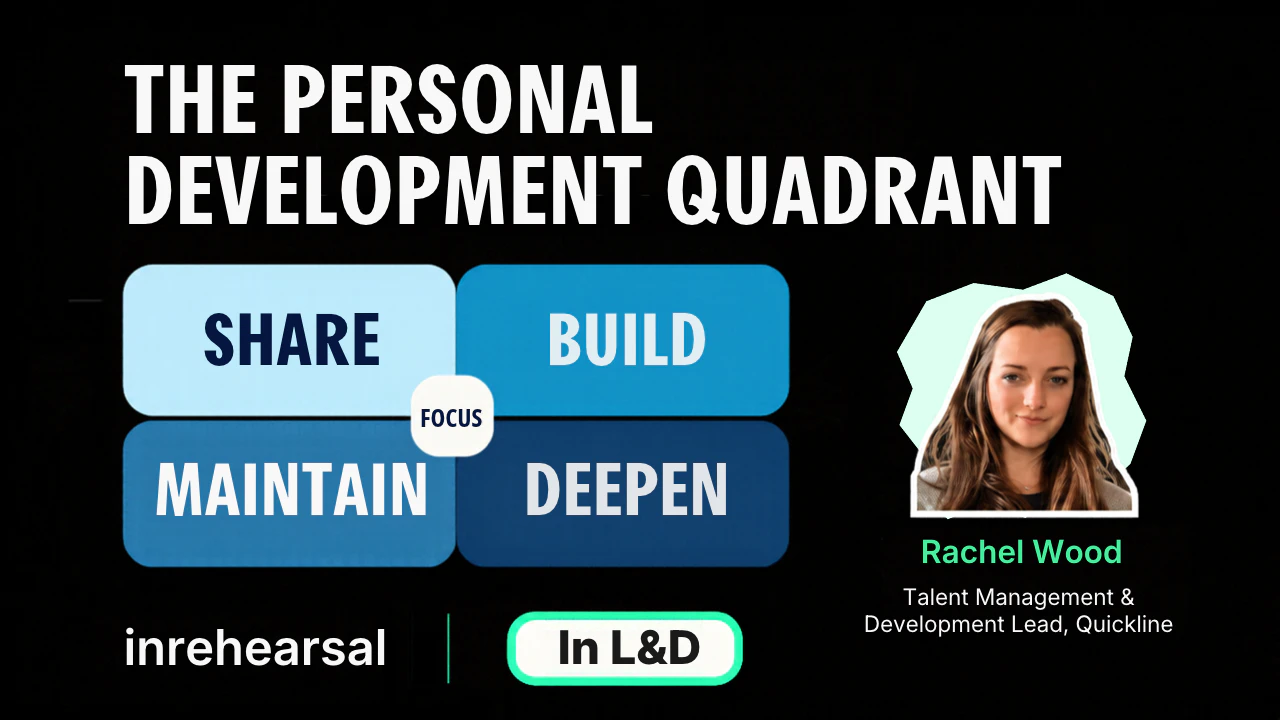
Development frameworks can be tricky. Too complicated. You don’t know where to start. They get filled in and stuck in a draw…
That’s why Rachel Wood (Talent Management and Development Lead at Quickline) developed the Personal Development Quadrant.
Four boxes that connect development to your work, what’s going on in your life and your current energy level or capacity.
Rachel took us through how to use the framework, the four quadrants, and how she’s used this in her L&D roles.
Timestamps
Intro 0:00
Rachel’s background 1:31
Framework overview 2:16
How the formula works 5:22
Why she started the framework 10:38
Maintain 13:50
Build 18:29
Deepen 25:34
Share 29:32
What 12 months should look like 35:35
How this helps L&D? 38:24
Where to start? 41:10
Watch and listen to the episode
You can also listen to the episode:
On Spotify by clicking here.
On Apple Podcasts by clicking here.
Or by searching for In L&D… wherever you get your podcasts.
Why Rachel Developed The Personal Development Quadrant
This was born out of a need to help people build a culture around what development actually is, what it means to them as an individual.
One of the questions I get asked regularly in a number of different places that I’ve worked is, I’m looking at a blank piece of paper, how do I even start writing a plan?
Or I don’t need development, or I can’t think of what I could do to be developing in any sort of way.
And the formula was born out of a place of how do we anchor this to anything?
It’s not just a piece of paper that somebody fills out one time in a conversation and then it gets stuck in a system or it gets stuck on a filing cabinet somewhere.
It’s actually, where does this hook into my journey in a workplace or personally?
So it’s based around sort of four key elements of where development activity actually happens in your working journey.
The 4 quadrants explained
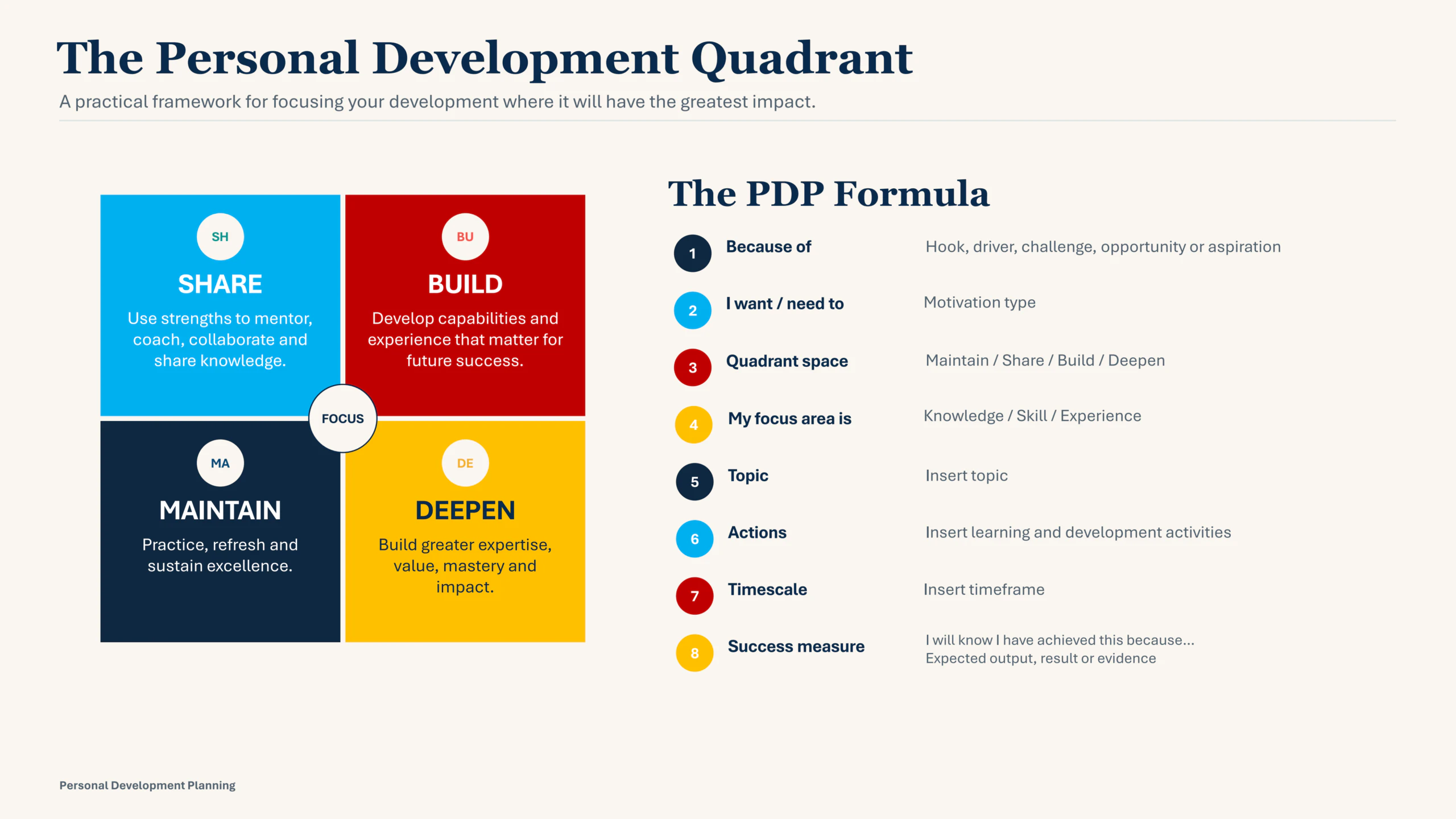
You don’t have to have all four at any given time. And I want to stress that significantly. But the one that you will always have is maintain, so we’ll start there.
1. Maintain
Maintaining doesn’t mean ticking boxes, but it does mean maintaining excellence in the things you’re doing and sustaining a level of competence, credibility, and excellence in the performance of the thing that you’re already good at.
An example of someone who might sit in maintain:
When someone’s been on parental or adoption leave, and they’re asked to build a development plan when they come back. Because so much of their life has changed, and that influences the capacity they have for development.
“I use the word energy a lot when I talk about development and this framework because the amount of energy that you need in maintain is very different to the amount of energy that you need in build.
“So we had people come back off parental leave and they were saying to us, I have no capacity for anything else. I don’t want to develop right now. I just want to relearn how to do my job and be great at it – so maintain is the box they’re going to sit in.”
Example activities for maintain:
“This is about you reconnecting with the things that you’re great at. So this could be some really low-level, low-intensity things that you’re doing, like listening to a podcast on a topic that you already know, right?
“It’s not about going through the motions. You are still trying to maintain excellence in what you’re doing but perhaps it’s something that you don’t have to stretch yourself to.”
2. Share
Sharing is a unique part of development. There are skills that you learn in order to share the things that you are uniquely good at with others.
But also in the process of sharing, other people are gaining from you. It is a space where you have to understand the gravity that comes with sharing with other people. Because there is a responsibility to share well.
This is not just about sharing your opinion with other people. This is about sharing real life experience. Mentorship sits in this box. But it takes thoughtfulness and effort to be a great mentor with people.
Share is a really special place to be in, particularly for those people who don’t think that they have anything else to learn. People who are preparing to leave the workforce, where they’re like, I don’t want to learn new things.
A lot of their skillset now sits in this: I’m in a position now where actually I can’t learn anything new in my area, in my specialism and my expertise, but what I can do is I can share it with other people.
3. Build
This is the space that everybody thinks of when they think of development. It’s the new and shiny stuff.
And the reason that I split out these different areas is because what I was seeing and identifying in people is that they always went to build. They all want to do all of the new stuff.
And that’s great, because everybody needs to learn new things. But what the quadrant actually helped people do was:
1. Zoom out a little bit and be like, what is it I’m actually trying to achieve here?
2. Be able to recognise how much time and energy we spend in each place.
Build takes the most amount of energy because you are learning and experiencing new things and trying things out new in environments that you’ve never been in before.
Or maybe it’s a familiar environment but you’re taking on additional responsibility. Build is really a place of discomfort.
Example of people who normally sit in build: Early careers
New starters in your organisation, whether they’re early careers, whether they’re brand new, they spend a huge amount of time of their onboarding in that build space because they’re trying to understand you as a business.
Give them the space to do that well because this is brand new information for them. It is not, ‘well, we inducted them for a day, now they’re off on the tools and they’re not meeting their targets and they’re doing it’, because they’re trying to learn how you communicate and they’re trying to learn how you do it in your business.
4. Deepen
A really cool space is when you move from the build down into deepen. Because it’s something that you already know about or you have experience with, the energy shifts and your brain thinks it’s easier.
People can get confused about what goes into deepen. It’s something that you’ve had previous exposure to (and that could be awareness exposure) and you have to have deep motivation personally to drive this forward.
“When we’re talking about deepen, we have to recognise: ok, I don’t know how to do it well currently and if I want to do it well, this is how much I need to invest into it.
“So actually you’ve moved from a build, where you learn how to do it, and deepen is the quality space, where you learn to do it well. Build is, you can do it. Deepen is, you can do it well.”
Knowledge vs experience when you’re in deepen
What’s interesting about deepen is it’s a space where deepening your knowledge in something is actually more limiting than deepening your experience in something.
So the amount of activities that are going to help you deepen your knowledge, they’re transactional things, but they’re kind of numbered. Whereas deepening your experience is an everyday daily habit.
And it’s cyclical, in terms of you build a thing, you deepen your knowledge, you build a thing, you deepen your knowledge, and then you maintain it in that space.
How many of each should I be building at once?
If you want a balanced plan, there should be something of everything, really. But it’s not equal, it’s not 25 % each.
You’re probably doing this in a 12-month period:
- 1 x Build.
- 2 x Deepen.
- 3 x Share.
- 4 x Maintain.
So that’s what that cycle then looks like. And once that build has dropped down, you can then replace it with something new.
You build one more new thing, it drops down, and it’ll all shift round in a bit of a cycle.
But don’t feel bad if you take six months to be like, all I’ve got is maintained for six months, that’s all I’ve got. Okay, well you’re doing something!
There’s an opportunity for everybody to grow in whatever way they need to in any of these spaces.
And you have to recognise where you’re at, the amount of energy that you have to be able to put into these things.
What your opportunities are in terms of, are you in a space that is open to the fact that you’re going to need to learn new things?
Because if you’re not in a space that will invest, learning new things becomes quite difficult.
How they work together: Current and future capabilities
The reason that you’ve got maintain and share in one column, and you’ve got build and deepen in another column is because, selfishly in L&D in an organisation, what that allows you to do is it allows you to plan for your current capability and your future capability.
Because your current capability sits in the share and maintain space your future capability sits in the build and deepen space.
How this helps managers
Rather than starting with a blank piece of paper, it helps people understand, ‘I’m doing it for this reason, this is the bit that I’m actually focusing on, and these are the activities that are going to help me get there.’
And then it helps managers have that conversation to say, actually, it’s not hooked onto anything. You’re coming to me to say that you want to go on a training course, but why?
If I’m trying to advocate for you as your manager to say, we want funding for this, or you need time to invest in this. What’s the purpose behind it?
How this helps L&D teams
It also helps you as a L&D leader to identify whether people really understand the development activities that are going to help them get there.
Most of us will have had people come to us and say they want to go on a course. And you might hear that they want to get more experienced in something, but a course isn’t going to help you then.
Because a course is there for knowledge and skill transfer. The experience you need is exposure to a project, you need exposure to a different group of people, or you need to take on some additional responsibility in a different context than the one that you’ve already been in.
That’s going to build the skill set for your experience!
Related articles
L&D Trends 2027: (6 Challenges And What They Mean For Your Team)
Explore 6 key L&D trends for 2026/2027, including talent velocity and manager engagement, backed by fresh industry data and expert analysis.
Read more