

- Podcast
In L&D, there’s a loud narrative right now that we’re broken.. But brilliant work is already happening | Kim Rodrigues
03 Jun 2026 By
Gary Stringer
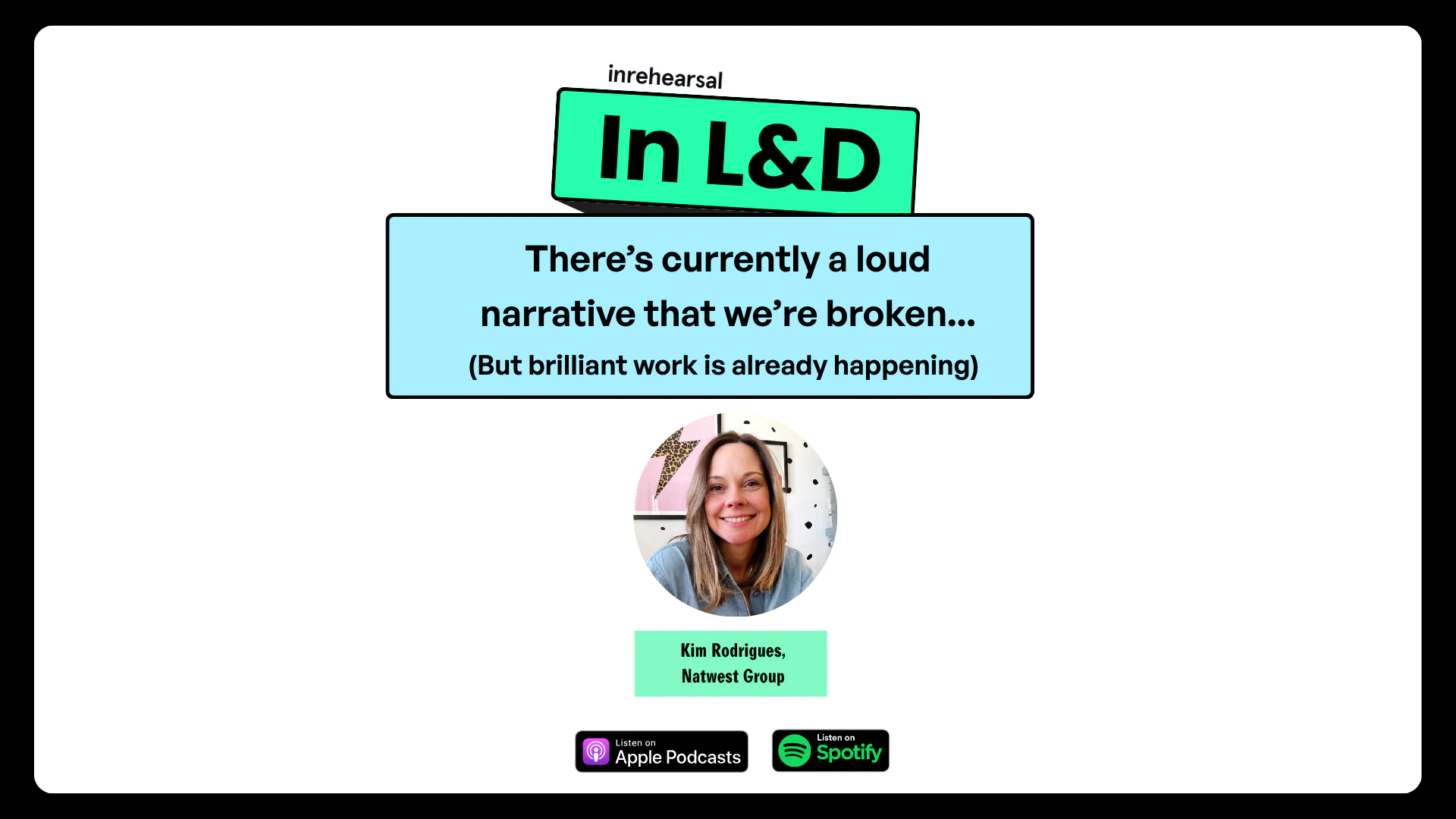
“If everyone in the profession hears we’re broken often enough, it really starts to affect how they see their own work. It affects how they pitch, how ambitious they’re willing to be…”
Kim Rodrigues (Natwest Group) described this as giving ourselves a narrative problem on top of a practice problem.
But we can shift that narrative! By recognising when great work is being done, sharing it openly and prioritising progress over perfection.
Kim shared some great examples of this happening in practice that she’s seen recently, including:
- Measurement maps that help them get a deeper understanding of KPIs and outcomes.
- A shift in mandatory learning with pre-assessment that respect people’s knowledge.
- Delivering a learning experience for branch managers by nailing the design intent.
Watch and listen to the episode
You can also listen to the episode:
On Spotify by clicking here.
On Apple Podcasts by clicking here.
Or by searching for In L&D… wherever you get your podcasts.
Four takeaways on brilliant work that’s happening in L&D
1. Work in motion, honestly shared, helps us move forward together
The positive examples Kim saw had one thing in common: they were works in progress.
People testing, prototyping, sharing what was happening to help L&D pros learn together.
“Nothing was the finished article. Nothing there had a big bow around it, all done, and complete. It was all in testing, it was being refined, it was failing fast, it was prioritising progress over perfection.
“What we need as a profession is more of that raw progress. Not case studies from five years ago that have got that nice neat bow on them, but work that’s in motion, really honestly shared.”
It can feel vulnerable sharing work in progress, you might think it’ll open the door to lots of questions – but it adds value to others, and we have to adopt that mindset.
2. Respect what people already know (and deliver more personalised learning experiences)
Mandatory learning comes with challenges, and Kim spoke about the need to “move away from the idea that mandatory learning has to mean that everyone spends the same amount of time on the same content.”
The team that Kim saw doing great work asked themselves a key question to help with this:
“How do we keep our organisation, our customers and our colleagues safe and secure, but also respect what people already know?”
They used pre-assessments to answer that last question, and it allowed them to reduce training time for colleagues who were already able to demonstrate that capability.
“The benefits are really strong because, yes, there’s efficiency there. It’s driven a substantial reduction in training hours and that comes with a commercial benefit in terms of resource time and cost…
“But this is about experience as well, and with what that team created, the story’s as much about relevance as it is efficiency…
“By respecting that prior knowledge, it’s good for the colleague experience, it’s good for productivity, it’s great commercially, and when it’s done well, it can strengthen the focus and effectiveness of mandatory learning rather than dilute it.”
3. Start with a clear problem, match that with the right design intent
Kim talked us through a recent development experience for frontline colleagues, which recognised the “need to support branch managers in thinking like a customer and acting like an entrepreneur.”
It was a structured space for peer collaboration, that really focused on the problem it was there to solve.
They established a really clear problem/the metrics it would influence:
“The team had a real crystal clear view on how that would show up in business outcomes and commercial metrics over time. Whether that’s business activity, referrals, customer satisfaction.”
The design intent was built on that foundation:
“It wasn’t about shipping a digital module or content. It was about practical application over information transfer… about creating an environment for sharing and learning from each other with the right prompts and tools.”
“The real value hasn’t been in content consumption. It’s been about seeing what happens when people connect and share what works and build confidence through practical commercial conversations.”
4. Use a measurement map to understand impact
Happy sheets get a bad rep, but they have their place. If you’re collecting post-event feedback or piloting an experience, they’re great…
The problem is when they become your entire measurement strategy! Kim and her team use a measurement map to prevent that happening:
“Sometimes we can scoff at completions and say ‘oh it’s just activity’. And it is, but it’s a really valuable part of the story as well. It tells us something. But what we do is we build on top of that… and we use something that we call a measurement map.”
Kim shared two key parts involved in this:
- They consider which metrics are going to help demonstrate learning gain/behavioural shift.
- They’re capturing outputs in a way that helps them understand what it does for business outcomes.
“It almost gives us a framework to work through in terms of testing our own thinking on a project-by-project basis, but also with stakeholders as well.
“It allows us to really make sure that we’re partnering with the business to understand, right, what data can we capture from an L&D perspective, what data will we bring in from a business perspective, how will that all come together to create a really powerful story.”
Built for L&D,
Loved by Learners
See the most authentic library of original expert-led video content in L&D. Learn how it could work for your organisation.
Episode transcript
This transcript was generated using automated transcription software and lightly edited for readability. There may still be minor errors or inaccuracies.
Gary Stringer
Well, Kim, thank you so much for coming on the In L&D podcast. Would you mind kicking us off by completing that sentence for me, please?
Kim Rodrigues
Yeah, sure I will. So in L&D, there’s a loud narrative right now that we’re broken. But the critique could crowd out something really important. All of the brilliant work that’s already happening.
Gary Stringer
Positivity. I like it. That’s a good start to the conversation. And what I liked about this, you posted about on LinkedIn. A lot of these episodes start with I see something great on LinkedIn. We should discuss this in more detail. And what I liked in your post is you had some good context around, you made the point it wasn’t about putting on rose-tinted glasses or pretending that everything’s jolly, but or ignoring the idea that L&D doesn’t need to evolve. But you were saying that we should spend more time talking about what is working. So tell us about that kind of sentiment and the motivation behind the post.
Kim Rodrigues
Yeah, definitely. And that was it, right? I was having this week where I genuinely kept coming across really exciting work in the L&D field. Just pretty people doing brilliant things quietly. And then at the same time, you know, I was scrolling my LinkedIn and I was seeing a lot of takes about L&D as an industry being in crisis. And look, I don’t think that there’s an L&D professional out there right now.
That wouldn’t say, look, L&D does need to change and fast, like a lot of industries, we’re being hugely disrupted by AI, and I think there’s a lot of things that we’ve been saying we need to change as an industry for a long time. And it’s some of those things are still hanging around. So I get it, we do need to evolve. but I do think that there is a risk that we give ourselves, on top of a practice problem, a narrative problem as well. And if we do that, we’re kind of just doing that to ourselves. and look, if if everyone in the profession hears we’re broken often enough, it really starts to affect how they see their own work. It affects how they pitch, how ambitious they’re willing to be. and I think it can feel really overwhelming in that LinkedIn space at the moment. I think though, look, change happens when we see something that works. We’ve all felt that you get a little spark of
You see something you think, I could do that, you know? And you know, that’s how ideas travel. so shining a light, I think, on what’s working, which is what the post was, you know, about. It’s not just about feeling good or ignoring the problems. I do think it’s genuinely useful to to spark new ideas and innovation. so it was the post was about starting that conversation, it was about creating that spark. I just thought let’s point at the good stuff for a minute. Let’s ask people to share their wins and and they did. So that response told us that people do want to be in that conversation, which is great.
Gary Stringer
Yeah. Yeah, exactly. The sentiment was loads of people agreeing with you, you know, I’ve just done this thing, I’ve seen these people go through a program and it had this great outcome. I saw someone else do this case study and it gave me inspiration to do something different. And I love that framing about the narrative problem on top of the practice problem because it does become a self-fulfilling prophecy of I don’t realize I’m doing good work. Because the noise is that everything is doom and gloom and and then I lose perspective of all the good things I’m doing because I feel like I’m behind or someone else is doing it this way. So I love that idea of just shifting the perspective and and trying to work out what your own narrative is, not just what I’m hearing every day.
Kim Rodrigues
That’s it. And do you know I don’t know, I mean it’s difficult, right? I don’t see other what other industries are talking about as much, but just as I’m out and about, I don’t see or hear other industries being so self-critical or certainly putting that out on a public platform. So it’s just really interesting. What I’m not sure is is it unique to LED? It can’t be, I’m sure. maybe it just feels like it’s really loud because I’m in it.
Gary Stringer
Yeah. Yeah. Well, marketing, w which I’m in, is the opposite. People are telling you all the time they’re doing a great job. So I’m right at the other end of the spectrum. and also they need the same probably the opposite treatment on themselves. Their narrative problem is that they’re cherry picking all of the stuff that makes them look good or only shouting about their successes. So it’s interesting we’re coming at from two other ends of the spectrum. Hopefully we’ll end up in the middle at the end with a good practical viewpoint on it. Yeah.
Kim Rodrigues
Find a balance. I love it.
Gary Stringer
in the post as well, you you talk you know, talking about that positivity, but with that bit of pragmatism around it’s not all rose-tinted. You had a lovely frame in in the post. You said, over the last couple of weeks, I’ve observed brilliant people quietly shifting the needle through action, not by preaching what we should do, but by modelling what’s already possible. And we touched on it a bit, but I’d love to get your thoughts on this. There’s a million things we could do, but what are the actually the things we should do that are gonna make a difference to us and our organization and you know the impact we can have?
Kim Rodrigues
Yeah, definitely. And look, I think, you know, any profession I’m sure can get stuck in a loop of talking about what good looks like or, you know, what’s not working. And L&D I’m sure is as guilty as any. And I think as an industry, I mean I’ve been working in L&D now for around fifteen years and I think, you know, we’ve been talking about those shits, you know, future of learning, you know, it it’s not really shifted that much. Future of learning, personalised learning. Future of learning.
measuring impact, you know, future of learning, learning in the flow of work. These are not new conversations, but at some point the future has to arrive. And sometimes I do wonder if it has arrived, but we’re still looking for the next thing. And that’s not like a that’s an ambitious behaviour. I think you know that’s excellent. But I do think what’s super exciting is when people you see people getting on with the work, they prototype something.
You know, they test it, they share what happens, and I think that’s how the profession moves forward. That’s so powerful. I s I personally find that more powerful than hearing about the problems. But instead, here’s how people are trying to solve them. That’s where we get those great ideas from. And I think you know, that is how we will move forward. But what’s really important is I do think as an industry as well, we can be quite hard on ourselves. You know, everything that I had seen, you know, in those examples, the positive things that week, nothing was the finished article. Nothing was there with a big bow around it, all done, complete. it was all in testing, it was being refined, it was failing fast, it was, you know, kind of prioritizing progress over perfection. so I think that’s really powerful as well. Those teams that I saw doing things in action.
Gary Stringer
Yes.
Kim Rodrigues
They weren’t waiting until they had the perfect conditions or the perfect methodology. So I think that’s what we need as a profession is more of that raw progress. So not case studies from five years ago that have got that nice neat bow on them, but work that’s in motion, really honestly shared.
Gary Stringer
Yeah. Yeah. I think it links back to what you said about the narrative issue because if you’re constantly waiting for the next trend to be told to you or this is what’s going to be important, then you work towards something that’s probably shifted by the time you get there. Whereas if you’re really pragmatic about the problem you’re facing now, then you can say, Well, let’s test this, let’s test this over like a short period, as opposed to trying to keep up with something that feels like it’s always changing because that is what people say. I I I’m trying to keep up with
Kim Rodrigues
Yes.
Gary Stringer
Whatever’s changing in the industry, but actually is that kind of you’re setting yourself up to fail by doing that when really you could probably do like three things in your business that will have a massive impact and no one’s talking about those things, in the public sphere maybe.
Kim Rodrigues
Yeah, yeah, absolutely. I think there’s something as well that maybe feels vulnerable when you start sharing raw work and raw progress. And I think it can be challenging as well if you are then faced with lots of questions, you know, what about this? Have you thought about that? But it’s a it’s a mindset thing. I think sometimes it can it can feel like a vulnerable place to go is sharing your work early. but it does genuinely add value to others.
Gary Stringer
Yeah.
Kim Rodrigues
so yeah, progress over perfection I think is a really important mantra for us at the moment.
Gary Stringer
Yeah. I guess, you know, sometimes we spend ages on something and then when it’s done and it doesn’t necessarily work out, there’s like this big amount of feedback. But actually, if you just shared it periodically about honestly what’s going on, then you know, this feedback you might be scared of or the failure you might be scared of at the end, you can kind of mitigate the amount of it that happens and actually the end result might be better because you’ve decided to share honestly and frequently, like this week we’re doing this. I know we’re gonna get into some of the the ways that you’ve been doing this. But I think maybe the fear of the feedback you’ll get at the end stops people sharing honestly throughout the journey. But actually the thing that would be most beneficial in terms of learning and feedback and testing would be to share often and honestly, like you said.
Kim Rodrigues
Yeah, and and widely as well. You know, I think like I would say of the some of the examples I shared in my post and that we’re going talk a little bit about today, you know, I know a lot of the people who’ve been driving that work and these are not necessarily individuals that are gonna shout publicly about their work externally. You know, they are passionate about quietly getting on with the job, driving that progress. and I think hopefully, you know, we can
if we can encourage people to share more widely, it’s like we get a broader diversity of voices as well and examples and things like that. So yeah, some of the work I’m gonna talk about today and that I shared in my post, you know, it’s not my work. It’s it’s things that I’ve maybe been involved in on the periphery, but it’s it’s been done just by brilliant individuals who, you know, they’re walking the talk and I think that that’s really cool.
Gary Stringer
Yeah. I was about to say I love a tangent and we’ll get into the things you did in the post, but then another tangent came to me. And I was just gonna say, you know, you mentioned people who are doing the work quietly and getting on with it. when you start maybe reflecting that what that person’s doing internally or saying back to that person how good it is, I mean, are you seeing a change in maybe that feedback loop that we spoke about earlier where people don’t realize they’re doing good work? But if you start building this culture where you’re going, actually, this thing you’re doing is really cool, or we should share this more often, are you seeing kind of a a direct shift in that narrative we were were talking about right at the start.
Kim Rodrigues
Do you know I think we would if we if we continue to kind of focus on some of these positives, because I think sometimes it’s almost like there’s a level of kind of getting on with the job and a level of modesty, certainly in some of the examples that I’ve seen, where maybe even people aren’t sitting thinking, Wow, this thing that I’m doing is really brilliant, really amazing, because it’s just what they’re doing. It’s like this is what I do. But actually, you know, when I look at it as
somebody who’s you know on the periphery or outside of that work, I’m like, wow, this is great. Loads of people could learn from this. So yeah, I think I think it could. I think the more that we can sprinkle these kind of really practical examples into some of the narrative that we’ve got in the industry, I think it’ll spark a lot more kind of sharing and innovation and ultimately it will help us move quicker individually. And collectively.
Gary Stringer
Yeah. Awesome. Right. Now I am on a tangent, Dan. We’re gonna get into the post and the some of the great stuff you mentioned, you know, positive things you’d seen just by observing other people. And I think the one that really encapsulates the sentiment the best is you talked about this shift to respecting what people already know by shifting the question from what do we teach to what is already known by using pre-assessments and it helped increase speed to competence. So tell us about what that was, how it was received and that impact on the speed to competence.
Kim Rodrigues
All right. Yeah, for sure. So look, there’s a lot of I think there’s a lot of kind of rhetoric out there and a lot of chat about how important it is that you know when we are helping people develop their skills that it’s relevant, it’s timely, it’s personalized, you know, there’s a lot out there. I was at Learning Technologies a few weeks ago and there was a lot of conversation about you know the one size fits all course. Like, does that have a place anymore? Where does it have a place? Because actually in the direction we’re moving.
The capability that AI gives us is that actually we can personalize at scale. And that’s super exciting. But what I had seen was actually it was it was simple, but it was in the context of mandatory learning. So moving away from the idea that mandatory learning has to mean that everyone spends the same amount of time on the same content. And the team that I had seen doing the work, they had asked themselves the question you know, how right? Mandatory learning is super critical, especially if you’re in a regulated industry. You know, they ask themselves how do we keep our organization, our customers and our colleagues safe and secure, but also respect what people already know. And using pre-assessments has been a hugely successful lever. So, I mean, first of all, you know, I’m sure lots of other
places we’ll be tapping into this, you know, it’s you know it’s something that I’m sure is quite widely utilized. But it’s just such a simple way to assess retain knowledge, drive smarter learning in our case across the mandatory curriculum and reduce that training time for colleagues that are already able to demonstrate that capability. It means that they can skip content, they can fast forward through content and you know the benefits are really strong because Yes, there’s efficiency there, it’s driven a substantial reduction in training hours that comes with a commercial benefit in terms of resource time and cost, but this is about experience as well, and I think what that team have created is it’s as the story’s as much about relevance as it is efficiency. So I think it for me the real story was that by
Respecting that prior knowledge, it’s good for colleague experience, it’s good for productivity, it’s great commercially, and when it’s done well, it can strengthen the focus and effectiveness of mandatory learning rather than dilute it. So just it felt like a really great example. We so often talk about what impact is the work that we’re doing in L&D having. And there for me I I thought, you know, seeing that work, what a commercial benefit, absolutely, a colleague experience benefit.
Gary Stringer
Mm-hmm.
Kim Rodrigues
and you know you can of course we can think about this like banging a pre-assessment on the front of some content, but this team I know the work that has gone into working with their stakeholders to influence that and to make sure that the stakeholders are comfortable with the experience and that we have assessed all of the risk elements and the fact that they have been tenacious in following that through and are now managing to scale this. then that impact is really great. So that was that was one that’s really stood out to me recently.
Gary Stringer
I don’t think I’ve ever heard anyone make that point before that mandatory doesn’t mean everyone spends the same amount of time on a piece of content. Because I think often, like you said, where it is something that’s maybe regulated or has to be done, people think, well, to cover ourselves it has to be from here to here. And but it doesn’t necessarily reflect reflect the fact that someone might know all of this part and all of this part, and then we’re asking them to just go through everything because that’s the easiest way for us to distribute it to them. And then we
you know, I often hear the narrative of internal brand or why don’t people have time for learning. All of these things are, you know, downstream of just sending everyone the same blanket thing. So just to kind of clarify, so it was a qualifying question around how much knowledge people already had around this subject and then maybe tailoring what the offering was to that person based on what they already knew.
Kim Rodrigues
Exactly. It’s about testing that knowledge up front and then adapting the pathway based on the knowledge that they’re already able to demonstrate. so I think that in the kind of context of mandatory is it’s really important that we can evidence that, you know, that capability, that’s really important. That’s why the the kind of content is there in the first place. but I think what the team have achieved is a way of kind of meeting that requirement. but also putting colleague at the heart of the experience.
Gary Stringer
And what was kind of the the reception for that internally? You know, were people really thrilled that, actually this is coming to me now and it feels really relevant and as a business, you know, we can see collectively across our teams that everyone’s getting a unique experience and people aren’t spending more time than than is needed on that. Do you have any, you know, is there anything you can share around that?
Kim Rodrigues
think in terms of reaction, so I would say when probably in the earlier days when we were starting to put the pre-assessments in and people were feeling that immediate benefit of it releasing that time for them. Yeah, absolutely really, really positive response. I would say we’re at a place where it’s become normal and expected. So actually that’s no bad thing as well. It’s become part of our business as usual. but I think it’s that kind of it absolutely we saw in in that initial reaction. I think where then we see the positive reaction from a stakeholder perspective, more of a kind of business leader perspective, is you know, everyone’s got a different angle at this. You know, the the pounds and the pence and this resource savings, you know, this is time that can be reinvested into customers, into really kind of high value activity. So that really does, you know, land with our
business stakeholders as a story, which is great.
Gary Stringer
Yeah, that’s great. Like you said, everyone essentially benefits from that. The L&D team is doing great work. The person at the end of the learning experience, it feels relevant to them. The people maybe at the top of you know the management level, they can see the benefit to everyone else. So it goes to show you that testament around reflecting on the thing that is useful to you, not necessarily the narrative can have a really contextual impact on your business. And that is the perfect segue into the next. piece from your post. You’d mentioned that you’d seen peer learning influence in business KPIs and that this was around an experience for frontline colleagues. So tell us a bit more about, you know, what that was and also how it worked and what you learned from that.
Kim Rodrigues
Yeah, no problem. So first of off, there are so many things that I love about this example. so if if I start by talking a little bit about what we were, you know, trying to do. So essentially developing, you know, a journey, a skill development journey, but delivered through community learning. So this it wasn’t about creating the thing, the content, the you know, the thing that you can look at or touch and feel. But instead, it was about driving straight through community learning, supplemented with tools, insights, and effective prompts. So this was the kind of experience that the team have developed. And essentially, that experience was being developed for, in this case, branch managers who we could see that need to support branch managers in thinking like a customer and acting like an entrepreneur. And the team had a real crystal clear view on.
How that would show up in business outcomes and commercial metrics over time. So whether that’s business activity, referrals, customer satisfaction, okay. And I think that, first of all, you know, it’s it’s one of those you’ve got you’ve got a really clear problem, right? Starting from a really good place. So that’s great. But what I did really love was the design intent. The fact that the team that were working on this, it wasn’t about, you know, sort of shipping a digital module. it was about really thinking about practical transfer first rather than information transfer. So practical application over information transfer. So it not being about content. again if I think about how much we are hearing out in the kind of industry world about, you know, AI is kind of sending us into a place where content is becoming a commodity. And actually that means that, you know
as L&D functions, we have to think about where do we add unique value, you know, in the future. and I think sometimes we have defaulted to kind of mass content creation because it’s scalable. And I was actually listening to one of your podcasts from a few weeks ago and there was someone who appeared on your podcast who talked about sometimes something needs to feel visible to feel valuable. And that being almost a little bit of a
Of a cultural thing that can exist, and and I agree. And I think in this case, the team pushed back, pushed through that, focused on the practical transfer, and really designed something about creating an environment for sharing and learning from each other with the right prompts and tools, of course, to support it. So that was a big tick. there was really clear intent, as I say, about the problem and the metrics that it was going to move. And I think what I saw when I heard about that work was. That the real value hasn’t been in content consumption. It’s about been about seeing what happens when people connect and share what works and build confidence through practical commercial conversations. And they can see the original intent showing up in the business metrics off the back of that. It’s almost what I can see from this example is it’s people who’ve spent as much time thinking about.
Before and after of training as the actual training, and I think that’s just been really superb. They also moved really fast. So back to our earlier point, they started small, they tested, they piloted through a a series of sprints, and now they’re in this brilliant position of being able to evidence the value and the benefits and understanding what this needs to look like at scale because they they’ve seen it in practice. So, yeah, I think. There was a few things that were great about it, but for me, contentless course with business impact. And I just thought the amount of kind of chat we hear about that and I loved seeing a little micro example of it in action.
Gary Stringer
Yeah. Do you know what’s one thing I love about having these conversations is to see how it works in different industries, because different industries, sometimes a specific industry, is really good at shining a light on how something can be done. So you mentioned the outcome is, you know, customer referrals, customer happiness, customer attention. if you want to know actually how to engage with customers, the only person who can really help you with that is the branch managers that you mentioned, who interact with customers every single day. So if you did rush to create content, you wouldn’t
Kim Rodrigues
Yes.
Gary Stringer
really know the problem as intimately as someone like the branch manager. And then makes complete sense that you go, well, the best way to get that this at scale is to bring all of the branch managers maybe together to learn as a community. And then you’re clear on what the problem is, you’re clear on the person who knows it best, and you’re clear on the way to bring those people together to share it. And then like you say, if that validates it at a small level, of course you can scale it and I think that’s testament to not just rushing to the output and taking time to go
Kim Rodrigues
Yeah.
Gary Stringer
Actually if I wanna influence the business KPI, what is the KPI? What are the problems that prevent the KPI being re realised? And who are the people who know best how to solve the problem that stops the KPI being kind of hit in the in the end?
Kim Rodrigues
That’s it. Yes you’re you’re spot on. There’s that kind of element about, you know, we talked earlier about respecting what people already know. And there’s an element I hadn’t really thought about internal, but there’s an element of that in this example because it’s about, you know, a a team within an L&D function who are recognising that the people who know most need to just be in the room and be given the space and the tools and maybe the framework to work through the problem. rather than being hit with a bunch of information about how we could do things differently. So yeah, there’s a it’s back to respecting what people know, actually.
Gary Stringer
Yeah. There you go. That’s a core fundamental throughout this conversation now is respecting what people know. And you talked about maybe future proof in L&D and what can unlock L&D earlier in the conversation. It’s that kind of mindset, isn’t it? You know, am I, being honest to myself, the best person to create whatever is needed to make this happen? Or am I better off just facilitating and getting the right people together and giving a platform and the skill set and like you said the tools, the prompts, the frameworks to make sure that knowledge from that person gets to other people. And respect what they know.
Kim Rodrigues
Yeah. Yeah.
Gary Stringer
Let’s do one final example because you’d also mentioned in your post something similar which was shifting the dial when it came to measurement. And this was about tracking changes in colleague behavior and KPIs before and after training, which I think is something I see a lot of frustration with because people don’t necessarily know how to do it. They get to the end of something, they don’t know what’s changed, they’re not really happy with just using feedback scores, and then you hear the word happy sheets used a lot. So tell me about what was happening here, the approach to shifting the dial measurement and kind of what you learned from that as well.
Kim Rodrigues
Yeah, no problem. And look, I think measurement for L&D is one of those things that a lot of L&D professionals will would say I think it’s the thing that keeps them up at night. And I know myself I’ve been worked in, I’ve been involved in I’ve been involved in lots of work over the years where we’ve measured what’s easy rather than measuring what matters. Like one hundred percent. And I’m gonna start by being fair to the humble happy sheet, right? Because The happy sheet does get a really, really hard time. but I think look, if you want to know how something landed, particularly if you’re piloting an experience, then a post-event survey is a perfectly reasonable tool for that. it tells you something real and it tells you something useful. so I think sometimes we we bash the happy sheet.
But the real problem is when the happy sheet becomes your entire measurement strategy. That that’s where the real kind of problem is. And you know, in in my world, my team, we use something that we call a measurement map. So it’s essentially a bit of a structured way for us to build plans that get us clear on what needs to be measured and why at what point, all linking back to the kind of business subject or the problem. Now, engagement and experience are a really important part of the story.
So I think sometimes we can scoff at kind of completions and it’s just activity. And it is, but it’s a really valuable part of the story as well. It tells us something. But what we do is we build on top of that. We think about it in terms of okay, we’ve got activity, engagement, but then we move on to then thinking about what metrics are going to help us to demonstrate learning gain, i.e., that behavioural shift. And what metrics are we going to be able to track downstream that show us that there is a knock-on kind of business impact? So we use this measurement map that just helps us to organise our thinking. So critically though, for that approach to work for us, there has to be that really clear business problem to solve in the first place. But the work that I talked about in my post was really about optimising how we evidence that learning gain element at scale.
and and more consistently and business impact too. so we’re in the experiment stage at the moment. So inspired again great ideas travel, inspired by some external best practice and we’re trailing a method of measuring behavioural shifts using scenario-based surveys pre and post learning. Now that concept pre and post learning it’s as old as L&D time for sure. You know it’s not new. But what we are doing is we are capturing the outputs in a way that can be connected to business metrics over time. So that’s been, you know, exciting. we’ve we’ve been, as part of that, we’ve been experimenting with AI tools for question generation, for helping us to connect results back to a single data model. So it has felt like steps forward. We’re not there yet, but it’s been progress over perfection. and I think this is
Gary Stringer
No.
Kim Rodrigues
probably the that really good example of where we don’t have to have a perfect case study tied up in a bow, but we’re learning with others, we’re starting small with the aim of creating something that gives us much richer impact insights at scale. So I think something that, you know, absolutely as we learn more as we go along, I will make sure that I’m sharing more of that through LinkedIn with others as well.
Gary Stringer
You know what I love about that whole mindset, starting with the happy sheets in moderation, you know, they can’t just be your whole strategy is goes back to that point at the start. The narrative is either this thing is good or bad. But actually the real narrative is this thing can be an indication of this. But like you said, let’s build upon that. And I love the idea of the measurement map. Are you kind of doing that on a per project or per problem basis, saying these are the different components? This is what would indicate engagement. this would indicate behavior change. This is the outcome that would indicate it’s actually been affected.
Kim Rodrigues
Yeah. Yeah. Yeah, it gives us almost gives us a framework to work through ourselves in terms of testing our own thinking on a project-by-project basis, but also with stakeholders as well. it allows us to really make sure that we’re partnering with the business to understand, right, what data can we capture from an L&D perspective, what data will we bring in from a business perspective, how will that all come in, you know, together to create a really powerful story. So it definitely gives us a way to organise our thinking, plan and We do it on a project basis, we don’t do it for everything. You know, there are we definitely I would and I’m I’m sure lots of people think l in exactly the same way, which is we put that energy where there is the most investment.
Gary Stringer
Yeah. Yeah, if you see a sp really significant business problem, then it’s worth your time taking those extra measures to measure, do the measurement map. And data’s a great point you mentioned there. Often people miss that. Who has access to data? Can I access the data that evidences it? Because sometimes you start planning something, you realize you’re not the owner of the data, and then measurement becomes even harder. But if you bake that into the start with the measurement map of, well, this is the data we need, these are the stakeholders we need to work with to get it. I think it’s just a more foolproof way to then you can test that scale and move quickly because you have all the components in place, I guess.
Kim Rodrigues
Yeah, yeah, for sure.
Gary Stringer
And the last question, follow-up question, I told you I liked a tangent, but scenario-based learning is something I’ve not really come across, but I’m imagining that is asking someone how would you solve X problem or how would you act in X situation training and then measuring the kind of response against what they said before and seeing the progression in that.
Kim Rodrigues
Exactly, exactly that. So it’s it’s something that certainly others may be using it already. It’s something I’ve not used before. I think we’ve used the much more kind of direct questions around getting people to self-assess their capability. This this felt like a smarter way of doing it and it can still be connected to, you know, a a kind of tangible data model in the background. so we are really excited to see what what that can what that can produce.
Gary Stringer
Mm.
Kim Rodrigues
I think what’s interesting is, you know, I know myself already, like with that approach, you know, I’ve been guilty of the question of, it’s self-reported though. So is it is it viable data? What else do we need to do to make sure that that’s really robust? And those are not the wrong questions, but I think it’s the perfect example of sometimes where we can maybe let the the desire for perfections get in the way of the progress. And actually I was reading something the other day, a
Gary Stringer
Mm.
Kim Rodrigues
a study around kind of self-reported behaviours that actually I know sometimes there’s quite a strong emphasis on you know those needing to be validated by l managers or you know being more objective but actually something like a 92% accuracy rate in terms of how people rate will go rate their own knowledge. I wish I had the quote because I could I could say where that’s come from. Maybe we can find a way to put it in the notes but yeah.
Gary Stringer
Mm-hmm. Yeah, yeah. Yeah. Yeah, yeah. We’ll credit in, we’ll put it in the notes. Yeah, yeah yeah.
Kim Rodrigues
But you know, and I think that’s that’s a really good example where sometimes I think we can get caught up in the finer detail and lose the big picture benefit.
Gary Stringer
Yeah. Yeah. That is a great example because like you said, I I f I went through the whole thr thought process there. I was like, yeah, that’s great, scenario-based learning. Then you said, Well, actually, is it self reporting? They actually, well, maybe you’re right. And then you said, Well the data shows that’s self-reporting. But it made me think that I could have sat there, you know, if I was in that position, question everything and then do nothing. But what I could say is the self reporting, there might be a degree of discrepancy or fluctuation in the accuracy of it, but
Kim Rodrigues
Yes, yes.
Gary Stringer
Is there a better indication? And if there isn’t, then you can decry it all you want, or you could just say this is the best thing for me to use now and I’ll use it. And if I’m doing it smart in sprints or small scale, I can test it over a couple of weeks and then I might learn that I’ve not sent the self reported scenario-based loan to a thousand people and then learnt that measuring that’s really hard. I’ve tested it with twenty and go, that can work if we do this and this to it.
Kim Rodrigues
Yeah. Yeah. Exactly. And I think if then we can validate that, like if we bring those business KPIs then we can connect that together. It’s more validation that potentially comes later. but see if that little study is right, you know, the ninety two percent if it’s right ninety two percent of the time, then I think there’s also that right. When’s good good enough? Maybe that’s good enough.
Gary Stringer
Yeah. Well, I’m not right ninety two percent of the time on anything. So I’ll like I’ll happily default to something that is I’m probably on a sixty percent metric at the moment. So I’m more than happy to to deflect to something with a bit more robustness. amazing. Cool. Like I wanna wrap it up by coming back to, you know, collectively the examples. We talked about narrative at the start and how we can kind of shift it and gone through some great specifics. And I’d love to know if there’s some common threads across these examples and that we you know, shared and also other stuff you’ve seen recently that you think could, like you said, unlock L&D and help it move forward and ignore this narrative that everything’s broken and we are doing better work.
Kim Rodrigues
Yeah, I think look, when when I reflect across all those examples that we’ve we’ve talked about today, I think the common thread that jumps out for me is is partnership. So all of those examples well none of those examples, it’s a better way of putting it, none of those examples happened in an L&D silo. So, you know, if we take that kind of community peer learning programme that I talked about. It was designed with the business, around what the business needed. And there was a real kind of shared accountability on identifying the right metrics and tracking the progress to make sure that it was an effective, you know, intervention. That impact was never gonna show up in LMS data. So that partnership is absolutely critical. you know, we’ve part of the team have been doing some experimentation with a learning agent.
to improve how colleagues search and discover for learning to build their skills. And, you know, there’s a really good example. I talked about that in the post as one of the successes that I’d seen, but that happened because L&D people and technologists got in a room together and worked it out and brought their different specialist knowledge together to create this idea. And I think that’s the real unlock for our professional. It’s that for our profession, it’s that genuine genuine partnership.
with the business to understand what success looks like and measure it honestly with technology teams to build things that actually work in practice and you know with learners themselves to actually understand what they already know and what they really need. So I think L&D is at its most powerful not as a function that delivers learning to a business but it’s a function that thinks and builds alongside the business and that’s why these examples really excited me because I think they’re all quietly proving that, which I love.
Gary Stringer
Awesome. What a brilliant note to end on. Kim, what I’ll do is I’ll put that post in the description and then if people want to connect with you, but even better, if they want to go and read that post and follow your call to action on air to leave something that they’ve seen recently or a win they’ve had and help spread the positivity, then feel free to do that. But thank you for a great conversation and yeah, really appreciate
Kim Rodrigues
Thanks, Gary.
Gary Stringer
Brilliant.
Related articles
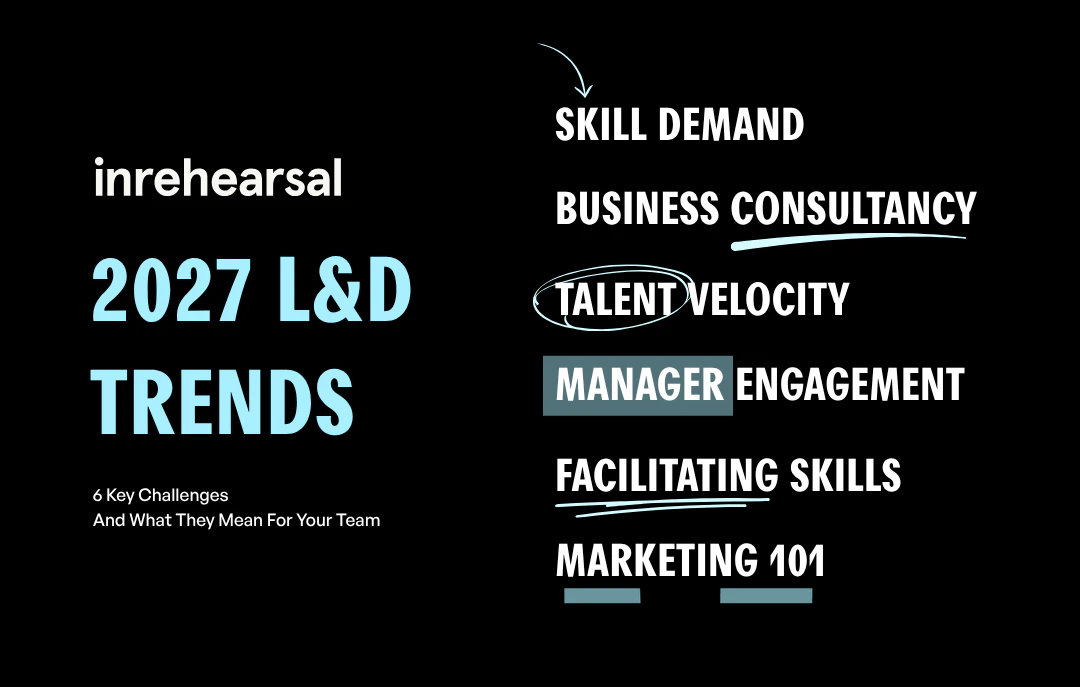
L&D Trends 2027: (6 Challenges And What They Mean For Your Team)
Explore 6 key L&D trends for 2026/2027, including talent velocity and manager engagement, backed by fresh industry data and expert analysis.
Read more