

- Podcast
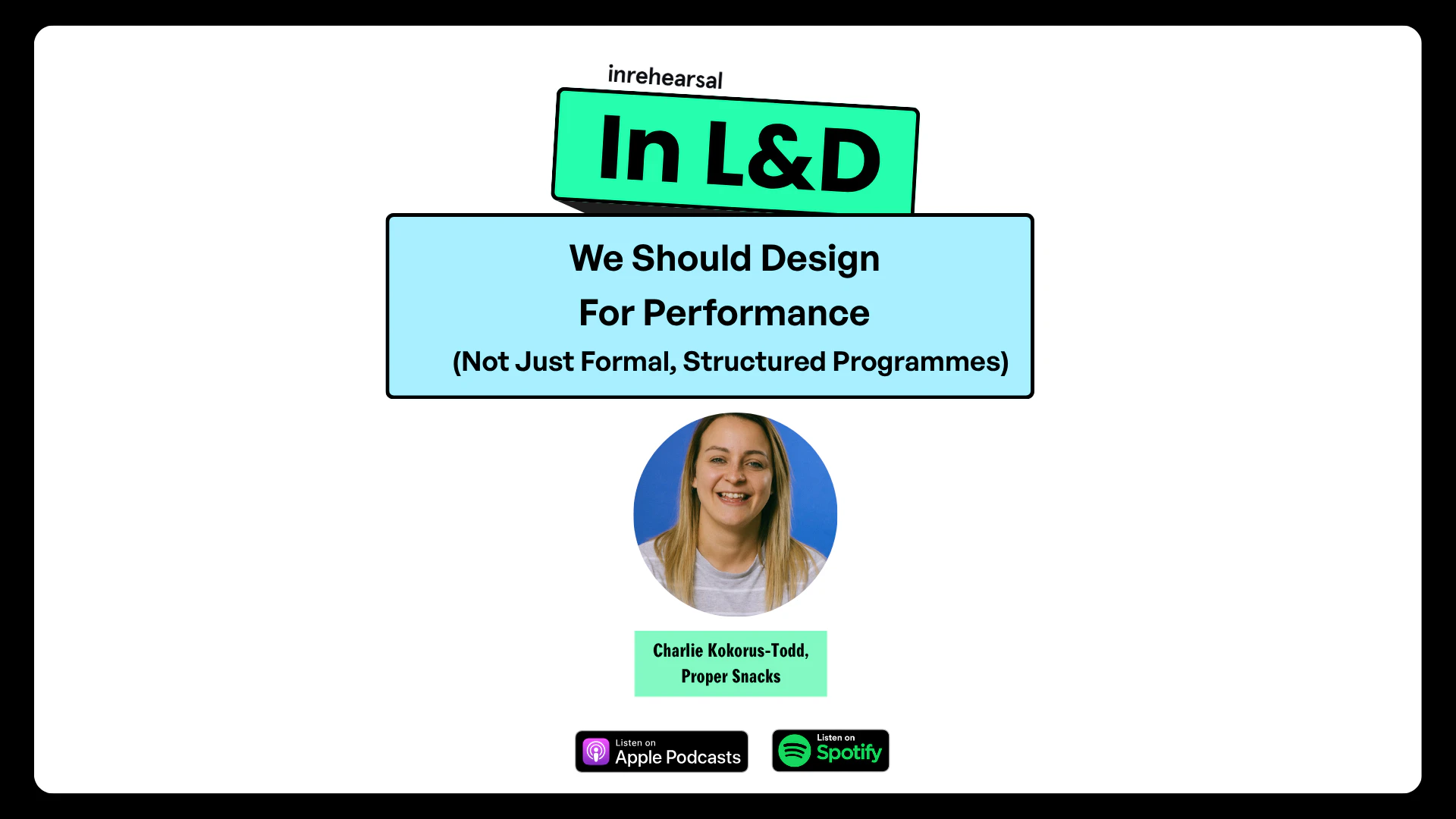
In L&D… we should design for performance (not just formal, structured programmes) | Charlie Kokorus-Todd
20 May 2026 By
Gary Stringer
It’s easy to fall into the L&D trap of thinking: If it’s visible and something people can attend, it’ll solve my problems.
And that can lead us to creating structured, formal, course-based learning… but is that really how people build capabilities?
Charlie Kokorus-Todd (L&D Manager at Proper Snacks) summed it up perfectly:
“Learning is so very different to what capability is, they’re not the same thing. They’re messy, they’re contextual.
“I think application is key and sometimes we worry so much about what the design looks like, and have I got a set of pretty slides, and how big is my content library?
“And we’re actually missing the point of what that looks like in application in the real world.”
Charlie shared some great advice on:
- Building for application and capability.
- Learning to love the problem.
- Asking consultative questions
- Understanding the current environment while building towards the future state.
- And lessons from her L&D role in manufacturing.
Watch and listen the episode
You can also listen to the episode:
On Spotify by clicking here.
On Apple Podcasts by clicking here.
Or by searching for In L&D… wherever you get your podcasts.
Four takeaways on building capability and application in L&D
1. Ask yourself this: Is it really knowledge that someone needs?
“Because if it is knowledge, learning is great, let’s build a learning event. But nine times out of 10, it’s not about the knowledge of individuals, it’s about how they apply it.”
Charlie is currently supporting employees in manufacturing roles, and her experiences in that environment have helped shift her mindset to improving performance (not just creating content).
“It hit home for me that I’ve got to stop building content, and we really need to focus on how we’re going to improve performance over time.”
2. Establish what great looks like in the future (it’ll help you create the right thing now)
Whether you’re new to L&D or you’ve been in it for decades, this simple framework will help:
- What does great look like?
- What’s getting in the way of that?
- Build your solution around making this possible.
This stops you defaulting to creating content and shifts you towards performance metrics (not the vanity ones like bums on seats) because you work backwards from the outcome.
3. Performance is messy! So our initiatives don’t have to be so formal or structure
“When you and I try to learn something, we’ll go to Google or YouTube, and problem solved! It doesn’t require me to jump on a programme, a learning or education piece.”
When we pull someone out of work and into something formal, it often feels worlds away from the challenges they’re seeing in their day to day.
Which is why we have to design solutions with an environment-first mindset:
“Let’s look at the environment. How can we design an initiative around that? And it might come with aspects that do involve short, bite-size learning — but does it really need a three-hour, workshop session?”
“Are we just getting them on a training programme to show them about all the challenges they’re having? Or are we showing them how to overcome those things? And to do that, it has to be in their world.”
4. Take the advice you see on LinkedIn with a pinch of salt
“Ultimately, what you see on LinkedIn, nine times out of 10 will not support your environment.”
Yes, you’ll see a lot of advice on how learning design, programmes and facilitation should be done, but you have to be mindful of what will actually work in your context.
“I don’t necessarily think there’s always one good approach… because all the problems are very, very different. Not one single solution is going to solve that problem.”
“Absolutely take pieces of information on how it’s going in different organisations and what’s on the agenda for L&D in the L&D world. But take things with a pinch of salt, because it can be so conflicting trying to cut through that noise.”
Built for L&D,
Loved by Learners
See the most authentic library of original expert-led video content in L&D. Learn how it could work for your organisation.
Episode transcript
This transcript was generated using automated transcription software and lightly edited for readability. There may still be minor errors or inaccuracies.
Gary Stringer
Charlie, thank you very much for coming on the In L&D podcast. Do you mind completing that sentence for us, please?
Charlie Kokorus-Todd
Yeah, absolutely. I think we’ve created this system where it’s created tension in L&D. We’ve got to create structured programmes. If it’s visible, then it’s valuable.
Gary Stringer
You recently posted about this on LinkedIn and you referred to it as a strange tension, this thing between wanting to do something that’s really formal and trackable versus actually what’s the best way to help people build capability. So tell us a bit more about that tension and where you think that’s coming from.
Charlie Kokorus-Todd
Yeah, absolutely. think, you know, over a period of time, think a lot of organisations need to provide that evidence, whether that’s through kind of compliance, governance, audit readiness, that we’ve had to sort of create learning and learning being those kind of traditional workshop based environments. And I think as L&D professionals, we’ve kind of got to the point where we think, OK, if we create something that is visible, that we can then that will solve our problem. And that is a kind of, know, my 15 years of L&D, that’s always been quite inherent in terms of like what we do and how we have to do it. We have to build content, we have to create content. You know, if you work in an organization that’s regulated, then absolutely you need to provide that evidence. And I think, you know, as L&Ders over the years, historically, we’ve had to provide that evidence-based learning.
being our workshop environment.
Gary Stringer
Yeah, I think that is the challenge, isn’t it? You need to provide, I think maybe it filters over, doesn’t it? There’s situations where you need to provide evidence and that therefore covers you against people questioning maybe your value. Then you think, well, actually for the non-compliancy type stuff, if I also then apply the same mindset that if it’s trackable or formal, like you said, then it can easily prove that I’m doing things that are contributing to the business. But like you said, is that really how we build capability? That’s the challenge there, isn’t it?
Charlie Kokorus-Todd
Yeah. Absolutely, you know, learning is so very different to what capability is. They’re not the same thing. You know, they’re messy, they’re contextual, and I think application is key, and sometimes we worry so much about what the design looks like, and have I got a set of pretty slides, and how big is my content library? And we’re actually missing the point of what that looks like in application in the real world.
Gary Stringer
remember this is one of things I really noticed when I first joined L&D was sometimes there’s that need to default to something that’s trackable or looks good or has gone through all the process means that the moment has passed where someone really actually needed that thing to build capability. So the desire to take lots of time to formalize something means that there’s this window where people who just need the thing in the moment miss it for a period of time until the thing is finished. And then there’s no guarantee that the thing is. going to help build the capability because it’s not necessarily designed to build the capability. So I did notice that at the start. was a message I kept hearing from other people in the place.
Charlie Kokorus-Todd
Yeah, yeah, you know, we, I think we’re these solutions architects as L&D is really, you know, we want to create solutions and we go straight to the solution sometimes at the detriment of actually thinking about what is the problem and actually how do we fix that problem? What’s missing? What does great look like and how do we get there?
Gary Stringer
Yeah. I know we’re going to dive into that bit more in terms of the practicalities and your advice for other people on that front. But what I’ve already noticed a few episodes into this is that there’s really these moments in people’s career, whether they’re single moments or just periods where these beliefs really get shaped. So I’d love to know what shaped your belief around this tension or the balance between formal and capabilities and what actually works there.
Charlie Kokorus-Todd
Yeah, I think in my recent… kind of career where I am currently, know, manufacturing is so different, know, and lots of different industries are very different, but you know, manufacturing is really reactive. And although it’s a regulated environment where you have to provide evidence to auditors, but compliance doesn’t need to be boring. And actually, you know, teaching people topics and providing them with the learning. thinking about application, is it really knowledge that they need? Because learning, great, if it’s knowledge, fantastic, let’s build a learning event. But nine times out of 10, it’s not about the knowledge of individuals, it’s about how they apply it. And I think my recent kind of reflection on that is actually looking at the bigger picture, how that’s applied in the real world, in their environment.
And it’s kind of hit home for me really to look at, I’ve got to stop building content. We have to stop doing this and we really need to focus on how we’re going to improve performance over time. A learning event. I mean, who likes education, right? Who does? I mean, some of us do. L&Ders do. And traditionally, we’ve always gone to that education piece and kind of forgetting what’s down the line of how we’re to move that needle, how we’re going to improve individual performance. And that’s how it’s really happened for me recently. It’s very easy going back to mine. previous message about, know, how do we, you know, be these solutions architects, which we are without just sitting creating content.
Gary Stringer
Yeah, it’s hard, isn’t it? I noticed this a lot of the time, the similarities between L&D and marketing, but I always have to train myself when I go into a new industry or a new role or even a new role in the same industry that what works won’t work here. And I don’t need to just churn out and get to output. So has that really made you rethink the whole process in terms of from the very beginning, how am I approaching this? I kind of need to park maybe past experiences and go from scratch in this new industry.
Charlie Kokorus-Todd
Yeah. Absolutely. Yeah, absolutely. when you work in different industries, yes, you can translate a lot of L&D practices, a lot of models and theories. I think ultimately different industries come with different learner personas, right? And… very much in manufacturing, know, the learner personas that I see every day are so very different to what I would be used to, you know, working in education. And I think that is really crucial that we understand those learner personas, you know, in manufacturing, they don’t want to sit through a two hour session talking about, I don’t know, food safety, you know, that’s crucial, that’s important, but how are they going to apply that in their day to day work?
right, how are they going to move that needle? And we just forget about those learner personas and it’s so important to understand our audience rather than making these lovely pretty content libraries and forgetting about performance.
Gary Stringer
Yeah. Is it a case that, so if we were thinking that someone in food safety, for example, if they needed a course, here’s everything that they do day to day in a row, and then you kind of build all that back up to like one big course, but actually the opposite is the most effective of like, if we just had a resource that supported every small thing that they would need to do day to day, then it wouldn’t be a case of having to go through the two hours in a linear thing or hunt through it to find what you need.
Charlie Kokorus-Todd
Yeah, absolutely. think we start at the very start all the time, What is the solution? How can we create content around that solution? What we’re kind of forgetting in the L&D world right now. I believe a lot of L&D professionals and you know me included we need to look at you know future state what does great look like what do we need to be great and what’s kind of the barrier to being great right And sometimes we, you know, that is a simple framework that I think would be great for new L&Ders coming into the industry now, but also current ones, those that have been in the industry for, you know, 10, 15, 20 years. What are we missing? What is great? What’s getting in the way of doing that and building that, you know, solution around that, not content. What are the expectations? What is the environment?
but we create in the environment for them to go and apply it when they do come to a workshop. And I think, again, that’s so important. We look at these trackable metrics of bums on seat completions that I like to say, because it’s really trackable, isn’t it? You everyone’s got an LMS, everyone knows, you know, how many bums on seats we have, what the completion rate is, but they’re tracking the wrong metric. around those things? What metrics are they tracking based around performance and moving the needle of performance? I think, you know, probably going off on a tangent here, Gary, but when we look at things like metrics, you know, and the metrics that we do track,
Data analytics have been high on L&D reports. And I think that’s changing now because of AI. We’re tracking, I’d hope that that’s kind of off the scale at the moment and not so important because maybe we’re using AI to track the right data. And I think that that will change over time. And I think, you know, the content builds will change over time. You know, as I say, the introduction of AI, but it’s been around us for a long time. It’s just sort of blown up recently because people are worried that it’s going to take our job, right? So, yeah, don’t know we’re going off on a tangent, but thinking about future state being
Gary Stringer
Yeah.
Charlie Kokorus-Todd
greatness, what does that look like? I really, to step back and work back from there as opposed to going, I can build some lovely fluffy content.
Gary Stringer
Okay. Yeah, I do think that’s good because that’s a balance between the ideal world and real world, isn’t it? In the ideal world, this is what great looks like and in the real world, there’s those blockers that you mentioned. And once you, I think, probably identify the blockers, I’d imagine it’s easier then to not default to knowledge or trackable or courses because you might say, well, actually, the only thing that is stopping this person in their day-to-day role reaching the great state or the ideal future state are a few small things that can be solved by something different.
Charlie Kokorus-Todd
Yeah. in.
Gary Stringer
completely. I guess that’s the, like you said, working backwards from that is a really tangible way to just go, what are the barriers, how do we remove those? And I’m sure that does a lot of the heavy lifting towards the outcome you actually want to happen in that case.
Charlie Kokorus-Todd
Yeah, yeah, absolutely. The process before kind of anything else comes around, whether you’re creating learning, know, yes, that’s vital. And it’s really important that, you know, we design great kind of activities and initiatives, but education isn’t always the fix.
Gary Stringer
Yeah. Yeah. I wanted to come back to when you said education, you reminded me, you spoke a little bit about learning versus education earlier in on the conversation. And I wondered if you could tell us a bit about, if you noticed telltale signs that something was becoming very education, you know, like you’ve started off wanting to solve a problem and before you know it, you’re in a course or you create something really structured and long that felt like it was overcomplicating. I’m saying this with the self-awareness that I do this all the time as well.
Charlie Kokorus-Todd
Yeah.
Gary Stringer
suddenly decide that I’ll create this big deck or PDF and then I go a loom video would have been fine and that’s what it reminded me of.
Charlie Kokorus-Todd
Exactly. Yeah, exactly. And, you know, it brings me back to the point about looking at the future state, but also thinking about behaviours and environment first. You know, forgetting about the education piece. OK, is it going to change someone’s behaviour if I let them know about a specific regulation? To some people that will hit home, right? Absolutely, I get that, know, when we when we look at different kind of learning personas. But I think we really have to think about the environment first. OK, let’s look at the environment. How can we design an initiative around that? not learning, right? It might come with, you know, aspects of initiatives that that do involve, you know, short bite size learning.
but does it really need a three hour workshop session with death by PowerPoint? You know, and I think, you know, it goes back to my point about performance is messy, right? It doesn’t need to be so formal. Our initiatives don’t need to be so structured. Right, and I think, you know, it goes back to my LinkedIn point about us building this tension around it has to be formal and structured. You when we think about you and I, when we’re trying to learn something new, I’ll Google it or go on YouTube, right? Problem solved, done. Right, it doesn’t require me to kind of jump on a programme.
or jump on a learning or education piece when it’s so far away from what I really need to do and so far away from the challenges that I’m sort of seeing every day in my day-to-day world, right? Are we just getting them on a training programme to show them about all the challenges they’re having or are we showing them how to overcome those things? And to do that has to be in their world.
Gary Stringer
in. Yeah, I think problem and environment are two words you used quite a bit throughout that. I think that that’s a great way to just keep yourself honest, isn’t it? Like what’s the problem actually trying to solve and what are the conditions that I’m either trying to create or that in point to the point of our blockers that I’m trying to remove. I think sometimes it’s just about keeping yourself honest, isn’t it? And building mechanisms to challenge yourself to say, am I still doing the right thing to get us towards the performance or the behavior? Am I still doing the right thing?
Charlie Kokorus-Todd
Thank Yay. Yeah, yeah, absolutely.
Gary Stringer
Yeah.
Charlie Kokorus-Todd
Yeah, and that has to be, you know, kind of consistent in the thought process. You know, it’s really easy for us, Dears, to sort of design something lovely and fluffy, not really getting the concrete information about what their real world looks like, you know, that consultative… questioning piece is so important. I think we wear so many different hats in L&D when it comes to, you know, building relationships, consultative questioning. You know, really got to nail down that piece before we just make a lovely course that actually just suits us.
Gary Stringer
Yeah. Yeah. think that’s sometimes, isn’t it? If you’re to our point about compliance earlier, if you’re judged on output, did you create this training that then led to the completion rate, for example, then you might default to output as a way to show kind of your value or worth. And I wanted to ask you actually about making something applicable. Is there anything you’ve learned, whether they’re examples or just some best practices on making sure something is really applicable? can actually be applied, can actually reinforce the behavior over time if it’s reused, anything like that.
Charlie Kokorus-Todd
Yeah, absolutely. think, you know, going back to my point about being in that particular environment and really… understanding the problem, you know, you’ve almost, as cliche as it sounds, you have to fall in love with that problem, right? You have to really understand that problem. And I know that sounds like really cheesy, but really understanding their environment, their challenges, you know, and it goes back to the great kind of leadership piece that Proper Snacks is working on at the moment to build that capability and build that performance. But it’s about
understanding their environment, how do we do that? We need to have those consultative questioning but also the great piece that we’re getting from that is nine times out of ten we forget the consultative piece around the individual stakeholders that are involved in a project, that will be involved in the programme or the course or the academy and I think we should start with those first. I think in recent kind of examples of that, we started with our leaders first, you know, what are your problems? What’s preventing you from being great, from being able to apply greatness, from being able to perform? What does great performance look like to you? And I think sometimes we can be so zoned in on being involved in the key stakeholders that we believe.
want us to write the Fluffy programme, right? Because businesses want that because it’s visible and I get that, you know, we can still do those things but actually don’t forget about the people that are going to be involved in it, right? And I think that would be my advice to anyone and a great example of how we’ve built great leadership programmes is the key people need to be involved in the consultative bit too.
Gary Stringer
Yeah. Yeah, when you say key people, you’re speaking to leaders, but I guess also to example earlier, you’re those people in the manufacturing role itself and you know, kind of.
Charlie Kokorus-Todd
Yeah, absolutely. you know, historically we’ve called our learners. But, you know, the individuals that will be attending these initiatives, whether that’s coaching. on the shop floor, whether that’s involved in 360 feedback, in one-to-ones, in handling those kind of difficult conversations, what does that look like to them? It has to be with them, it has to start with them. And I think key stakeholders after it, of course, the board leadership team, what do they want to move the needle and to be focused on organisational plans. But we forget about the people that are involved and not nailing and being in love with that problem.
Gary Stringer
Yeah, I really agree because it’s so easy to make an assumption about the problem someone’s facing. We actually go and look at it like this is only tangentially related. But I went to the Skoda factory a few years ago and did a tour of that. And I saw what happens on the production line of a car. And it was completely different to my assumption in the sense that if one machine in the entire process stops, then every other machine has to stop. And then there’s a counter on how far behind they are on that.
Charlie Kokorus-Todd
Yeah. Great. Yeah.
Gary Stringer
And without seeing that upfront, I would have never known that that’s the context of if one machine in 100 starts, how much it delays the rest of the process and the output for the day. And you miss all of those small nuances. So I imagine that.
Charlie Kokorus-Todd
100 % you know and if we look at traditional leadership programs let’s book a leader onto handling difficult conversations or performance conversations or you know trying to get them to adhere to a policy let’s get them on that workshop. I’m struggling to understand how that would close a capability or performance gap. know, going back to your point about manufacturing, it’s so reactive, right? It doesn’t necessarily need to be, but you know, that’s the nature of the industry. You have got those bars where you see them on the line, you know, is my line in red or is it in green gold star? And they’ve got all these problems going on. You know, a lovely fluffy course isn’t going to solve those problems. you
Gary Stringer
I imagine there’s a real direct correlation between the amount of time you spend understanding a problem to the quality of the thing you create to solve it. I know it sounds simple, so often we just… It sounds simple, but it’s the most effective thing.
Charlie Kokorus-Todd
Yeah. Yeah. It does. Yeah it does and you know these programs need to evolve over time I L&D professionals you know and organisations kind of miss the mark sometimes because they spend 12 months designing the program and they’ve not solved the problem and something’s changed now right so it goes back to my point about it doesn’t always have to be formal
Gary Stringer
Mmm.
Charlie Kokorus-Todd
It’s giving people the opportunity to apply bite-size initiatives or coaching or in the moment learning in the flow of work. It doesn’t have to be so formal.
Gary Stringer
Yeah. Have you done sort of testing around that? You know, if you do the consultative part, you think that this is the key problem to solve or the blocker to remove, do you kind of test stuff on a small scale and then try to roll it out? How does that process work?
Charlie Kokorus-Todd
Yeah, absolutely and you know, historically I will own up. I’ve been that person that, you know, sits there for months and creates this programme, delivers it and God, it hasn’t worked. It hasn’t landed. It hasn’t closed any performance gaps. We haven’t seen any, you know, crucial metrics improve because we haven’t understood their environment. understood how they can apply it in that real world. You know, and I’ve seen great examples of how we’re doing that now, how we’re coaching in that moment, how we’re allowing them to, okay, is it a kind of knowledge gap that they’re missing? How can we get them on board with that knowledge gap? You know, is it coaching? Is it 360 feedback? And we’ve sort of been able to see that needle move with engagement of our frontline staff.
historically focused on bums on seats and again I hold my hands up here it’s an easy metric but we’ve really got to consider the bigger picture and great examples of how we’re doing that in our real world now is seeing them coach you know hearing those conversations in the moment sometimes we forget that actually that is happening right that development that capability and performance is changing it doesn’t need to be that formal workshop environment.
Gary Stringer
Yeah, I think there’s a good, we talked about tension at the start and actually your point around if we take 12 months to build something and then the problem actually changes and there’s no guarantee the thing that took 12 months is going to solve it versus your point around if it’s something on a smaller scale and we can actually observe the interactions happening using that piece of content, we’re also quicker to figuring out what doesn’t work and that’s better. I know there’s a fear of failure sometimes, isn’t there? Especially in, I’ve seen it with workplace learning and
sort of enablement materials, but sometimes it’s better to know what doesn’t work quickly so you can pivot and iterate. And then also you probably in those moments you’re seeing things that work but could be refined even better if you know that framing for this is actually starting to solve the problem. Let’s build on it instead.
Charlie Kokorus-Todd
Yeah, yeah. Yeah and I think you know being in manufacturing has helped me adapt to that approach you know things move so quickly we have to be on the ball of kind of sitting down creating a great learning you know program actually won’t fix how quickly we move in manufacturing.
Gary Stringer
think that’s a good lesson for everyone to be honest with you because I’ve seen it in companies. Like one example would be I’ve been in a company where there’s an assumption that the customer success team are struggling because I don’t know of capacity, for example, or how to deal with complaints or difficult conversations when actually what would help them is clearer messaging. So marketing could help the customer success team solve that problem by just building clearer messaging so that customers who come in then have a better understanding of what the product actually is. and that
was only something we solved by digging into the problem and falling in love with it and not assuming that it’s just, there’s lots of complaints. It must be that we need to train people on how to deal with difficult conversations, for example. Actually, expectations on what we do would help our customer success team. So I think that’s a good lesson for anyone in any function of the business, not just the ones where they’ve got the dilemma of kind of office-based and manufacturing or front-line, as we often say. I’m trying to think if there’s anything we really wanted to cover that we haven’t covered.
Charlie Kokorus-Todd
I think maybe a piece on that kind of cutting through that noise. what hasn’t helped, I guess, me or any other L&D professional, you know, in my 15 years of being in L&D is there is so much noise. There is so much noise around, you know, learning design and facilitation and how. program should be structured, whether that is kind of face-to-face, self-directed, lots of kind of different models and theories. I don’t necessarily think there’s always one good approach. It goes back to my point about falling in love with the problem. All the problems are all very, very different. Not one solution is going to solve that problem.
you know, iterations of course and pilot, you know, programmes and initiatives. But removing that formalisation, I think is key. You know, you hear lots of conflicting voices on LinkedIn about you should do this and don’t do that and you should do this and don’t do that. I think. Going back to my point, fall in love with your environment and the problem and kind of absolutely take pieces of information on how it’s going in different organisations and what’s on the agenda for L&D in the L&D world. But take things with a pinch of salt sometimes because it can be so conflicting to kind of cut through that noise.
Gary Stringer
Yeah. Yeah, the noise is the perfect word because it makes you feel like you’re behind. It makes you question yourself. If someone else is doing this, I should be doing this. And then you feel like you’re behind and then you panic and then you go, oh, actually, this would never work for me because my context of my business to your point around solving the problem and knowing what the problem is. And yet the more you understand that, the more you can go, well, this is a great idea. But in my conditions of what I’m trying to actually solve, it wouldn’t work.
Charlie Kokorus-Todd
Yeah, it really is. Yeah. No. Yeah. Absolutely. Yeah. Exactly. Yeah, there’s no, yeah, there’s no single right way. Ultimately, you know, what you see on LinkedIn, nine times out of 10 will not support your environment. Yeah, yeah, yeah.
Gary Stringer
Mm-hmm. Yes. It is a hard pill to swallow, it? It’s that meme that difficult to swallow. Yeah, think you may actually, you know, you said about trying to resist the urge to make everything formal. I think just to maybe close the loop on the tension. You said that you’re seeing more people engage and, you know, rather than trying to measure bums on seats, you’re actually seeing engagements and you’re seeing a meaningful interactions between people and you’re seeing problems you want to solve. Has that kind of actually helped more with your internal brand or people seeing the value because you’re not trying to just prove that X, Y said people completed this course, but you’re saying this is behavior change. Look at the culture change. Look at people actually seeing the, the problem they want to solve be solved by the help that, or what we’re putting in place. set to help them solve it.
Charlie Kokorus-Todd
Yeah, and I think manufacturing is perfect for that because it has so many metrics that you can actually say, actually, I did move the needle on that. That initiative did move the needle on performance. We did make fantastic products. And that is great within manufacturing because there’s so many metrics that you can use to say, I had a direct link to increase in that. I think removing the tension around formal programmes and looking at what tools we provide individuals with. Do they have access to all the tools that they need to get quick answers, whether that is AI, chat GPT, co-pilot, Claude, those examples. Do they have that tool at the click of a button? Great, they have that.
you know, do they have YouTube to kind of quickly help them solve this issue? You know, it’s about having the right tools, I think will support the reduction in these kind of formal learning processes, but also having individuals that really understand how to coach, that really understand individuals’ performance issues and problems and their challenges. Are they in love with those problems and challenges?
Gary Stringer
Yeah.
Charlie Kokorus-Todd
And I think if we are as a business, then that will naturally come, right? I hear so much about, know, L&D creating this learning culture. What is that? You know, what is that? You know, is it a fluffy LMS, which is fantastic tool, you know, used in the right way. But a learning culture for me is, you know, seeing those initiatives
Gary Stringer
Yeah.
Charlie Kokorus-Todd
happen naturally, organically, holistically, not in that formal environment with the lovely happy sheets. Yeah.
Gary Stringer
It’s nice to the same mindset there because earlier we were talking about working back from the problem and then understanding the blockers to that. And it’s similar with the culture. Creating a learning culture would be about the repeated actions that happen all the time, working back from, well, you’d like people to be, I don’t know, self-sufficient, for example, in how they learn. The conditions for that to happen are small resources that enable people or… just going with their existing behaviour like people are going to go to YouTube or ChatGPT of this trying to solve a problem in their day to day life. So it’s nice. There’s a real consistent message in what we’ve kind gone.
Last question is something I’ve been asking everyone so far, and it’s just because it’s a nice reminder to everyone that we haven’t all got it figured out and there’s still things we’re trying to work on. So is there anything that you’re still working on that you haven’t quite cracked yet, either around this topic or other things in your day-to-day role?
Charlie Kokorus-Todd
Around this topic, I’d say, Gary, it can be so challenging with that noise of what’s out there, what’s working. And I think what I’m trying to learn to do is focus on what’s in our environment. It’s really important that I stay abreast of what’s going on in L&D and great tools that are coming through. what’s on the L&D agendas but I think forget the noise, cut through that and look at what your problems are, fall in love with them, fall in love with your environment and I think sometimes we can forget that, move away from seeing someone’s lovely post on LinkedIn to say that this program was successful, this is how I designed it. That’s great, know, it’s inspiring but focus on your world.
Gary Stringer
Yeah, brilliant. I think we started with that and we’ve ended with that. Love the problem, solve the problem, think about the blockers to the problem and then be realistic about what’s actually controllable in your environment. So that’s cool that we’ve come full circle. Charlie, thank you so much for a great conversation. I’m going to put your LinkedIn profile and the couple of the posts we referenced in the description below so people can connect. And I always commit people to this say, they can reach out to you if they have any questions or compliments they can send them over.
Charlie Kokorus-Todd
Yeah. Yeah, absolutely.
Gary Stringer
on LinkedIn. So thank you very much.
Related articles
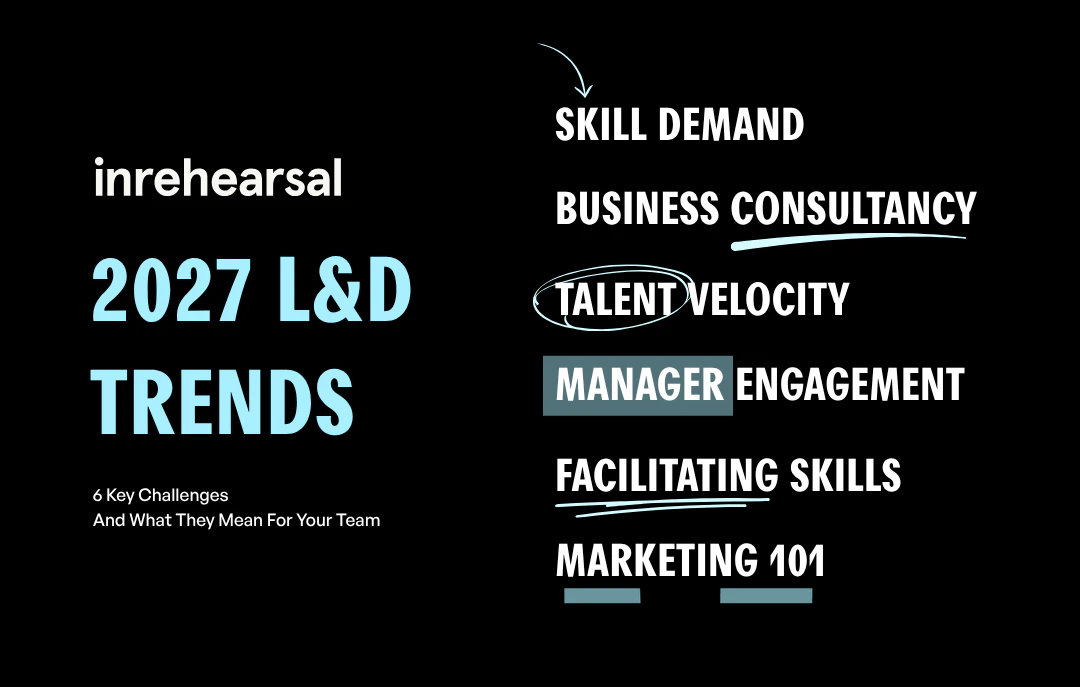
L&D Trends 2027: (6 Challenges And What They Mean For Your Team)
Explore 6 key L&D trends for 2026/2027, including talent velocity and manager engagement, backed by fresh industry data and expert analysis.
Read more