


- Podcast
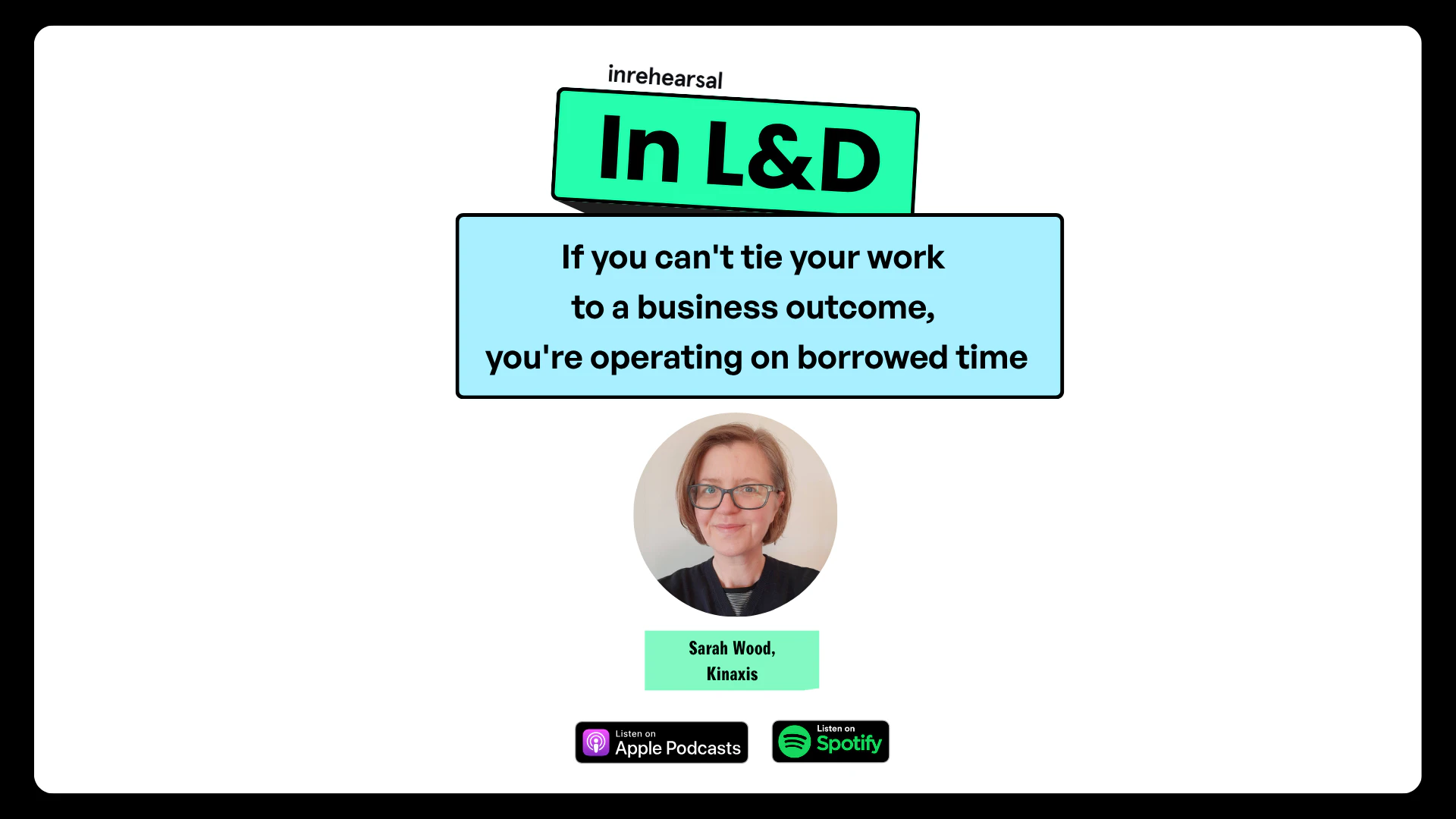
In L&D… if you can’t tie your work to a business outcome, you’re operating on borrowed time | Sarah Wood
22 Apr 2026 By
Gary Stringer
We’re often told that L&D needs to rebrand to get a seat at the table, but it’s not as simple as that…
L&D builds credibility and trust by connecting what it does to business outcomes.
And there are challenges that come with this too, as Sarah Wood explains on this episode of In L&D.
You have to be pragmatic about how much influence you have, your access to key data, when you’re brought into projects.
Working within those constraints, rather than following the pie in the sky thinking of rebranding, might help you do your best work!
As Sarah puts it: “Constraints aren’t bad. You can do a lot within them.”
Watch and listen the episode
You can also listen to the episode:
On Spotify by clicking here.
On Apple Podcasts by clicking here.
Or by searching for In L&D… wherever you get your podcasts.
5 lessons on building connections to business outcomes
1. We have to consider access to data and ability to influence
“Most L&D roles are individual contributors or mid-level. They don’t own revenue targets, organisation design, compensation plans, hiring standards, performance management systems. We don’t necessarily have that level of influence.”
Sarah explained that when lots of people entered L&D around COVID and there was an explosion of available roles, there was an enthusiasm for the opportunities and a feeling of excitement.
“We came into that with a different set of expectations, feeling like we had influence and authority. But as time went on, realising that that doesn’t necessarily equate to actual political capital in your organisation.”
The trouble is, this doesn’t feel like the discourse we’re seeing on LinkedIn, where we’re told L&D can rebrand, get a seat at the table, and have unlimited influence.
Something that got a lot of traction when Sarah posted about it on LinkedIn.
“The reality is that we work within constraints. We always work within constraints and we can’t necessarily go out there and change people’s minds in the way that it’s positioned on LinkedIn.”
2. Understand the perception of L&D in the business and work with it
Sarah shared a story from earlier in her career, where L&D was seen as an order taker function and the current training just wasn’t working.
It was a series of technical videos explaining a process of filling in paperwork — but sellers still weren’t filling in paperwork correctly, which was causing problems with customers.
“The videos were meant to walk them through it step by step by step by step. Nobody was watching them.
They figured out if they fast forward through the videos an hour and a half is actually 30 seconds and it ticks off that they’ve completed it, gets their manager off the back.”
The solution? Sarah’s manager spoke with the ops team to find the top 10 errors in this process.
“We decided that let’s focus on that first because the top 10 errors, it actually might’ve even been the top five errors, were causing 95% of the problem.
“If we pull those top five errors and I do some screenshots and some bullet points and they can just scroll through and read as and when they need it and they can just dip in and out.”
So while they were still functioning as an order taker, they came up with a creative solution that met the needs of the business within those constraints.
“I think it’s a really succinct example of how you as an L&D professional can still meet the business needs and hit the mark data-wise within quite extreme constraints.”
3. Be pragmatic about what you can do
“Sometimes, you’re not brought in at the right stage of a project, and you have to be realistic about what you can offer in that scenario.
“With a recent one, I was brought in really late before the launch of a new initiative. And as a result, like I wasn’t able to bring the full scope of what I could offer.
“So instead of trying to squeeze it in or do the whole shebang and say here’s the suite of enablement opportunity… it was very much like, okay well this is the capacity, this is how much time we have…”
It might be hard to look at that and say, it’s not your best work. But sometimes, it’s better to get it done, get it out the door, and learn from it.
4. Win hearts and minds by understanding someone’s challenge and speaking their language
“If I’m building product training and I’m working with the product subject matter experts, I’m like the whole point of this is so that you’re not getting pinged with calls all day.”
“Let’s make sure that we’re hitting those things that you keep getting asked about over and over and over again, so that we can just point them in the direction of the training.”
“And that you can come into high-value conversations like, we’re right on the cusp of signing a deal with a customer, and they need you to come in and answer these highly technical questions rather than coming in at the demo stage of a sale.”
Sarah frames this as winning people’s hearts and minds by:
- And speaking their language so that they get the value of engaging.
- Understanding where someone’s challenges are.
- Thinking about how you can lift some of that off their plate.
5. Reinforce that small improvements can have a big impact
“When you’re delivering this sort of training to like 200+ people, if you move the needle a tiny bit, the impact to that is big.
“So we’re not here to boil the ocean. We’re not here to change everything at once because you can’t. But if you change one thing and you know how to track that one thing, then you learn from it…
“You either bin it because it didn’t work, or you learn from it, you build on it.”
Built for L&D,
Loved by Learners
See the most authentic library of original expert-led video content in L&D. Learn how it could work for your organisation.
Episode transcript
This transcript was generated using automated transcription software and lightly edited for readability. There may still be minor errors or inaccuracies.
Gary Stringer
Sarah, thank you so much for coming on the In L&D podcast. Would you mind kicking us off by completing that sentence, please?
Sarah Wood
Absolutely. So I’m going to say in L&D, if you can’t tie your work to a business outcome, you’re operating on borrowed time.
Gary Stringer
Yeah. Okay.
Sarah Wood
I’m going to quantify, I’m going to qualify that a little bit now, now that you’ve got the sound bite. So I say that for L&D, but I would also say this is the same for sales enablement, rev ops, sellers themselves, product development, probably everyone. But I think for L&D, we need to be thinking about data.
Gary Stringer
Yeah, you don’t have to sell it to me. One of the things I always get, I’m going to segue quickly into I’m from a marketing background much earlier than I normally do in these conversations, but that is always the same challenge for us as well. It’s all these top of funnel and upfront metrics are great, but what’s happening that’s driving us towards a business outcome here. So I can fully relate to that challenge. First of all, I’d love to get into what’s kind of shaped that belief. Where from your experiences has that come from in terms of if we’re not tying it to business outcomes, then we’re going to be on borrowed time.
Sarah Wood
Yeah, I think that one of the things that really brought it like some crystal clarity to that was after the COVID explosion for L&D roles, there was a massive spike in the need for online training. Obviously everyone was suddenly at home and that we couldn’t have those workshops. so there was a massive increase of roles available for people in L&D to, it just was. huge. When I changed jobs during that time, I ended up with three job offers in one week. And that’s not to say I’m amazing. It’s just to say there was a lot of opportunity. And so at the time, it felt like the world was our oyster as L&D professionals. And we’re like, we can just print money. No, not really. But there were lot of opportunities.
Gary Stringer
Yeah.
Sarah Wood
Because the new entrance to the field had a different experience to existing L&D professionals, we came into that with a different set of expectations, feeling like we had influence and authority. But as time went on, realizing that that doesn’t necessarily equate to actual political capital in your organization. So although you as a as a person who came into it with that feeling of expansion and excitement and opportunity, you’re still in a business that has its ways of working, has its functions, has its roles. And most L&D roles are individual contributors or mid-level. They don’t own revenue targets, organization design, compensation plans, hiring standards, performance management systems. don’t
necessarily have that level of influence. So the discourse that I was seeing on on LinkedIn, for example, didn’t really match the actual day to day. So that’s something that there’s been a, that mismatch there has caused a little bit of friction.
Gary Stringer
Yeah. Yeah. And for the benefit of people listening, the reason I reached out to you to have this conversation is about a month ago, you posted about L&D not necessarily needing to rebrand itself to have influence or get a seat at the table. And you mentioned some of those challenges about being an individual contributor and having limited capacity or having to work within restrictions like access to the data you have. And it really resonated with people. I checked before we jumped on the call and 43 comments already, which is…
Sarah Wood
Mm. golly. Yeah, yeah, absolutely. And I don’t get a whole lot of traction on my LinkedIn posts, so to have 43 is a big deal. But those sorts of posts, they get the idea of, we need a seat at the table. We need to reinvent, Ellen do we need to think of ourselves in a different, with a different language or a different definition. They always get high engagement on LinkedIn. Everyone’s like, yeah, rah rah rah, let’s do it.
Gary Stringer
shows you the volume of how that’s resonating.
Sarah Wood
But actually it causes a lot of, maybe not depression, that’s probably too heavy of a word, but lot of frustration in people who are getting all excited about this on LinkedIn. But actually the reality is that we work within constraints. We always work within constraints and we can’t necessarily go out there and change people’s minds in the way that it’s positioned on LinkedIn. But having said that, we can. There are opportunities.
Gary Stringer
Yeah. And I wanted to come back to that point you made around not having access to things because as per your LinkedIn post, people want to affect change, but if you don’t have access to a lot of the stakeholders or the systems or the data that you need to influence change, that can make things really difficult, can’t it? So seeing lots of things that say you need to really revolutionize what you’re doing while you have this disconnect of what do I actually have access to or ownership over?
Sarah Wood
Mm-hmm. Mm.
Gary Stringer
from your experience how I guess that is, well, it must be incredibly challenging to do that in an actual role where access can be limited and the narrative is you should do this, you should do this.
Sarah Wood
Yes. Yeah. Yeah. And so I have a have a fun story about that actually. Earlier on in my career, it was so as as an individual contributor, you’re really dependent on not so much your influence in an organization, but your manager’s influence. So I had I had a really good relationship with my manager, and we had a very collaborative back and forth. which was fantastic because it gave me opportunities to push boundaries a little bit, to explore opportunities and to try new things. So we were very much in a function in that organization of L&D is an order taker function. You go out and you just, we’re telling you we need training, go make the training, the end. Okay, this is where we’re at, fine.
But the training isn’t working. So we were, we were given this task of like, okay, we’ve got, we’ve got a system, a training program that’s already in play on the LMS. It’s a series of videos explaining a technical paperwork, filling in paperwork process and sellers. Cause even though I wasn’t in sales enablement at the time, I was still serving sellers through the LND function and they weren’t filling in the paperwork correctly. Therefore. It was kicking back and it was causing problems with customers. And it wasn’t like highly technical, it was attention to detail. was like specific. So the videos were meant to walk through it step by step by step by step. Nobody was watching them. figured out, long story short, they figured out if they fast forward through the videos.
An hour and a half is actually 30 seconds and it ticks off that they’ve completed it, gets their manager off the bat, gets them back out onto the shop floor. Job done. They were still making the errors, clearly. talking this through, because the data aspect, the data capture, all we had access to ourselves as a team was the LMS. So we could go and look at the backend and say, right, okay, this is meant to be an hour and a half. That’s an hour and a half of video content. Everyone’s whipping through it at hyper speed. So clearly we have to fix this. So talking to the manager, he went off and he, he spoke to, um, the ops team and found out the top 10 errors. What are the top 10 errors? So we decided let’s, let’s focus on that first because the top 10 errors actually might’ve even been the top five errors were causing 95 % of the problem.
So I said to the manager, okay, nobody’s gonna look at these videos. They’re not doing it. But if we pull those top five errors and I do some screenshots and some bullet points and they can just scroll through and read as and when they need it and they can just dip in and out, then we’re actually hitting the mark. So that was, we were still in order taker function. We were still providing training, but it was… Within those constraints, we came up with a creative solution that met the needs of the business. so that was something that I really, that’s a story that I lean into quite a lot when I’m talking about these issues, because I think it’s a really succinct example of how you as an L&D professional can still meet the business needs and hit the mark data-wise within quite extreme constraints.
Gary Stringer
Yeah, no, I love that. It’s a perfect example because you’re thinking about what’s the end outcome. You mentioned things like conversations with customers and the process failing. You’re saying, well, what are the key things that contribute to that? And then actually how can we respond to just those key things? Cause then 90 % of the problem is solved. Whereas if you’re maybe obsessed about the data that you didn’t have access to or only trying to lead with the data you had access to, which is around the consumption.
Sarah Wood
Mm. Yeah.
Gary Stringer
I guess those are good signals of what was and wasn’t working, but fundamentally the best thing for you to do in that case was like you said, speak to someone with the influence that you, could explain to you what was causing the problem and then simply say if you, and then it’s an easy pitch, I guess, for you that if you say, create this, it will solve 90 % of these problems. And that’s most of the problem solved.
Sarah Wood
Mm-hmm. Yeah, yeah, absolutely. then that product, that learning product, I suppose I could call it, was used in ways that we didn’t necessarily expect because it was, they picked it up and instead of it being just a course that people had to go through, managers were pulling it into their onboarding because at that point we didn’t have a structured onboarding that managers were just doing ad hoc. But they were like, this is a tool that’s useful. So we’re gonna add it into our onboarding experience. and this is something that people can look at at any point. So it was good. It was very good experience.
Gary Stringer
think that is a brilliant example. I really like that. We also spoke about when we had our first conversation that the more we focus on unrealistic things rather than what’s possible, the more we set ourselves up to fail. So I just wanted to touch on that and get your thoughts around like expectations setting for yourself in a role. What does that look like if you do focus on unrealistic things a lot of the time?
Sarah Wood
Mm. Mmm. Yeah, I mean, it’s every project is a learning experience. even in the role that I am in now, although I’ve said, like I’ve moved into sales enablement because of there’s a stronger tie to metrics and data and it’s easier to see the impact of my work on the business. It’s still like, there’s still very much a winning hearts and minds. sort of thing that needs to happen because I, as someone who creates training, am leaning on other people to provide me the content. We have to have a strong relationship. We have to work together. And sometimes I’m not brought in at the right time in the project. So the cycle of the project. So a recent one, I was brought in really late before the launch of a new initiative. And as a result, like I wasn’t able to
bring the full scope of what I could offer because I didn’t like I was still it was just too late. It was too late for me to come in and and and do everything that I could do. So that that there’s still those constraints of frustration of not being able to do as much as as I could do. So in that situation, I could have done a lot more, couldn’t, didn’t have time. So instead of trying to squeeze it in or trying to do the whole shebang and like, oh, here’s the suite of enablement opportunity and we’re just gonna have to like figure out it’s it was more it was very much like okay well this is the capacity this is how much time we have this is how much I can give to this team and it’s not it’s not everything I could do it’s not my best work but it’s done and I think sometimes with with the work that I do done is better than not so we just get out the door and we do it and we learn from it.
Gary Stringer
Yeah, I was expecting you to say, I thought you were about to say done is better than perfect there, but done is better than not done is even, even more fun.
Sarah Wood
Yeah, yeah, yeah, yeah. Well, that’s it. was like, well, we could not do it this way or we could get it out the door. Like, that’s it. So and there’s really no point in I think going back to the idea of relationships, there’s no point in undermining relationships with people in other teams to focus on, well, this is the best enablement approach. This is the best learning approach.
Gary Stringer
Yeah. Yeah.
Sarah Wood
Nobody cares how the sausage is made as long as it’s made like that’s all so I have to be very pragmatic as well
Gary Stringer
I think that’s the challenge, isn’t it, of you want to come in and say, in an ideal world, I’d do it like this, but we don’t live in the ideal world a lot of the time. that’s really, I think, a great point to consider, I wanted to ask you a little bit about one other thing you mentioned to me before, before we get into any advice on how people can then work within the remit of what’s actually possible. But you mentioned before,
Sarah Wood
Mmm. Mmm.
Gary Stringer
that organizations are often quite big or quite slow. They’re not dynamic. It can move slowly. So the idea that you can really influence change in a big organization that is quite rigid, that’s also something to consider when we think about being realistic, isn’t it?
Sarah Wood
Mm-hmm. Yeah, absolutely. think there’s… I think of the people that I create training for as my customers. And I think of that from a marketing perspective, although I’m not a marketer. I have to win hearts and minds from people. And so an example would be, in my current organization, the enablement function has lived in the customer enablement space for a while. And then after I joined, about six months after I joined, we moved to report directly into rev ops, which is really where enablement, sales enablement should sit. But because of that, that distance, we were trying to serve an audience of sellers that we didn’t like, we didn’t have a reporting line into them. didn’t have connection, like really strong connections with them. And so, it was, it was just not, there was a lot of friction.
So moving into rev ops was not my choice. I agreed with that, but I didn’t have any influence over it. And as a result of moving into that function, I was able to build stronger relationships with people, it took, it’s taken a year really to build relationships and to build my reputation in the business and running consistent programs. showing up, being there, being the face of enablement, being someone they can turn to when they need help, or knowing where they can get the help and being someone who’s reliable and dependable. And that’s people from the customer service team, people from the partners team, people from the sales team, people cross-functionally in marketing and product and rev ops and everywhere. And that’s required a lot of patience and just consistency and just showing up and being someone.
that is good to work with that and that gets the job done. And those are the kinds of things that you don’t get a lot of likes on LinkedIn when you say, I did my job. But that is how it works. Yeah. And also I think another thing that I’ve really thought about as well from a modern day perspective of how you work within an organization remotely.
Gary Stringer
and it took a year.
Sarah Wood
I think it takes twice as long to build your reputation, at least, because you’re so distant from each other. The only times you interact with each other is through like specific calls. so it’s really difficult to build that reputation remotely as well. It’s not impossible. I work, I’ve worked remotely exclusively for years and years, but it’s something to bear in mind.
Gary Stringer
Yeah. Has now you’ve seen those relationships build and you know, it’s taken maybe a year, but you’re coming to that point now where you are that trusted source for people. Have you found it easier to understand what the business outcomes are or be involved earlier in the process? Has that helped?
Sarah Wood
Mmm. Yes, absolutely. Yeah. Yeah, yeah, yeah. It’s a combination of things. I have like the pulse of the sellers because I’ve got relationships with sellers themselves. So I’m hearing what they’re saying directly, which is really great. But also being involved in the right meetings at the right time. an example of this would be that challenge that I talked about before where I wasn’t brought in the project until quite late in the game. Now I’m able to say, right, I need to know what’s going on. Even if I don’t action anything, even if it’s not time for enablement to start building content and start delivering it because it’s still too early in the project, I need to be on those calls. I need to be part of the conversation so that I’m seen by default as a trusted advisor.
of that function. I’m not in a leadership role, but I am in a senior role. so I am brought in on those conversations earlier than perhaps I would have, well, I definitely would have been earlier in my career. But so there is an element of that. And that’s something really to call out. Like if you’re a junior, your influence is limited by default. That’s okay. It’s not an issue, but it’s just something to be aware of.
Gary Stringer
Okay, so at this point we know we need to connect what we’re doing to business outcomes so we’re not on borrowed time. We know we have to be realistic about the time and capacity we have available to us and the context of our business. So with that in mind, what can we do to ensure that we’re still doing our best work that’s connected to business outcomes and is in the realms of what’s possible, which is a big challenge. yeah, what are some of the ways you’ve seen that kind of work?
Sarah Wood
Mmm. I right, so one of the things that I’ve been thinking about is how important it is to be proactive within the limits of the scope of your role. I would say that creating training, regardless of what your role title is, L and Z, sales enablement, revenue enablement, whatever it is. You trade on relationships. Like you build relationships of trust with other people in order to get the content. But if you’re sitting around twiddling your thumbs waiting for people to do stuff for you as a favor, because it is a favor, let’s be honest, it’s not their day job. They don’t really care. They don’t. So, but I do. So what do I do to make this as frictionless as possible? I go into those meetings fully prepared. I do the prep work. I create like,
something for them to edit. Subject matter experts, like they don’t know how to build training and that’s because it’s not their job, it’s mine. So I create stuff for them to rip apart or put metaphorical red lines through or a proof. Like that’s how you get things going. That’s how you build the trust with them. It’s like, I’m you’re not here to do my job for me. You’re here to you’re here to sign off on the the validity of the content. So here are my ideas. Is it right? Is it wrong? Why? I’m not, I don’t understand the nuance of the technical product. don’t, I don’t have, I’m not as close to that team as you are. So I need you to just say yes or no to things that it doesn’t matter what your, your like junior, senior, whatever role is. You can always do stuff like that. so it’s, it’s the relationship piece that is like 90 % of the job, really.
Gary Stringer
Is the framing when you’re going to those conversations, is it this thing that we’re putting together is to help you with X, Y, and Z to your point about people not necessarily caring, unless they know why it’s going to benefit them. So what’s the framing that you’re going into those conversations with?
Sarah Wood
Exactly, yeah. Yeah, absolutely. So for example, if I’m building product training and I’m working with the subject matter experts, I’m like the whole point of this is so that you’re not getting pinged with calls all day. Let’s make sure that we’re hitting those things that you keep getting asked about over and over and over again so that we can just point them in the direction of the training and they can go do that and they can leave you alone. And that you can come into high-value conversations like, we’re right on the cusp of signing a deal with a customer, and they need you to come in and answer these highly technical questions rather than coming in at the demo stage of a sale. That kind of thing. Definitely. Winning their hearts and minds and speaking their language and understanding where their challenges are and how this can lift some of those challenges off their plate.
Gary Stringer
makes complete sense. think that leads us nicely to the point about revenue and enablement being something that is quite inherently tied to outcomes or numbers, isn’t it? You’d mentioned to me before about this idea of breaking things and learning quickly and understanding the influence of what’s happening on those end goals. know, like the sales cycle can be quite long. It can be volatile. can be variables.
Sarah Wood
Mm. Mm-hmm. Mm-hmm.
Gary Stringer
So we can’t necessarily
Sarah Wood
Mm-hmm.
Gary Stringer
always hedge our bets that what we’re gonna do is gonna work. so tell us a bit about that idea for what you’ve learned from revenue enablement around breaking things and learning to get through outcomes.
Sarah Wood
Yeah, yeah, I think because things move so fast in sales, even with long, even if you’ve got like a long sales cycle, things still move quite fast. And so you, you, it, it, there’s high pressure in that. Like you got to make things happen, but also if it doesn’t work, bin it, move on, get something else out there, just try it, see what happens. So there’s an example of this is, I’m, I’m putting time bound, expectations on some live trainings that I’m developing and running, or it’s like, all right, guys, you’ve got 20 minutes to deliver this piece of content. and it needs to be something by the end of those 20 minutes, sellers need to know they have to go do it within seven to 14 days. Like, and we’re going to be measuring it. We’re going to be following what that action is. So it could be,
as simple as sending a piece of content to a customer or prospect. Like here is a limited time offer that we’re launching and here is the content that you can send that customer and you have two weeks to do it and we’re going to track it on the system because we can. So go do it. Here’s how to do it. Here’s what to give them. Go do it. And those sorts of things like it’s fast, really, really fast. But what reason why we’re able to do that is because we’ve got access to the system to be able to track it. So this is the metric side of it that I find really interesting. when I talk to people about this, like, when you’re delivering this sort of training to like 200 plus people, if you move the needle a tiny bit, the impact to that is big. So we’re not here to like, I don’t know whether they say boil the ocean.
We’re not here to change everything at once because you can’t. But if you change one thing and you know how to track that one thing, then you learn from it. And it’s either, like I said, you’ve been it because it didn’t work or you learn from it and you build on that. think move fast, break things, but not actually break things. Move fast and learn about learn from it.
Gary Stringer
Yeah. Yeah. Now, you know, when you said about 1 % better, think immediately my brain, when I thought about business outcomes and the way you framed the sentence at the start was the final outcome. We’re going from what we want to do to the final thing, which is 2 million in pipeline, for example, or 400 new deals. But actually we can be a lot more realistic about all of the framing, you know, what we’re asking people to do.
Sarah Wood
Right, yeah.
Gary Stringer
and be realistic about what the outcome is going to be. If you use this for two weeks, and it helps move the needle on two or three of your deals, then everybody is going to win. So it doesn’t need to be like, this is going to take you four hours, and it’s going to be the golden goose or silver bullet for us to get to 20 million revenue.
Sarah Wood
Yeah. Yeah. There isn’t one, is there? That’s the thing. There’s a lot of little decisions, a lot of little changes that add up to something big. There isn’t one big change, at least from my experience.
Gary Stringer
Yeah. Yeah, I think that’s a great mindset, isn’t it? What can I influence that will have an impact on how we get to our business outcome as opposed to what can I do that is directly responsible? It’s about those different levers that you can pull and what you can, to our point earlier, what you can and can’t do. If you can improve a few parts of the process by three, 4%, even 1%, that will have a massive benefit. actually that changed the way I think about.
Sarah Wood
Mm. Yeah. Mm-hmm.
Gary Stringer
And not so binary between like the business outcome is the very final thing we have to do. It’s those small things along the way that you mentioned.
Sarah Wood
Yeah, yeah, absolutely. Yeah, it’s been a helpful mindset shift for me as well because it’s overwhelming to think, I’m responsible for my part of this. Yes, but your part of it is orchestration within a whole. You’re not isolated. It’s not all on you. And it can’t be because you’re part of an organization of people.
Gary Stringer
You mentioned as well, binning it if it’s not working and thinking about our earlier point of often an organization could be quite rigid and things can take a long time. We do need to try and think faster and bin it if it isn’t working. I think the challenge there is if I wedded to something for too long and it’s not working and I damage my internal credibility, but if I’m more willing to test it and say this isn’t working, let’s move to something else.
Sarah Wood
Yeah.
Gary Stringer
question I was trying to get to that took me a while was have you found that’s helped your credibility or relationships internally to just draw a line under something that’s not working and move on to something else and not take up too much of people’s resource and bandwidth?
Sarah Wood
Absolutely. Yeah. Because what I like to say to people when I’m having these sorts of conversations with my stakeholders is like, I’m in my ivory tower of perfect training ideas. What is actually going to work in the real world? Tell me. Because these are great ideas that I love because I made them, but I need them to be tested. Is it actually going to work?
Gary Stringer
Yeah.
Sarah Wood
I’m not gonna be offended if it’s not gonna work. Just tell me because none of us want to waste our time on something That’s not gonna work So that opens the floodgates to people feeling like okay Psychological safety we can talk about this in real terms. This isn’t someone’s not gonna like like get upset cool. Okay now You then have to pull back because that also opens the floodgates to complaints lots of people are like well everything sucks and I’m gonna tell you why and then
And then I’m like, okay, cool. So how are going to fix it? And they’re like, I don’t know. It’s just, it’s like, it can’t be fixed. It’s just terrible. I’m like, okay, I’m going to go away with this and think about it for a while. But, and that’s fine. think you have to go into those sorts of conversations. Like you never, as they say with surveys, never ask a question you don’t want to hear the answer to. Like don’t open that if you’re not willing to look at those can of worms and figure out what’s valuable or not. But yeah, it’s,
Gary Stringer
Yeah.
Sarah Wood
There’s a level of lack of ego and humility. Like I know what I’m doing, but I don’t know your world. So how do I take my experience and bring it into your world and make it something valuable?
Gary Stringer
think it’s so hard with feedback, isn’t it, about filtering out what is and isn’t helpful, especially if we’re looking through that lens of what’s actually going to help us get closer to our business outcomes or our goals. If our mindset is that, we want to take all of the feedback on and try and action as much of it as possible, we might spend a lot of time changing things that wouldn’t really have a massively tangible benefit.
Sarah Wood
Mm. Yeah. yeah, no, and I definitely spend time saying with my team as well. I say to them things like, wow, they’re complaining, but they still have to do it. well. Too bad.
Gary Stringer
Yeah, that’s it. They’re just some non-negotiables, aren’t they? Sometimes it’s just enough for people to hear, do you know what we’ve heard that we’ve taken that on board? We’ve heard that this particular process is frustrating or this particular thing doesn’t work as well as we’d like it to. But as per our earlier point of what’s possible and what we have capacity for, sometimes you just need to communicate back that we’ve heard it, but there’s not a lot we can change. And even sometimes that’s enough, isn’t it?
Sarah Wood
Yeah, yeah. Yeah. Yeah, yeah, yeah.
Gary Stringer
So I think the only thing that we didn’t discuss that we wanted to discuss before this was this idea of the middle ground between revenue enablement and L&D. And I think you talked a bit throughout this conversation about what you’ve learned from corporate L&D, what’s working for you in revenue enablement, what’s kind of the middle ground if there was anything there.
Sarah Wood
Hmm. Well, what’s really interesting is there’s been a report that’s come out just recently, Global Sentiment Survey 2026. And I was reading it and what’s interesting is there’s a lot of chatter in the L&D space about moving into more, what is it? coaching culture and capability system approach and using data. because analytics isn’t just about technical development, it’s strategic, it responds to the business in a deeper way. And so it looks to me that some of the reasons why I moved from L&D to sales enablement, I’ve just moved a little bit faster than what L&D is actually doing. I think that there’s that idea. And I’ve floated this on LinkedIn with people. like,
I think L&D and enablement need to come closer together and we need to, like enablement sometimes doesn’t have the foundational like adult learning principles elements to it that would be really beneficial that I’ve been able to really lean on as I’ve moved into this space. So that’s really a good thing for enablement to learn and then L&D to learn from enablement in the data, the analytics, the being more strategic. and not just the smiley face stuff that L&D people feel really happy about, which is great. It’s great that people like do that, but what are they doing afterwards? That’s always been what I’ve been more interested in. But it sounds like that is happening. So that middle ground is already existing. And if anybody listening to this is feeling similarly, please reach out. I’d love to like…
Gary Stringer
and
Sarah Wood
talk more about it because I find this very interesting that we have so much to learn from each other, LND and enablement.
Gary Stringer
Yeah, completely agree. I lied when I said there was one other thing. There was another thing we weren’t wanting to discuss as well. Only because you put a great example in the of the doc that we were using to collaborate, but it’s about this idea of proving behavior change. And it’s something I’ve heard loads and loads and loads over my experience in L&D. It’s the thing people want to see is behavior change. Proving behavior change can be difficult. What’s kind of the answer there in your opinion?
Sarah Wood
Okay. Yeah. Mm-hmm. Yeah. It’s proving behavior change is, mean, it’s just tied to outcomes. What are you trying to change? Like what are you looking at? Like say for example, you don’t have a very strong coaching culture with your manager layer. And I’ve always said that without managers, training is the tail wagging the dog. We can put out as much training as we want. And if the managers are saying to their team, that’s a waste of time, get back on the phone, or what is this? I’ve never even heard of it. Like, we’re not going to get anywhere. If you get, there’s a really strong example in an organization I worked for where they had an amazing onboarding program.
really like just got the new the new people really excited, really into it. So looking forward to their new role. And it was a complete whiplash effect when they actually got in there with their managers and started working day to day, because the culture that they were expecting from the onboarding was not the culture that they were receiving from their manager. And so the managers are huge. So I think in terms of behavior change, if you don’t think about managers, then you’re going nowhere. Managers are the key, really, to everything. So from the perspective of coaching culture, like I mentioned, how can you support the managers in supporting their team? And I think that winning hearts and minds piece is also really important. So getting them onside, understanding their world, and giving them the tools they need to have a successful team, you’ll see a lot of change, actually.
Gary Stringer
So we’re coming close to time. I wanted to see if you had final advice for those people who maybe have found tying what they’re doing to those business outcomes a challenge or working in the remits of what’s actually possible to do that. Any final advice for those people?
Sarah Wood
Yeah, so as we kind of have talked about before, like we all have limits to our role. So just make sure that you really understand what that is. I’ve been in roles where I’ve not understood the limits and it’s been very frustrating. And it’s meant that I’ve attempted to do things that have been against the company culture and it’s caused clashes. or I’ve had conversations that really have ended up being a waste of everyone’s time because we’ve gotten excited about an initiative and then it’s fallen flat or it’s just not taken off. So really clearly understanding your remit and the boundaries and then seeing where you can go from there. Just because those boundaries exist now doesn’t mean they always will, but working within them and
They say from a creative perspective that when you actually have boundaries, creativity flows even more than if you can just have do everything and anything. If you only had a pencil to draw with, your pencil shading skills would be amazing, right? But if you used every pen pencil possible, then you wouldn’t have great pencil shading skills. So if you’ve only got a pencil, you can do a great job with it, right? So that’s kind of, that would be my thought. that it’s not bad, constraints aren’t bad. You can do a lot within them.
Gary Stringer
Awesome. And just to wrap us up, one thing I’m going to be asking to every guest is to just tell us something that they’re still working on so we can see if there’s any great advice and insights we can crowdsource from everyone. So what’s one thing that you’re still working on, haven’t cracked yet, however we want to frame it?
Sarah Wood
Yeah, I I’ve talked about data and measuring impact. It’s an ongoing thing. To calculate true ROI requires a level of scientific rigor that’s really just not possible. We’d have to have people who weren’t receiving the training and people who were receiving the training. that’s not cool. Those sorts of things is still an ongoing process. So anybody that wants to talk about data and measuring impact and how they do it, I am always learning more about that. Like I know it’s important and I do it, but I’m not a pro at it yet. I don’t know if I ever will be.
Gary Stringer
I don’t know anyone who’s ever claimed to be a data pro who isn’t actually working in a proper data role. So I think there’ll be a lot of people hearing that and thinking, I can relate. Wonderful. You mentioned people reaching out and getting in touch. So I will put both the links to your LinkedIn profile and also the post that I mentioned about the start that started all this conversation off in the description and the show notes so people can get in touch. But Sarah, thank you so much. I really appreciate you coming on the show.
Sarah Wood
Amazing. Yeah, thank you. It’s been great.
Related articles
L&D Trends 2027: (6 Challenges And What They Mean For Your Team)
Explore 6 key L&D trends for 2026/2027, including talent velocity and manager engagement, backed by fresh industry data and expert analysis.
Read more